

Capsaicin |
Katalog-Nr.GC14065
 One-Click Copy Product Info
|

Capsaicin ist ein hochselektiver Agonist für den transienten Rezeptorpotential-Kationenkanal, Subfamilie V, Mitglied 1(TRPV1), einen ligandengesteuerten, nichtselektiven Kationenkanal, der bevorzugt auf sensorischen Neuronen mit kleinem Durchmesser exprimiert wird.
Products are for research use only. Not for human use. We do not sell to patients.
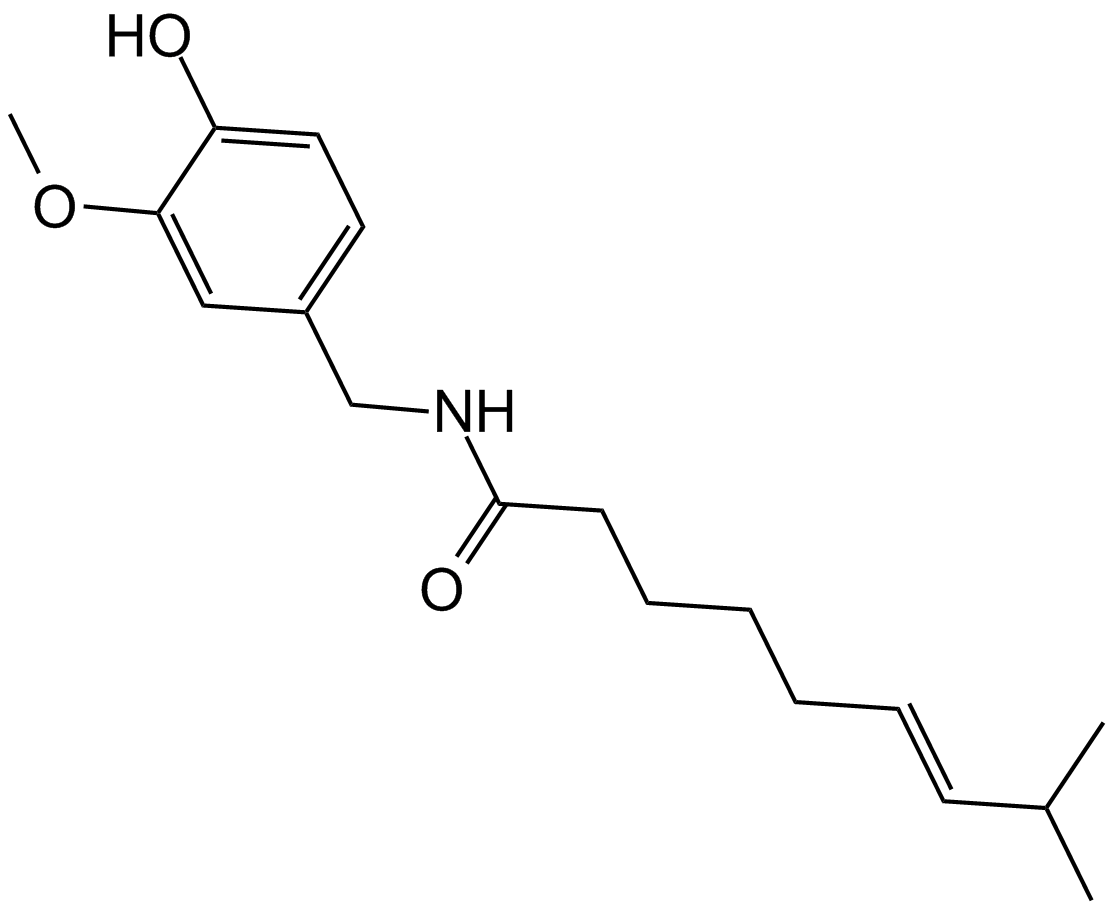
Cas No.: 404-86-4
Sample solution is provided at 25 µL, 10mM.
Capsaicin ist ein hochselektiver Agonist für den transienten Rezeptorpotential-Kationenkanal, Subfamilie V, Mitglied 1(TRPV1), einen ligandengesteuerten, nichtselektiven Kationenkanal, der bevorzugt auf sensorischen Neuronen mit kleinem Durchmesser exprimiert wird[1]. Capsaicin hemmt CYP1A2, CYP2C9 und CYP2C19 mit IC50-Werten von 2.1, 2.0, bzw. 3.2 μM und CYP2B6, CYP2D6, CYP3A4 und CYP3A5 mit extrapolierten IC50-Werten von 24, 18, 38 bzw. 12 μM[2].
Capsaicin hemmte das Wachstum von menschlichen Gebärmutterhalskrebs (IC50 ~30 μM) und erhöhte den intrazellulären Kalziumspiegel, wobei dieser Effekt durch Capsaicin blockiert wurde [3]. Capsaicin induzierte bei ≥200 μM Apoptose beim menschlichen Glioblastom A172, was nicht durch Capsaicin gehemmt wurde. Oder BAPTA/AM 250 μM reduzierte die basale Bildung von ROS und die Lipidperoxidation. H2O2 reduzierte die Apoptose, während NAC die Apoptose verstärkte[4]. Capsaicin reduzierte das Wachstum von RT4-Zellen beim menschlichen Urothelkarzinom (IC50=80 μM) über einen TRPV1-abhängigen Prozess, induzierte einen Zellzyklusarrest in der G0/G1-Phase. und löste Apoptose aus[5].
Nach Vorbehandlung von ICR-Mäusen und CD-1-Mäusen mit 2.5 μmol Capsaicin wurde die durch VC-Induktion(5.8 mol) und TPA-Förderung verursachte Tumorinzidenz nach 22 Wochen verringert(um 62%, bei ICR-Mäusen). Außerdem hemmte die topische Applikation von 1 μmol topisches Capsaicin 24 Stunden und 1 Stunde vor der topischen Induktion von Tumoren mit BP (0.3 μmol) und anschließender Förderung mit TPA die Tumorentstehung bei CD-1-Mäusen erheblich.Die Schlundsonde mit Capsaicin erhöhte erheblich die Phase-II-Enzyme in Leber und Dickdarm. Orale Gabe von 500 ppm Capsaicin über 4 Wochen hemmte erheblich die durch AOM induyierte ACF-Bildung(20 mg/kg Körpergewicht, einmal wöchentlich über 2 Wochen). In einer 38-wöchigen Studie reduzierte 500 ppm Capsaicin während der 4-wöchigen Initiierungsphase die Dickdarmkrebsinzidenz erheblich um 60%[7].
References:
[1]. Bley, K.; Boorman, G.; Mohammad, B.; McKenzie, D.; Babbar, S. A comprehensive review of the carcinogenic and anticarcinogenic potential of capsaicin. Toxicol. Pathol. 2012, 40, 847-873.
[2]. Babbar S., Chanda S., Bley K. (2010). Inhibition and induction of human cytochrome P450 enzymes in vitro by capsaicin. Xenobiotica 40, 807-16.
[3]. Takahata K., Chen X., Monobe K., Tada M. (1999). Growth inhibition of capsaicin on HeLa cells is not mediated by intracellular calcium mobilization. Life Sci 64, PL165-71.
[4]. Lee Y. S., Nam D. H., Kim J. A. (2000). Induction of apoptosis by capsaicin in A172 human glioblastoma cells. Cancer Lett 161, 121-30.
[5]. Amantini C., Ballarini P., Caprodossi S., Nabissi M., Morelli M. B., Lucciarini R., Cardarelli M. A., Mammana G., Santoni G. (2009). Triggering of transient receptor potential vanilloid type 1 (TRPV1) by capsaicin induces Fas/CD95-mediated apoptosis of urothelial cancer cells in an ATM-dependent manner. Carcinogenesis 30, 1320-29.
[6]. Surh Y. J., Lee R. C., Park K. K., Mayne S. T., Liem A., Miller J. A. (1995). Chemoprotective effects of capsaicin and diallyl sulfide against mutagenesis or tumorigenesis by vinyl carbamate and N-nitrosodimethylamine. Carcinogenesis 16, 2467-71.
[7]. Yoshitani S. I., Tanaka T., Kohno H., Takashima S. (2001). Chemoprevention of azoxymethane-induced rat colon carcinogenesis by dietary capsaicin and rotenone. Int J Oncol 19, 929-39.
| Zellexperiment [1]: | |
Zelllinien | Menschliche kolorektale Karzinomzellen(SW480, LoVo und HCT-116) |
Vorbereitungsmethode | Die Zellen wurden in einer Konzentration von 2×10⁵ Zellen/ml kultiviert und dann mit Capsaicin behandelt. Die verwendeten Konzentrationen und Behandlungszeiten sind in den Abbildungsvermerken angegeben. |
Reaktionsbedingungen | 0, 50 und 100 µM für 0, 1, 2 oder 3 Tage |
Anwendungen | Das Wachstum aller 3 menschlichen Darmkrebszelllinien wurde durch die Behandlung mit Capsaicin dosis- und zeitabhängig gehemmt. Während eine Behandlung mit 50 µM Capsaicin das Zellwachstum zwar etwas reduzierte, zeigte sich bei einer Konzentration von 100 µM Capsaicin eine deutlich stärkere Hemmung des Zellwachstums. |
| Tierversuch [2]: | |
Tiermodelle | Männliche Schweizer Albino-Mäuse |
Vorbereitungsmethode | Gruppe 1(Kontrollgruppe) erhielt während des gesamten Versuchs Olivenöl. Gruppe 2 wurde 4 Wochen lang zweimal wöchentlich(am 1. und 4. Tag) oral mit BP(50 mgkg, gelöst in Olivenöl) behandelt. Gruppe 3 erhielt 14 Wochen lang einmal wöchentlich intraperitoneal Capsaicin(10 mgkg, gelöst in Olivenöl), um die eventuelle zytotoxische Wirkung von Capsaicin zu untersuchen. Gruppe 4(BP + Capsaicin) erhielt neben BP(wie Gruppe 2) auch intraperitoneal Capsaicin (10 mg kg, gelöst in Olivenöl). Die Behandlung mit Capsaicin begann eine Woche vor der ersten BP-Dosis und dauerte 14 Wochen. |
Dosierungsform | Intraperitoneale Injektion, 10 mgkg wöchentlich für 14 Wochen |
Anwendungen | Die Vorbehandlung mit Capsaicin führte zu einem Effekt, der die Bildung freier Radikale hemmte und so die Lipid-Peroxidation bei den Tieren der Gruppe 4 deutlich reduzierte. |
References: | |
| Cas No. | 404-86-4 | SDF | |
| Chemical Name | (E)-N-[(4-hydroxy-3-methoxyphenyl)methyl]-8-methylnon-6-enamide | ||
| Canonical SMILES | CC(C)C=CCCCCC(=O)NCC1=CC(=C(C=C1)O)OC | ||
| Formula | C18H27NO3 | M.Wt | 305.41 |
| Löslichkeit | ≥ 15.27 mg/mL in DMSO, ≥ 52.3 mg/mL in EtOH with gentle warming | Storage | 4°C, protect from light |
| General tips | Please select the appropriate solvent to prepare the stock solution according to the
solubility of the product in different solvents; once the solution is prepared, please store it in
separate packages to avoid product failure caused by repeated freezing and thawing.Storage method
and period of the stock solution: When stored at -80°C, please use it within 6 months; when stored
at -20°C, please use it within 1 month. To increase solubility, heat the tube to 37°C and then oscillate in an ultrasonic bath for some time. |
||
| Shipping Condition | Evaluation sample solution: shipped with blue ice. All other sizes available: with RT, or with Blue Ice upon request. | ||
| Prepare stock solution | |||

|
1 mg | 5 mg | 10 mg |
| 1 mM | 3.2743 mL | 16.3714 mL | 32.7429 mL |
| 5 mM | 654.9 μL | 3.2743 mL | 6.5486 mL |
| 10 mM | 327.4 μL | 1.6371 mL | 3.2743 mL |
Step 1: Enter information below (Recommended: An additional animal making an allowance for loss during the experiment)
 g
μL
g
μL
Step 2: Enter the in vivo formulation (This is only the calculator, not formulation. Please contact us first if there is no in vivo formulation at the solubility Section.)
Calculation results:
Working concentration: mg/ml;
Method for preparing DMSO master liquid: mg drug pre-dissolved in μL DMSO ( Master liquid concentration mg/mL, Please contact us first if the concentration exceeds the DMSO solubility of the batch of drug. )
Method for preparing in vivo formulation: Take μL DMSO master liquid, next addμL PEG300, mix and clarify, next addμL Tween 80, mix and clarify, next add μL saline, mix and clarify.
Method for preparing in vivo formulation: Take μL DMSO master liquid, next add μL Corn oil, mix and clarify.
Note: 1. Please make sure the liquid is clear before adding the next solvent.
2. Be sure to add the solvent(s) in order. You must ensure that the solution obtained, in the previous addition, is a clear solution before proceeding to add the next solvent. Physical methods such as vortex, ultrasound or hot water bath can be used to aid dissolving.
3. All of the above co-solvents are available for purchase on the GlpBio website.
Quality Control & SDS
- View current batch:
- Purity: >99.50% Appearance: A solid
- COA (Certificate of Analysis)
- SDS (Safety Data Sheet)
- Datasheet
Average Rating: 5 (Based on Reviews and 30 reference(s) in Google Scholar.)