

Tideglusib (Synonyms: NP031112) |
Catalog No.GC14465
 One-Click Copy Product Info
|

Tideglusib은 강력하고 선택적이고 불가역적인 비-ATP 경쟁성 글리코겐 합성효소 키나제-3 (GSK-3) 억제제이다. GSK-3βWT와 GSK-3βC199A의 IC50 값은 각각 5nM과 60nM이다.
Products are for research use only. Not for human use. We do not sell to patients.
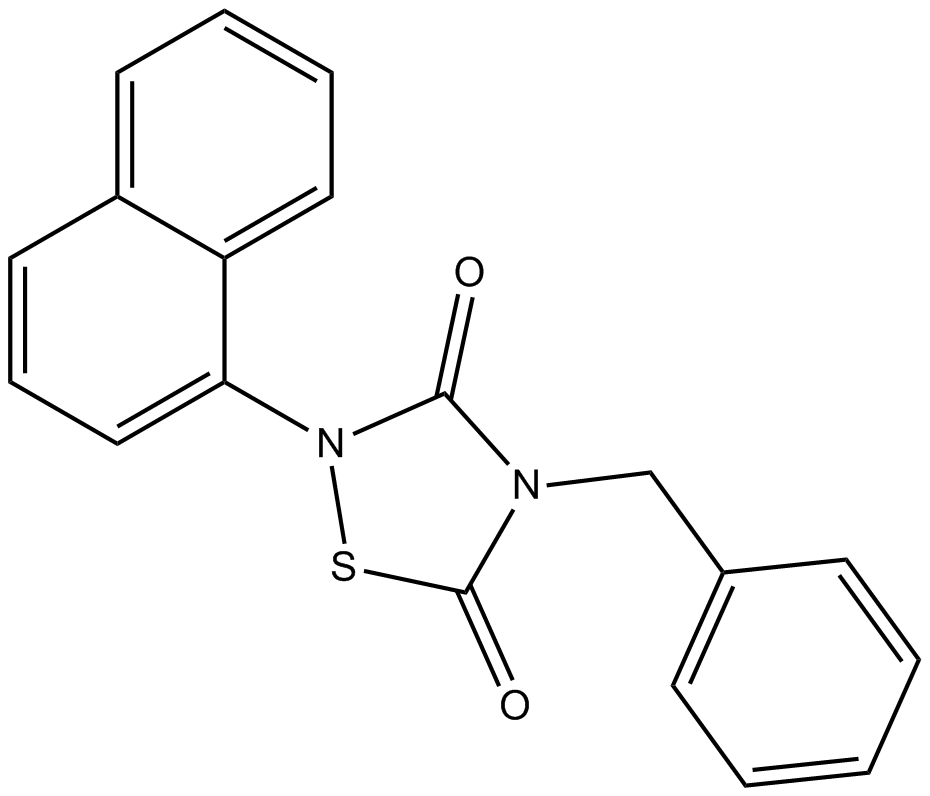
Cas No.: 865854-05-3
Sample solution is provided at 25 µL, 10mM.
Tideglusib은 강력하고 선택적이고 불가역적인 비-ATP 경쟁성 글리코겐 합성효소 키나제-3 (GSK-3) 억제제이다. GSK-3βWT와 GSK-3βC199A의 IC50 값은 각각 5nM과 60nM이다. GSK-3은 포도당 조절, 세포 사멸, 단백질 합성, 세포 신호전달, 세포 수송, 유전자 전사 및 세포 증식과 관련된 세린/트레오닌 키나제이다 [2]. Tideglusib은 염증과 신경퇴행성 질환을 억제할 수 있고 알츠하이머병의 치료에 사용될 수 있다 [3-4].
체외 실험에서 Tideglusib (2.5μM; 24시간)은 글루타메이트로 유도된 별모양 교질세포와 미세교질세포 배양기에서 TNF-α와 COX-2의 발현을 완전하게 제거하고 laminin-V 양성 세포의 수를 현저하게 줄여 대뇌 피질 신경세포에 항염증및 신경보호 작용을 나타냈다 [5]. 다양한 농도의 Tideglusib (5-120μM; 48시간)은 인간 신경 모세포종 (IMR32) 세포의 생존율을 용량 의존적으로 줄였다 [6].
체내 실험에서 Tideglusib (2ng/2.5μl PBS; 입체적 주입)은 카인산 (KA)로 유도된 부분적 흥분독성 모델 쥐의 뇌 손상을 현저하게 개선하고 별모양 교질 세포와 미세교질 세포에서 TNF-α 긍정적인 염색을 줄였다 [5]. Tideglusib (200mg/kg/day; 3개월) 경구 투여는 APP/tau 이중 유전자 변형 쥐에서 타우 단백질의 인산화 수준을 줄였고 아밀로이드 단백질의 침착과 플라크와 관련된 항성교질세포의 증식을 감소시켰고 내피질을 보호하고 해마 CA1 구역 신경세포의 사멸을 막았다 [7].
References:
[1] Domínguez JM, Fuertes A, Orozco L, et al. Evidence for irreversible inhibition of glycogen synthase kinase-3β by tideglusib. J Biol Chem. 2012;287(2):893-904.
[2] Pandey M K, DeGrado T R. Glycogen synthase kinase-3 (GSK-3)-targeted therapy and imaging[J]. Theranostics, 2016, 6(4): 571.
[3] Serenóa L, Coma M, Rodríguez M, et al. A novel GSK-3β inhibitor reduces Alzheimer's pathology and rescues neuronal loss in vivo. Neurobiol Dis. 2009 Sep; 35(3): 359-67.
[4] Lovestone S, Boada M, Dubois B, et al. A phase II trial of tideglusib in Alzheimer's disease[J]. Journal of Alzheimer’s Disease, 2015, 45(1): 75-88.
[5] Luna-Medina R, Cortes-Canteli M, Sanchez-Galiano S, et al. NP031112, a thiadiazolidinone compound, prevents inflammation and neurodegeneration under excitotoxic conditions: potential therapeutic role in brain disorders[J]. Journal of Neuroscience, 2007, 27(21): 5766-5776.
[6] Mathuram, Theodore Lemuel et al. “Tideglusib induces apoptosis in human neuroblastoma IMR32 cells, provoking sub-G0/G1 accumulation and ROS generation.” Environmental toxicology and pharmacology vol. 46 (2016): 194-205.
[7] Serenó, L et al. “A novel GSK-3beta inhibitor reduces Alzheimer's pathology and rescues neuronal loss in vivo.” Neurobiology of disease vol. 35,3 (2009): 359-67.
| 키나제 실험 [1]: | |
제조 방법 | 25°C에서 최종 부피 10μl의 384웰 저부피 라운드 바텀 블랙 판에서 50mm Hepes, pH 7.5, 10mm MgCl₂, 1mm EGTA, 0.01% Brij-35를 사용해서 키나아제 검사를 실시하였습니다. 효소 농도는 2-5nm 범위였습니다. ATP와 펩타이드의 농도는 각각 12.5μm과 2μm였습니다. 최종 DMSO 농도가 1%인 상태에서 화합물 유무와 관계없이 검사는 1시간 동안 진행되었고 시료는 처리되었습니다. ATP와 Tideglusib의 이중 투여를 수행할 때 펩타이드 기질의 농도를 고정한 상태에서 ATP와 Tideglusib의 농도를 모두 변화시켰습니다. 데이터 분석은 실험 데이터를 경쟁적, 비경쟁적 그리고 비-ATP 경쟁적 억제의 적절한 방정식에 맞추어 수행하였습니다. |
반응 조건 | 0.1nM-1μM; 1 시간 동안 |
응용 분야 | Tideglusib이 GSK-3β를 억제하는 IC50 값은 사전 배양 조건에서 5nm이고 사전 배양되지 않은 조건에서는 105nm입니다. |
| 세포 실험 [2]: | |
세포 라인 | 쥐의 일차 성상세포,미세교질 세포 및 신경세포 |
제조 방법 | 글루타메이트 (500μm)에 노출되기 1시간 전에 Tideglusib (2.5μm)을 별모양 교질세포와 미세교질세포의 배양액에 추가하였고 세포는 조직 배양액을 수집하기 전에 24시간 동안 배양되었고 세포는 종양괴사인자-α (TNF-α)와 사이클로옥시게나제 2형 (COX-2) 발현을 평가하였습니다. |
반응 조건 | 2.5μM; 24 시간 동안 |
응용 분야 | Tideglusib은 글루타메이트로 유도된 별모양 교질세포와 미세교질세포 배양기에서 TNF-α와 COX-2의 발현을 완전하게 폐지되었습니다. |
| 동물 실험 [3]: | |
동물 모형 | 위스타 쥐 (중점 엑시토독성 모델) |
제조 방법 | 각 그룹의 쥐 (n≥5)는 케타민 (60mg/kg) 과 도미토르 (5μg/kg)를 복강 주사해서 마취시킨 다음 입체 정위 장치에 놓였습니다. 카인산 (KA) (1μg를 2.5μL PBS에 녹인 것) 또는 Tideglusib (2ng를 2.5μL PBS에 녹인 것)와 함께 투여해서 각각 해마에 주사하였습니다. 대조 그룹 동물은 용매를 투여하였습니다. 각 주사는 마이크로 펌프를 사용해서 투여되었고2.5분 이상 지속되었습니다. 이 후에 이 쥐들은 개별적으로 사육해서 회복 관리를 받았습니다. 행동 분석이 실시되었습니다. 입체 정위 주사 후 동물들은 서로 다른 시간에 마취되었고 심장으로 4% 포름알데히드 용액을 투여하였습니다. 뇌를 제거하고 같은 용액에 밤새 4°C에서 놓아두었습니다. 30% 수크로스 폴리포름알데히드 용액에서 냉동 보호를 거쳐, 냉동시키고 고온에서 30μm 두께의 정면 절편을 얻었습니다. 떠다니는 절편은 니시 염색 또는 면역조직화학적 처리를 위해 디아미노벤젠법 또는 이중 면역형광 분석으로 처리하였습 니다. |
제형 | 2ng/2.5μl PBS; 입체적 주입 |
응용 분야 | Tideglusib 치료는 쥐의 뇌 손상을 현저하게 개선하고 해마세포의 손실을 줄였고 별모양 교질세포와 미세교질세포에서 TNF-α 긍정적인 염색을 현저하게 줄였습니다. |
References: | |
| Cas No. | 865854-05-3 | SDF | |
| Synonyms | NP031112 | ||
| Chemical Name | 4-benzyl-2-naphthalen-1-yl-1,2,4-thiadiazolidine-3,5-dione | ||
| Canonical SMILES | C1=CC=C(C=C1)CN2C(=O)N(SC2=O)C3=CC=CC4=CC=CC=C43 | ||
| Formula | C19H14N2O2S | M.Wt | 334.39 |
| Solubility | ≥ 16.7 mg/mL in DMSO with gentle warming | Storage | Store at -20°C |
| General tips | Please select the appropriate solvent to prepare the stock solution according to the
solubility of the product in different solvents; once the solution is prepared, please store it in
separate packages to avoid product failure caused by repeated freezing and thawing.Storage method
and period of the stock solution: When stored at -80°C, please use it within 6 months; when stored
at -20°C, please use it within 1 month. To increase solubility, heat the tube to 37°C and then oscillate in an ultrasonic bath for some time. |
||
| Shipping Condition | Evaluation sample solution: shipped with blue ice. All other sizes available: with RT, or with Blue Ice upon request. | ||
| Prepare stock solution | |||

|
1 mg | 5 mg | 10 mg |
| 1 mM | 2.9905 mL | 14.9526 mL | 29.9052 mL |
| 5 mM | 598.1 μL | 2.9905 mL | 5.981 mL |
| 10 mM | 299.1 μL | 1.4953 mL | 2.9905 mL |
Step 1: Enter information below (Recommended: An additional animal making an allowance for loss during the experiment)
 g
μL
g
μL
Step 2: Enter the in vivo formulation (This is only the calculator, not formulation. Please contact us first if there is no in vivo formulation at the solubility Section.)
Calculation results:
Working concentration: mg/ml;
Method for preparing DMSO master liquid: mg drug pre-dissolved in μL DMSO ( Master liquid concentration mg/mL, Please contact us first if the concentration exceeds the DMSO solubility of the batch of drug. )
Method for preparing in vivo formulation: Take μL DMSO master liquid, next addμL PEG300, mix and clarify, next addμL Tween 80, mix and clarify, next add μL saline, mix and clarify.
Method for preparing in vivo formulation: Take μL DMSO master liquid, next add μL Corn oil, mix and clarify.
Note: 1. Please make sure the liquid is clear before adding the next solvent.
2. Be sure to add the solvent(s) in order. You must ensure that the solution obtained, in the previous addition, is a clear solution before proceeding to add the next solvent. Physical methods such as vortex, ultrasound or hot water bath can be used to aid dissolving.
3. All of the above co-solvents are available for purchase on the GlpBio website.
Quality Control & SDS
- View current batch:
- Purity: >99.50% Appearance: A solid
- COA (Certificate of Analysis)
- SDS (Safety Data Sheet)
- Datasheet
Average Rating: 5 (Based on Reviews and 8 reference(s) in Google Scholar.)