

Celastrol |
Catalog No.GC15083
 One-Click Copy Product Info
|

Celastrol es un inhibidor del proteasoma con una inhibición potente y preferida del proteasoma 20S purificado con un IC50 de 2.5 μM.
Products are for research use only. Not for human use. We do not sell to patients.
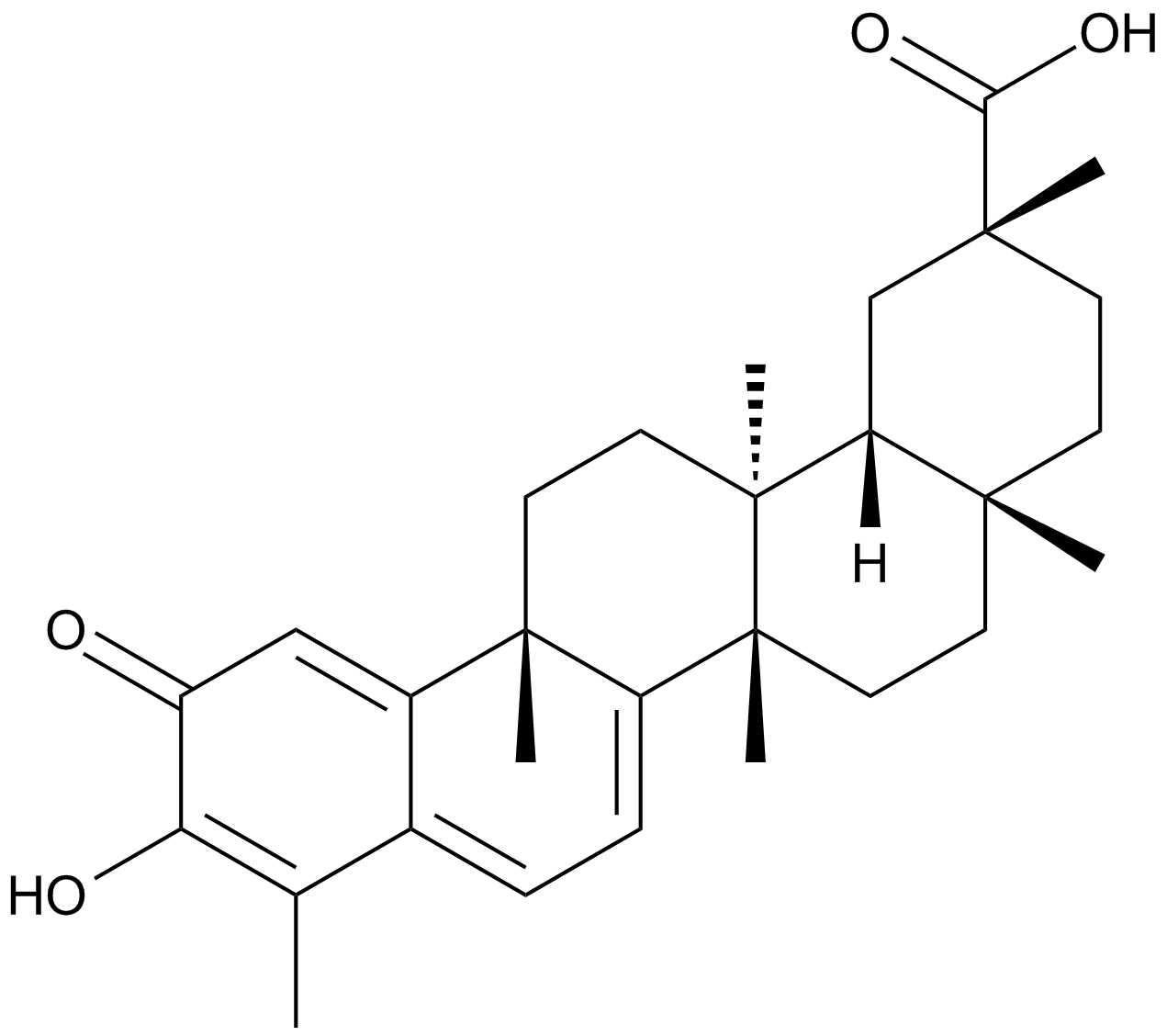
Cas No.: 34157-83-0
Sample solution is provided at 25 µL, 10mM.
_1-3.$$$39978408@51.jpg');)
_1-9.$$$38538795@65.jpg');)
_1-9.$$$39112701@51.jpg');)
_1-7.$$$37316672@70.jpg');)
_366-372.$$$36198801@70.jpg');)
.$$$38565142@65.jpg');)
_1867-1883.$$$33248023@67.jpg');)
_eads6055.$$$39977546@45.jpg');)
_eadm9805.$$$40080571@45.jpg');)
_eadj3020.$$$39666821@45.jpg');)
_1-20.$$$39757301@28.jpg');)
_1-24.$$$38898113@28.jpg');)
_273-287.$$$36806353@46.jpg');)
_1-16.$$$37156877@44.jpg');)
_1-19.$$$37460805@44.jpg');)
_1291-1307.$$$34518654@46.jpg');)
Celastrol es un inhibidor del proteasoma con una inhibición potente y preferida del proteasoma 20S purificado con un IC50 de 2.5 μM. Además, Celastrol actúa como antioxidante, agente antiinflamatorio e inmunosupresor, lo que permite su uso en el estudio del cáncer, enfermedades autoinmunes, asma, inflamación crónica y enfermedades neurodegenerativas [1-2].
Concentraciones de 1-5 μM de Celastrol inhiben la actividad similar a la quimotripsina del proteasoma 26S en células de cáncer de próstata humano, y en células PC-3 y LNCaP (positivas para el receptor de andrógenos), Celastrol provoca la acumulación de proteínas ubiquitinadas y sustratos del proteasoma (IKB-A, Bax y p27), e induce apoptosis [1]. Celastrol (0-1 μM) inhibe la proliferación y migración de células AGS y YCC-2, y aumenta el número de células en fase G1 [3]. Además, Celastrol (0-10 μM) inhibe completamente la activación de NF-κB en células de adenocarcinoma de pulmón inducidas por TNF (H1299) y en células de riñón embrionario (A293), sin afectar directamente la unión de NF-κB al ADN, pero inhibiendo su activación al bloquear la activación de IKK [4].
En ratones desnudos portadores de tumores PC-3, Celastrol a dosis de 1 o 3 mg/kg inhibió significativamente el crecimiento tumoral, con tasas de inhibición del 65% y 82% respectivamente, y se detectó una disminución en la actividad similar a la quimotripsina en los tumores de ratones tratados con Celastrol (45% y 30% del grupo control, respectivamente) [1]. En un modelo murino de xenotrasplante de cáncer gástrico, Celastrol (1 o 2 mg/kg) redujo la carga tumoral gástrica de manera dependiente de la dosis, incrementó la fosforilación de AMPK y disminuyó la fosforilación de AKT y mTOR en los tumores gástricos [3].
References:
[1] Yang H, Chen D, Cui QC, et al. Celastrol, a triterpene extracted from the Chinese "Thunder of God Vine," is a potent proteasome inhibitor and suppresses human prostate cancer growth in nude mice. Cancer Res, 2006, 66(9): 4758-4765.
[2] Salminen A, Lehtonen M, Paimela T, et al. Celastrol: molecular targets of thunder god vine[J]. Biochemical and biophysical research communications, 2010, 394(3): 439-442.
[3] Lee HW, Jang KS, Choi HJ, Jo A, Cheong JH, Chun KH. Celastrol inhibits gastric cancer growth by induction of apoptosis and autophagy. BMB Rep. 2014 Dec;47(12):697-702.
[4] Sethi G, Ahn K S, Pandey M K, et al. Celastrol, a novel triterpene, potentiates TNF-induced apoptosis and suppresses invasion of tumor cells by inhibiting NF-κB–regulated gene products and TAK1-mediated NF-κB activation[J]. Blood, 2007, 109(7): 2727-2735.
| Experimentos celulares [1]: | |
Líneas celulares | Células de cáncer de próstata PC-3 |
Método de preparación | Las células de cáncer de próstata fueron tratadas con Celastrol o Rubescensina A. Los extractos celulares completos preparados (30 μg por muestra) se incubaron con 40 μM de Ac-DEVD-AMC en 100 μL de buffer de ensayo a 37°C durante al menos 2 horas. Posteriormente, se utilizó western blot para la detección. |
Condiciones de reacción | 2.5-5 μM, 1-12 h |
Áreas de aplicación | Celastrol aumentó de manera dependiente de la concentración los niveles de proteínas ubiquitinadas, y también se observaron niveles elevados de IκB-α, Bax y p27 en células PC-3 tratadas con Celastrol. |
| Experimentos con animales [1]: | |
Modelos animales | Modelo de xenoinjerto de tumor de próstata humano |
Método de preparación | Catorce días después de la inoculación de los ratones con células PC-3, se les inyectó intraperitonealmente diariamente con 50 a 100 μL de vehículo [10% DMSO, 70% Cremophor/etanol (3:1), y 20% PBS] y 1.0 o 3.0 mg/kg de Celastrol. |
Forma de dosificación | 1 o 3 mg/kg/día, 16 días, i.p. |
Áreas de aplicación | Celastrol a 1 o 3 mg/kg puede inhibir significativamente el crecimiento tumoral, con tasas de inhibición de 65% y 82%, respectivamente. |
| Experimento con quinasas [1]: | |
Método de preparación | Un proteasoma 20S purificado de conejo (0.1 μg) se incubó con 40 μM de varios sustratos peptídicos fluorogénicos en 100 μL de buffer de ensayo [20 mM Tris-HCl (pH 7.5)], en presencia de Celastrol u Oridonina en diferentes concentraciones o en el disolvente DMSO durante 2 horas a 37°C, seguido de la medición de la inhibición de cada actividad del proteasoma. |
Condiciones de reacción | 0.1, 1, 10 y 100 μM, 2 h |
Áreas de aplicación | La actividad similar a la quimotripsina del proteasoma 20S purificado fue significativamente inhibida por Celastrol con un valor de IC50 de 2.5 μM. |
Referencias: [1] Yang H, Chen D, Cui QC, et al. Celastrol, un triterpeno extraído de la planta china "Thunder of God Vine", es un potente inhibidor del proteasoma y suprime el crecimiento del cáncer de próstata humano en ratones desnudos. Cancer Res, 2006, 66(9): 4758-4765. | |
| Cas No. | 34157-83-0 | SDF | |
| Chemical Name | (2R,4aS,6aR,6aS,14aS,14bR)-10-hydroxy-2,4a,6a,6a,9,14a-hexamethyl-11-oxo-1,3,4,5,6,13,14,14b-octahydropicene-2-carboxylic acid | ||
| Canonical SMILES | CC1=C(C(=O)C=C2C1=CC=C3C2(CCC4(C3(CCC5(C4CC(CC5)(C)C(=O)O)C)C)C)C)O | ||
| Formula | C29H38O4 | M.Wt | 450.61 |
| Solubility | ≥ 22.55mg/mL in DMSO | Storage | Store at -20°C |
| General tips | Please select the appropriate solvent to prepare the stock solution according to the
solubility of the product in different solvents; once the solution is prepared, please store it in
separate packages to avoid product failure caused by repeated freezing and thawing.Storage method
and period of the stock solution: When stored at -80°C, please use it within 6 months; when stored
at -20°C, please use it within 1 month. To increase solubility, heat the tube to 37°C and then oscillate in an ultrasonic bath for some time. |
||
| Shipping Condition | Evaluation sample solution: shipped with blue ice. All other sizes available: with RT, or with Blue Ice upon request. | ||
| Prepare stock solution | |||

|
1 mg | 5 mg | 10 mg |
| 1 mM | 2.2192 mL | 11.0961 mL | 22.1921 mL |
| 5 mM | 443.8 μL | 2.2192 mL | 4.4384 mL |
| 10 mM | 221.9 μL | 1.1096 mL | 2.2192 mL |
Step 1: Enter information below (Recommended: An additional animal making an allowance for loss during the experiment)
 g
μL
g
μL
Step 2: Enter the in vivo formulation (This is only the calculator, not formulation. Please contact us first if there is no in vivo formulation at the solubility Section.)
Calculation results:
Working concentration: mg/ml;
Method for preparing DMSO master liquid: mg drug pre-dissolved in μL DMSO ( Master liquid concentration mg/mL, Please contact us first if the concentration exceeds the DMSO solubility of the batch of drug. )
Method for preparing in vivo formulation: Take μL DMSO master liquid, next addμL PEG300, mix and clarify, next addμL Tween 80, mix and clarify, next add μL saline, mix and clarify.
Method for preparing in vivo formulation: Take μL DMSO master liquid, next add μL Corn oil, mix and clarify.
Note: 1. Please make sure the liquid is clear before adding the next solvent.
2. Be sure to add the solvent(s) in order. You must ensure that the solution obtained, in the previous addition, is a clear solution before proceeding to add the next solvent. Physical methods such as vortex, ultrasound or hot water bath can be used to aid dissolving.
3. All of the above co-solvents are available for purchase on the GlpBio website.
Quality Control & SDS
- View current batch:
- Purity: >99.50% Appearance: A solid
- COA (Certificate of Analysis)
- SDS (Safety Data Sheet)
- Datasheet
Average Rating: 5 (Based on Reviews and 30 reference(s) in Google Scholar.)