

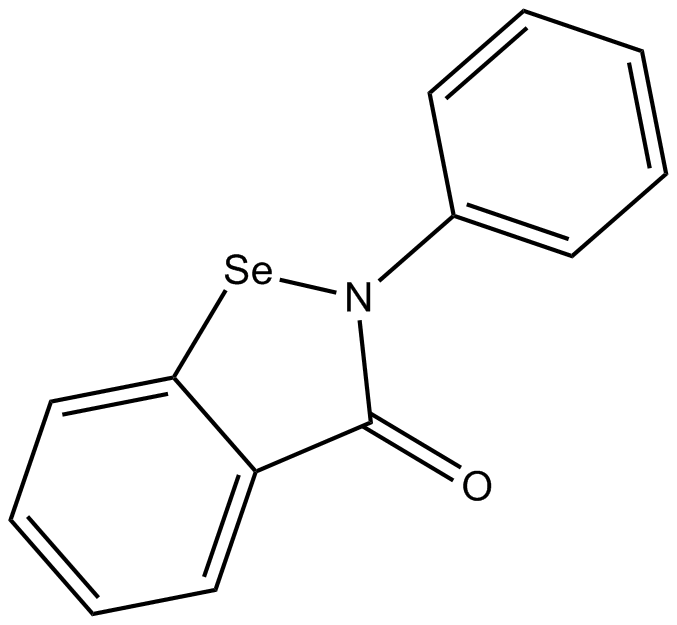
Ebselen |
Catalog No.GC10331
 One-Click Copy Product Info
|

Ebselen es un compuesto selenoorgánico con actividad similar a la glutatión peroxidasa y es un agente antiinflamatorio y antioxidante. Ebselen es un inhibidor de la inositol monofosfatasa (IMPase) con un IC50 de 1.5μM.
Products are for research use only. Not for human use. We do not sell to patients.
Cas No.: 60940-34-3
Sample solution is provided at 25 µL, 10mM.
_1-3.$$$39978408@51.jpg');)
_1-9.$$$38538795@65.jpg');)
_1-9.$$$39112701@51.jpg');)
_1-7.$$$37316672@70.jpg');)
_366-372.$$$36198801@70.jpg');)
.$$$38565142@65.jpg');)
_1867-1883.$$$33248023@67.jpg');)
_eads6055.$$$39977546@45.jpg');)
_eadm9805.$$$40080571@45.jpg');)
_eadj3020.$$$39666821@45.jpg');)
_1-20.$$$39757301@28.jpg');)
_1-24.$$$38898113@28.jpg');)
_273-287.$$$36806353@46.jpg');)
_1-16.$$$37156877@44.jpg');)
_1-19.$$$37460805@44.jpg');)
_1291-1307.$$$34518654@46.jpg');)
Ebselen es un compuesto selenoorgánico con actividad similar a la glutatión peroxidasa y es un agente antiinflamatorio y antioxidante[1]. Ebselen es un inhibidor de la inositol monofosfatasa (IMPase) con un IC50 de 1.5μM[2]. Ebselen es un potente desemedero de peróxido de hidrógeno e hidroperóxidos, incluidos los hidroperóxidos de fosfolíoidos y éster de colesterol unidos a la membrana[3]. Ebselen puede penetrar la barrera hematoencefálica y tiene actividades antiinflamatorias, antioxidantes y anticancerígenas [4].
In vitro, el tratamiento con Ebselen (0-100μM) de células U266 y RPMI8226 durante 24h redujo la viabilidad celular de una manera dependiente de la concentración, indujo la apoptosis celular,aumentó la generación de ROS intracelulares e indujo la translocación de la proteína Bax del citosol a las mitocondrias[5]. El tratamiento con Ebselen (5-10μM) de células V79 redujo el daño del DNA inducido por peróxido de hidrógeno[6]. Ebselen (10-20μM) inhibió el crecimiento de células de cáncer de pulmón A549, células de cáncer de pulmón Calu-6 y células primarias de fibroblastos pulmonares humanos normales (HPF),con valores IC50 de aproximadamente 12.5μM, 10μM y 20μM, respectivamente[7].
In vivo, Ebselen (10mg/kg) se inyectó intraperitonealmente en ratas con lesión de la médula espinal (SCI), lo que redujo los niveles de malondialdehído (MDA) y proteína carbonilo (PC) en el tejido de la médula espinal y evitó la inhibición de las actividades de las enzimas superóxido dismutasa (SOD), glutatión peroxidasa (GSH-Px) y catalasa (CAT) en los tejidos inducidos por SCI[8].
References:
[1]?Nakamura Y, Feng Q, Kumagai T, et al. Ebselen, a glutathione peroxidase mimetic seleno-organic compound, as a multifunctional antioxidant: implication for inflammation-associated carcinogenesis[J]. Journal of Biological Chemistry, 2002, 277(4): 2687-2694.
[2]?Ramli F F, Cowen P J, Godlewska B R. The potential use of ebselen in treatment-resistant depression[J]. Pharmaceuticals, 2022, 15(4): 485.
[3]?Santofimia-Casta?o P, Izquierdo-Alvarez A, de la Casa-Resino I, et al. Ebselen alters cellular oxidative status and induces endoplasmic reticulum stress in rat hippocampal astrocytes[J]. Toxicology, 2016, 357: 74-84.
[4]?Ali F, Alom S, Ali S R, et al. Ebselen: A Review on its Synthesis, Derivatives, Anticancer Efficacy and Utility in Combating SARS-COV-2[J]. Mini Reviews in Medicinal Chemistry, 2024, 24(12): 1203-1225.
[5]?Zhang L, Zhou L, Du J, et al. Induction of apoptosis in human multiple myeloma cell lines by ebselen via enhancing the endogenous reactive oxygen species production[J]. BioMed Research International, 2014, 2014(1): 696107.
[6]?Miorelli S T, Rosa R M, Moura D J, et al. Antioxidant and anti-mutagenic effects of ebselen in yeast and in cultured mammalian V79 cells[J]. Mutagenesis, 2008, 23(2): 93-99.
[7]?Park W H. Ebselen Inhibits the Growth of Lung Cancer Cells via Cell Cycle Arrest and Cell Death Accompanied by Glutathione Depletion[J]. Molecules, 2023, 28(18): 6472.
[8] Kalayci M, Coskun O, Cagavi F, et al. Neuroprotective effects of ebselen on experimental spinal cord injury in rats[J]. Neurochemical Research, 2005, 30: 403-410.
| Experimentos celulares [1]: | |
Líneas celulares | Células U266, RPMI8226 |
Método de preparación | Las células se trataron con 0 (control), 10, 20, 30, 40, 50 y 100μM de Ebselen durante 24h, respectivamente. Cambios dependientes de la concentración de la viabilidad celular determinados por el ensayo CCK-8 en las células. |
Condiciones de reacción | 0, 10, 20, 30, 40, 50, 100μM; 24h |
Áreas de aplicación | Ebselen indujo una disminución en la viabilidad celular de una manera dependiente de la concentración. |
| Experimentos con animales [2]: | |
Modelos animales | Ratas albinas Wistar |
Método de preparación | Las ratas se asignaron en seis grupos experimentales : A (control), B (solo tomía lamínica), C (Trauma; laminectomy+spinal trauma), D (Placebo grupo; laminectomy+spinal trauma+serum physiology), E (Methylprednisolone grupo; laminectomy+spinal trauma+Methylprednisolone tratada), F (Ebselen grupo; laminectomy+spinal trauma+Ebselen tratada), cada una con seis ratas. Grupo A, B y C no fueron tratados con ningún medicamento. Grupo D recibió 1 mL de fisiología sérica, el grupo E recibió 30mg/kg de Methylprednisolone por vía intraperitoneal (i.p.) y el grupo F recibió 10mg/kg de Ebselen i.p. justo después del trauma. Las ratas fueron examinadas neurológicamente a las 24 horas después del trauma y se recogieron muestras de tejido de la médula espinal para la evaluación tanto bioquímica como histopatológica. |
Forma de dosificación | 10mg/kg; i.p. |
Áreas de aplicación | El tratamiento con Ebselen redujo los niveles de malondialdehyde (MDA) y proteína carbonilo (PC) en el tejido de la médula espinal e impidió la inhibición inducida por SCI de las actividades enzimáticas superóxido dismutasa (SOD), glutatión peroxidasa (GSH-Px) y catalasa (CAT) en el tejido. |
References: | |
| Cas No. | 60940-34-3 | SDF | |
| Chemical Name | 2-phenylbenzo[d][1,2]selenazol-3(2H)-one | ||
| Canonical SMILES | O=C1C2=CC=CC=C2[Se]N1C3=CC=CC=C3 | ||
| Formula | C13H9NOSe | M.Wt | 274.18 |
| Solubility | ≤5mg/ml in ethanol;5mg/ml in DMSO;5mg/ml in dimethyl formamide | Storage | Store at -20°C |
| General tips | Please select the appropriate solvent to prepare the stock solution according to the
solubility of the product in different solvents; once the solution is prepared, please store it in
separate packages to avoid product failure caused by repeated freezing and thawing.Storage method
and period of the stock solution: When stored at -80°C, please use it within 6 months; when stored
at -20°C, please use it within 1 month. To increase solubility, heat the tube to 37°C and then oscillate in an ultrasonic bath for some time. |
||
| Shipping Condition | Evaluation sample solution: shipped with blue ice. All other sizes available: with RT, or with Blue Ice upon request. | ||
| Prepare stock solution | |||

|
1 mg | 5 mg | 10 mg |
| 1 mM | 3.6472 mL | 18.2362 mL | 36.4724 mL |
| 5 mM | 729.4 μL | 3.6472 mL | 7.2945 mL |
| 10 mM | 364.7 μL | 1.8236 mL | 3.6472 mL |
Step 1: Enter information below (Recommended: An additional animal making an allowance for loss during the experiment)
 g
μL
g
μL
Step 2: Enter the in vivo formulation (This is only the calculator, not formulation. Please contact us first if there is no in vivo formulation at the solubility Section.)
Calculation results:
Working concentration: mg/ml;
Method for preparing DMSO master liquid: mg drug pre-dissolved in μL DMSO ( Master liquid concentration mg/mL, Please contact us first if the concentration exceeds the DMSO solubility of the batch of drug. )
Method for preparing in vivo formulation: Take μL DMSO master liquid, next addμL PEG300, mix and clarify, next addμL Tween 80, mix and clarify, next add μL saline, mix and clarify.
Method for preparing in vivo formulation: Take μL DMSO master liquid, next add μL Corn oil, mix and clarify.
Note: 1. Please make sure the liquid is clear before adding the next solvent.
2. Be sure to add the solvent(s) in order. You must ensure that the solution obtained, in the previous addition, is a clear solution before proceeding to add the next solvent. Physical methods such as vortex, ultrasound or hot water bath can be used to aid dissolving.
3. All of the above co-solvents are available for purchase on the GlpBio website.
Quality Control & SDS
- View current batch:
- Purity: 99.97% Appearance: A solid
- COA (Certificate of Analysis)
- SDS (Safety Data Sheet)
- Datasheet
Average Rating: 5 (Based on Reviews and 9 reference(s) in Google Scholar.)