
Startseite>>Signaling Pathways>> Apoptosis>> Other Apoptosis>>2-Deoxy-D-glucose

2-Deoxy-D-glucose (Synonyms: 2-DG)

Katalog-Nr.GC17430

2-Deoxy-D-glucose (2DG), ein Glukoseanalogon, wirkt als kompetitiver Glykolytik-Inhibitor .

Products are for research use only. Not for human use. We do not sell to patients.
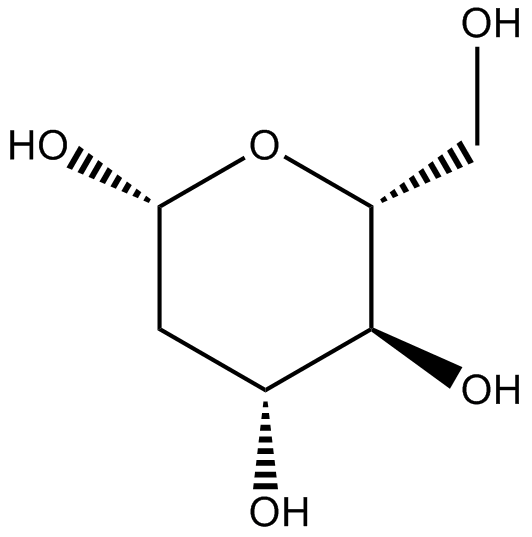
2-Deoxy-D-glucose Chemische Struktur

Cas No.: 154-17-6

Größe Preis Lagerbestand Menge
10mM (in 1mL DMSO)
38,00 $
Auf Lager
1g
30,00 $
Auf Lager
5g
108,00 $
Auf Lager

Tel:(909) 407-4943 Email: sales@glpbio.com


Kundenbewertungen

Basiert auf Kundenrezensionen.

Sample solution is provided at 25 µL, 10mM.

Product has been cited by 3 publications

Description of 2-Deoxy-D-glucose

2-Deoxy-D-glucose (2DG), ein Glukoseanalogon, wirkt als kompetitiver Glykolytik-Inhibitor [1].

2-Deoxy-D-glucose (2DG) hat sich als wirksames Mittel zur Blockierung und Untersuchung des erhöhten Zuckerstoffwechsels in Krebszellen erwiesen [2]. Aufgrund ihrer Ähnlichkeit mit Glukose hemmt 2-Deoxy-D-Glukose die Glykolyse, aber da sie chemisch gesehen auch 2-Deoxymannose ist, kann sie während der ersten Schritte der N-gebundenen Glykosylierung mit Mannose in der wachsenden lipidgebundenen Oligosaccharidkette konkurrieren. Die mannoseähnliche Eigenschaft der 2-Deoxy-D-Glukose führt zu fehlgefalteten Proteinen, die zu Stress im endoplasmatischen Retikulum (ER) [3].

Mit der Nahrung verabreichte 2-Deoxy-D-Glukose führt bei Ratten in Dosen von 0,02 bis 0,3 g/kg (0,04-0,6% 2-Deoxy-D-Glukose, bezogen auf das Gewicht in der Nahrung) zu Herztoxizität und beschleunigt die Sterblichkeit bei Dosen über 0,2 g/kg (0,4% in der Nahrung ) [4]. 2-Deoxy-D-Glukose führte zu einem Anstieg von Adrenalin und Glukose im Plasma nach 20 und 60 Minuten [5].

References:
[1]. MÜhlenberg T, Grunewald S, Treckmann J, et al. Inhibition of KIT-glycosylation by 2-deoxyglucose abrogates KIT-signaling and combination with ABT-263 synergistically induces apoptosis in gastrointestinal stromal tumor[J]. PloS one, 2015, 10(3): e0120531.
[2]. El Mjiyad N, Caro-Maldonado A, Ramirez-Peinado S, Munoz-Pinedo C. Sugar-free approaches to cancer cell killing. Oncogene. 2011 Jan;30(3):253-64.
[3]. Kurtoglu, Metin, Johnathan C. Maher, and Theodore J. Lampidis. "Differential toxic mechanisms of 2-deoxy-D-glucose versus 2-fluorodeoxy-D-glucose in hypoxic and normoxic tumor cells." Antioxidants & redox signaling 9.9 (2007): 1383-1390.
[4]. Minor R K, Smith Jr D L, Sossong A M, et al. Chronic ingestion of 2-deoxy-D-glucose induces cardiac vacuolization and increases mortality in rats[J]. Toxicology and applied pharmacology, 2010, 243(3): 332-339.
[5]. Bobrovskaya L, Damanhuri H A, Ong L K, et al. Signal transduction pathways and tyrosine hydroxylase regulation in the adrenal medulla following glucoprivation: an in vivo analysis[J]. Neurochemistry international, 2010, 57(2): 162-167.

Protocol of 2-Deoxy-D-glucose

Zellexperiment [1]:

Zelllinien

SkBr3, MCF-7, BT474, und MDA/MB468

Vorbereitungsmethode

Die Zellen wurden mit 4000 Zellen pro Well in eine 96-Well-Platte plattiert, 24 Stunden anhaften gelassen und anschließend 4 Tage lang 2-Deoxy-D-Glukose ausgesetzt.

Reaktionsbedingungen

4-12 mM für 0-4 Tage

Anwendungen

Das Wachstum von MDA/MB468-Zellen wurde durch die Behandlung mit 8mM 2-Deoxy-D-Glukose vollständig gehemmt. Die Behandlung mit 4 mM 2-Deoxy-D-Glukose führte zu einer Hemmung des Zellwachstums um etwa 30%. Von den getesteten Brustkrebszelllinien reagierte SkBr3 am empfindlichsten auf die wachstumshemmende Wirkung von 2-Deoxy-D-Glukose. Das Zellwachstum wurde bei 4 mM 2-Deoxy-D-Glukose vollständig gehemmt.

Tierversuch [2]:

Tiermodelle

männliche Sprague-Dawley (SD)-Ratten

Vorbereitungsmethode

Die Tiere wurden routinemäßig behandelt, um den mit der Injektion verbundenen Stress zu verringern. 2-Deoxy-D-Glukose(400 mg/kg) oder Kochsalzlösung wurde intraperitoneal verabreicht.

Dosierungsform

Intraperitoneale Injektion, 400 mg/kg

Anwendungen

Die Ad-Konzentration stieg von 2,73 ng/ml auf 7,2 ng/ml, während die NAd-Konzentration nach der Injektion von 2-Deoxy-D-Glukose von 1,8 ng/ml auf 3,14 ng/ml anstieg.

References:
[1]: Aft R L, Zhang F W, Gius D. Evaluation of 2-deoxy-D-glucose as a chemotherapeutic agent: mechanism of cell death[J]. British journal of cancer, 2002, 87(7): 805-812.
[2]: Bobrovskaya L, Damanhuri H A, Ong L K, et al. Signal transduction pathways and tyrosine hydroxylase regulation in the adrenal medulla following glucoprivation: an in vivo analysis[J]. Neurochemistry international, 2010, 57(2): 162-167.

Chemical Properties of 2-Deoxy-D-glucose

Cas No. 154-17-6 SDF
Überlieferungen 2-DG
Chemical Name (4R,5S,6R)-6-(hydroxymethyl)tetrahydro-2H-pyran-2,4,5-triol
Canonical SMILES [H][C@]([C@](C1([H])[H])([H])O[H])([C@](C([H])([H])O[H])([H])OC1([H])O[H])O[H]
Formula C6H12O5 M.Wt 164.16
Löslichkeit DMF: 10 mg/ml,DMSO: 20 mg/ml,PBS (pH 7.2): 10 mg/ml Storage Store at -20°C
General tips Please select the appropriate solvent to prepare the stock solution according to the solubility of the product in different solvents; once the solution is prepared, please store it in separate packages to avoid product failure caused by repeated freezing and thawing.Storage method and period of the stock solution: When stored at -80°C, please use it within 6 months; when stored at -20°C, please use it within 1 month.
To increase solubility, heat the tube to 37°C and then oscillate in an ultrasonic bath for some time.
Shipping Condition Evaluation sample solution: shipped with blue ice. All other sizes available: with RT, or with Blue Ice upon request.

Complete Stock Solution Preparation Table of 2-Deoxy-D-glucose

Prepare stock solution
1 mg 5 mg 10 mg
1 mM 6.0916 mL 30.4581 mL 60.9162 mL
5 mM 1.2183 mL 6.0916 mL 12.1832 mL
10 mM 609.2 μL 3.0458 mL 6.0916 mL
  • Molaritätsrechner

  • Verdünnung-Rechner

  • Molecular Weight Calculator

Gewicht
=
Konzentration
x
Inhalt
x
MW*


**Bei der Herstellung von Stammlösungen ist immer das chargenspezifische Molekulargewicht von

Berechnen

In vivo Formulation Calculator (Clear solution) of 2-Deoxy-D-glucose

Step 1: Enter information below (Recommended: An additional animal making an allowance for loss during the experiment)

mg/kg g μL

Step 2: Enter the in vivo formulation (This is only the calculator, not formulation. Please contact us first if there is no in vivo formulation at the solubility Section.)

% DMSO % % Tween 80 % ddH2O
%DMSO %

Calculation results:

Working concentration: mg/ml;

Method for preparing DMSO master liquid: mg drug pre-dissolved in μL DMSO ( Master liquid concentration mg/mL, Please contact us first if the concentration exceeds the DMSO solubility of the batch of drug. )

Method for preparing in vivo formulation: Take μL DMSO master liquid, next addμL PEG300, mix and clarify, next addμL Tween 80, mix and clarify, next add μL ddH2O, mix and clarify.

Method for preparing in vivo formulation: Take μL DMSO master liquid, next add μL Corn oil, mix and clarify.

Note: 1. Please make sure the liquid is clear before adding the next solvent.
2. Be sure to add the solvent(s) in order. You must ensure that the solution obtained, in the previous addition, is a clear solution before proceeding to add the next solvent. Physical methods such as vortex, ultrasound or hot water bath can be used to aid dissolving.
3. All of the above co-solvents are available for purchase on the GlpBio website.

Product Documents

Quality Control & SDS

View current batch:

Bewertungen

Review for 2-Deoxy-D-glucose

Average Rating: 5 ★★★★★ (Based on Reviews and 35 reference(s) in Google Scholar.)

5 Star
100%
4 Star
0%
3 Star
0%
2 Star
0%
1 Star
0%
Review for 2-Deoxy-D-glucose

GLPBIO products are for RESEARCH USE ONLY. Please make sure your review or question is research based.

Required fields are marked with *

You may receive emails regarding this submission. Any emails will include the ability to opt-out of future communications.