

AB-423 |
Katalog-Nr.GC19014
 One-Click Copy Product Info
|

AB-423 ist ein Inhibitor der HBV-Kapsid-Assemblierung und hemmt wirksam die HBV-Replikation mit EC50/EC90 von 0,08-0,27 μM/0,33-1,32 μM in Zellen.
Products are for research use only. Not for human use. We do not sell to patients.
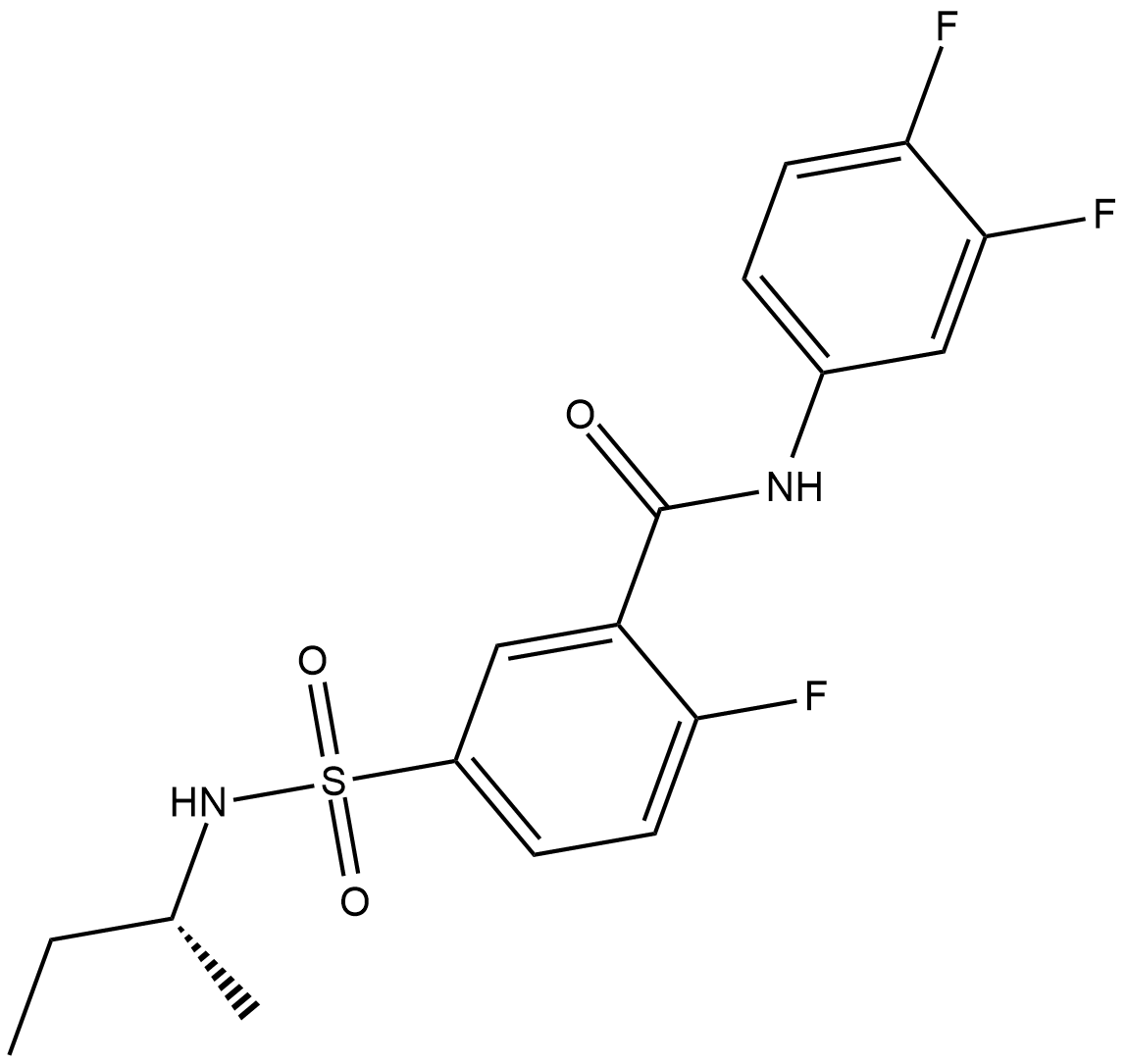
Cas No.: 1572510-80-5
Sample solution is provided at 25 µL, 10mM.
_1-3.$$$39978408@51.jpg');)
_1-9.$$$38538795@65.jpg');)
_1-9.$$$39112701@51.jpg');)
_1-7.$$$37316672@70.jpg');)
_366-372.$$$36198801@70.jpg');)
.$$$38565142@65.jpg');)
_1867-1883.$$$33248023@67.jpg');)
_eads6055.$$$39977546@45.jpg');)
_eadm9805.$$$40080571@45.jpg');)
_eadj3020.$$$39666821@45.jpg');)
_1-20.$$$39757301@28.jpg');)
_1-24.$$$38898113@28.jpg');)
_273-287.$$$36806353@46.jpg');)
_1-16.$$$37156877@44.jpg');)
_1-19.$$$37460805@44.jpg');)
_1291-1307.$$$34518654@46.jpg');)
AB-423 is an orally active sulfamoylbenzamide-class hepatitis B virus (HBV) capsid assembly inhibitor (EC₅₀/EC₉₀ values of 0.08–0.27μM / 0.33–1.32μM). AB-423 can be used in research related to chronic hepatitis B (CHB)[1-4].
In vitro, AB-423 (0.1nM–100μM) was applied to HBV-replicating cell models (HepAD38 and HepG2.2.15 cells) for 6 days. AB-423 reduced extracellular HBV DNA levels, decreased the accumulation of intracellular HBV DNA and pgRNA encapsidation-associated reverse transcription products, and was accompanied by a decline in total intracellular RNA levels as well as a reduction in HBeAg levels[5]. In HepAD38Tet-off (tetracycline-off regulated HBV replication) cells treated with AB-423 (2μM) for 2 days, AB-423 shifted the distribution of HBV core protein HBc from widespread diffuse localization under mock conditions to predominant cytoplasmic accumulation, exhibiting a cytoplasmic aggregation pattern[6].
In vivo, AB-423 (30 or 100mg/kg; twice daily; oral gavage) was administered for 7 consecutive days to NOD.CB17-Prkdc-scid/J immunodeficient mice that had been hydrodynamically injected via the tail vein with pHBV1.3 plasmids to establish an HBV infection model. AB-423 showed preferential accumulation in the target organ (liver) relative to plasma and dose-dependently reduced serum HBV DNA levels as well as intrahepatic HBV DNA levels[7]. AB-423 (100mg/kg/day) was given orally to a mouse HBV infection model for 42 consecutive days. AB-423 significantly decreased the HBV DNA content in mouse blood[8].
References:
[1] Zhao M, Yu Y, Sun LM, et al. GCG inhibits SARS-CoV-2 replication by disrupting the liquid phase condensation of its nucleocapsid protein. Nat Commun. 2021 Apr 9;12(1):2114.
[2] Joseph JT, Vishwanath R, Praharaj SK, et al. Efficacy and safety of endoxifen in bipolar disorder: A systematic review. Hum Psychopharmacol. 2024 Jul;39(4):e2899.
[3] Ren Y, Ma Y, Cherukupalli S, et al. Discovery and optimization of benzenesulfonamides-based hepatitis B virus capsid modulators via contemporary medicinal chemistry strategies. Eur J Med Chem. 2020 Nov 15;206:112714.
[4] Amblard F, Boucle S, Bassit L, et al. Novel Hepatitis B Virus Capsid Assembly Modulator Induces Potent Antiviral Responses In Vitro and in Humanized Mice. Antimicrob Agents Chemother. 2020 Jan 27;64(2):e01701-19.
[5] Wang C, Pei Y, Wang L, et al. Discovery of (1H-Pyrazolo[3,4-c]pyridin-5-yl)sulfonamide Analogues as Hepatitis B Virus Capsid Assembly Modulators by Conformation Constraint. J Med Chem. 2020 Jun 11;63(11):6066-6089.
[6] Zheng Y, Yang L, Yu L, et al. Canocapavir Is a Novel Capsid Assembly Modulator Inducing a Conformational Change of the Linker Region of HBV Core Protein. Viruses. 2023 May 18;15(5):1195.
[7] Mani N, Cole AG, Phelps JR, et al. Preclinical Profile of AB-423, an Inhibitor of Hepatitis B Virus Pregenomic RNA Encapsidation. Antimicrob Agents Chemother. 2018 May 25;62(6):e00082-18.
[8] Lee AC, Dhillon AP, Reid SP, et al. Exploring combination therapy for curing HBV: Preclinical studies with capsid inhibitor AB-423 and a siRNA agent, ABR-1740. Hepatology. 2016;64:122A–123A.
| Cell experiment [1]: | |
Cell lines | HepAD38 cells (HBV-replicating Tet-off cell line), HepG2.2.15 cells (stably transfected with HBV genomic integrants) |
Preparation Method | HepAD38 and HepG2.2.15 cells were seeded into 96-well culture plates at approximately 1×10⁴ cells/well in appropriate complete medium and allowed to adhere, then treated with AB-423 at indicated concentrations; the culture medium containing fresh AB-423 was replaced every 3 days for the duration of treatment. |
Reaction Conditions | 0-100μM; 6 days |
Applications | AB-423 reduced extracellular HBV DNA in a concentration-dependent manner, lowered intracellular HBV DNA and pgRNA-encapsidated reverse-transcription products, decreased intracellular total RNA levels, and reduced secreted HBeAg; AB-423 did not significantly suppress HBsAg secretion over the 6-day treatment window. |
| Animal experiment [2]: | |
Animal models | NOD.CB17-Prkdc-scid/J immunodeficient mice receiving a hydrodynamic tail-vein injection of 10μg pHBV1.3 plasmid |
Preparation Method | NOD-SCID mice received AB-423 via oral gavage at 30 or 100mg/kg twice daily for 7 consecutive days starting on day 0 (the day of hydrodynamic injection); blood was collected on days 0, 4, and 7 for serum HBV DNA measurement by qPCR, and livers were harvested for tissue drug concentration and HBV DNA assessment. |
Dosage form | 30 or 100mg/kg; p.o.; twice daily for 7 days |
Applications | AB-423 produced a dose-dependent reduction in serum HBV DNA levels and reduced HBV DNA in liver, consistent with its mechanism as a class II capsid assembly inhibitor blocking pgRNA encapsidation and functional capsid formation. |
References: | |
| Cas No. | 1572510-80-5 | SDF | |
| Canonical SMILES | O=C(NC1=CC=C(F)C(F)=C1)C2=CC(S(=O)(N[C@H](C)CC)=O)=CC=C2F | ||
| Formula | C17H17F3N2O3S | M.Wt | 386.39 |
| Löslichkeit | DMSO : 83.3 mg/mL (215.59 mM) | Storage | Store at -20°C |
| General tips | Please select the appropriate solvent to prepare the stock solution according to the
solubility of the product in different solvents; once the solution is prepared, please store it in
separate packages to avoid product failure caused by repeated freezing and thawing.Storage method
and period of the stock solution: When stored at -80°C, please use it within 6 months; when stored
at -20°C, please use it within 1 month. To increase solubility, heat the tube to 37°C and then oscillate in an ultrasonic bath for some time. |
||
| Shipping Condition | Evaluation sample solution: shipped with blue ice. All other sizes available: with RT, or with Blue Ice upon request. | ||
| Prepare stock solution | |||

|
1 mg | 5 mg | 10 mg |
| 1 mM | 2.5881 mL | 12.9403 mL | 25.8806 mL |
| 5 mM | 517.6 μL | 2.5881 mL | 5.1761 mL |
| 10 mM | 258.8 μL | 1.294 mL | 2.5881 mL |
Step 1: Enter information below (Recommended: An additional animal making an allowance for loss during the experiment)
 g
μL
g
μL
Step 2: Enter the in vivo formulation (This is only the calculator, not formulation. Please contact us first if there is no in vivo formulation at the solubility Section.)
Calculation results:
Working concentration: mg/ml;
Method for preparing DMSO master liquid: mg drug pre-dissolved in μL DMSO ( Master liquid concentration mg/mL, Please contact us first if the concentration exceeds the DMSO solubility of the batch of drug. )
Method for preparing in vivo formulation: Take μL DMSO master liquid, next addμL PEG300, mix and clarify, next addμL Tween 80, mix and clarify, next add μL saline, mix and clarify.
Method for preparing in vivo formulation: Take μL DMSO master liquid, next add μL Corn oil, mix and clarify.
Note: 1. Please make sure the liquid is clear before adding the next solvent.
2. Be sure to add the solvent(s) in order. You must ensure that the solution obtained, in the previous addition, is a clear solution before proceeding to add the next solvent. Physical methods such as vortex, ultrasound or hot water bath can be used to aid dissolving.
3. All of the above co-solvents are available for purchase on the GlpBio website.
Quality Control & SDS
- View current batch:
- Purity: >99.50% Appearance: A solid
- COA (Certificate of Analysis)
- SDS (Safety Data Sheet)
- Datasheet
Average Rating: 5 (Based on Reviews and 28 reference(s) in Google Scholar.)