

AM251 |
Katalog-Nr.GC15717
 One-Click Copy Product Info
|

AM251 ist ein Antagonist des Cannabinoidrezeptors Typ 1 (CB1) mit einem IC50 von 8nM und ein Agonist des G-Protein-gekoppelten Rezeptors 55 (GPR55) mit einem EC50 von 39nM.
Products are for research use only. Not for human use. We do not sell to patients.
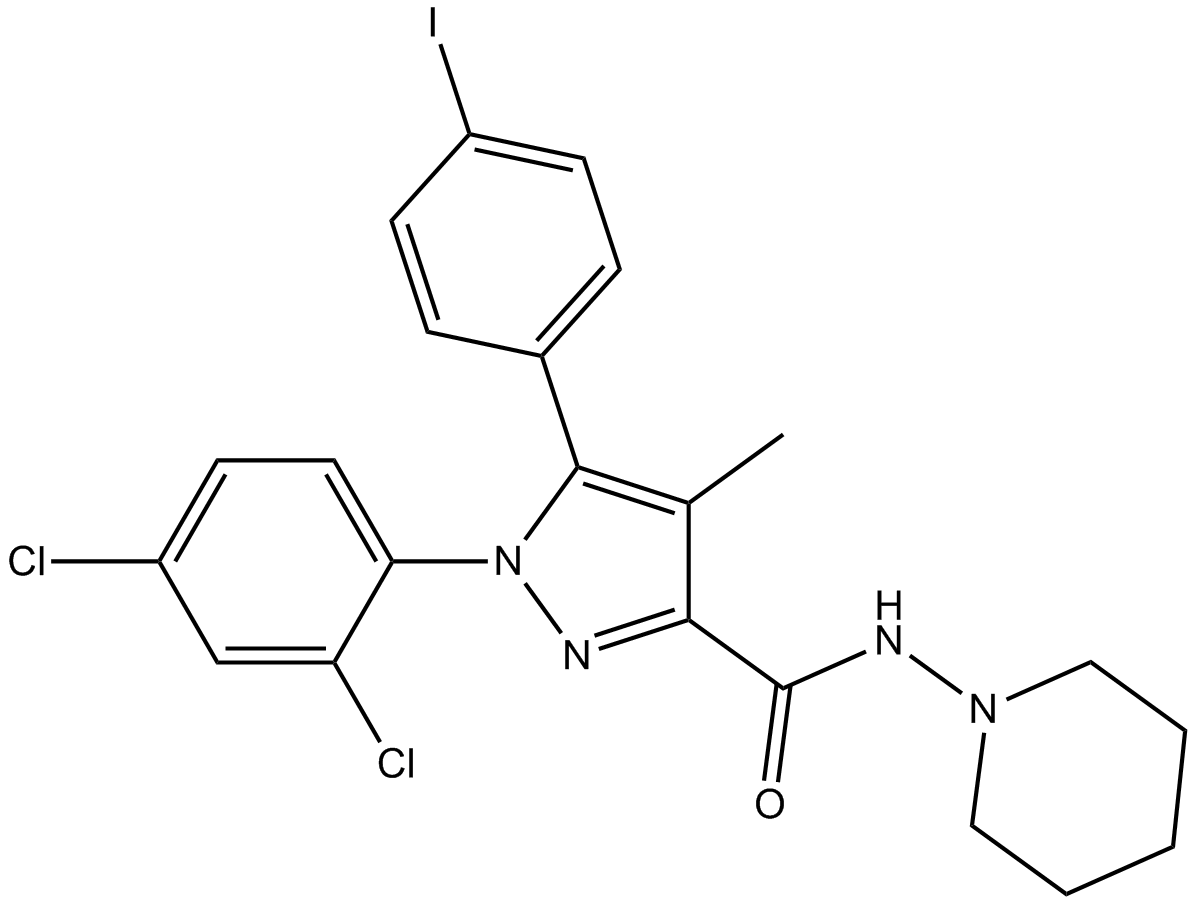
Cas No.: 183232-66-8
Sample solution is provided at 25 µL, 10mM.
AM251 ist ein Antagonist des Cannabinoidrezeptors Typ 1 (CB1) mit einem IC50 von 8nM und ein Agonist des G-Protein-gekoppelten Rezeptors 55 (GPR55) mit einem EC50 von 39nM[1] [2]. AM251 spielt eine wichtige Rolle bei physiologischen Prozessen wie Kognition und Immunfunktion und kann möglicherweise bei der Vorbeugung und Minderung von Fibrose nützlich sein.
AM251 (10μM, 24 Stunden) unterdrückte den epithelial-mesenchymalen Übergang von Epithelzellen des Nierentubulus ohne Zytotoxizität[3]. AM251 (10μM, 48 Stunden) hatte eine hemmende Wirkung auf die Differenzierung von Fibroblasten in Myofibroblasten und die durch TGF-β induzierte Kollagenproduktion in primären menschlichen Fibroblastenkulturen mit einem pIC50 von 5.5[4]. AM251 (IC50: 5μmol/L) induzierte Apoptose und G2/M-ZellZyklusarrest in A375-Humanmelanomzellen[5].
Die Behandlung mit AM251 (3mg/kg, i.p) führte zu einem Anstieg in entzündungsfördernden Zytokinen bei Ratten, während die Fettpolstermasse abnahm und die Plasmahormonspiegel verändert wurden, was zu Gewichtsverlust und Adipositasreduktion führte[6]. AM251 (1mg/kg, i.p.) verbesserte das Wiedererkennungsgedächtnis bei Ratten ohne änderung ihrer psychomotorischen Aktivität und Angst[7]. AM251 (1mg/kg, i.p.) schwächte Ataxie-bedingte Defizite in einem Kleinhirnataxiemodell ab, verbesserte die motorische Aktivität und blockierte die neuronale Degeneration der Purkinje-Zellen bei ataxishen Tieren[8].
References:
[1] Bruno A, Lembo F, Novellino E, Stornaiuolo M, Marinelli L. Beyond radio-displacement techniques for identification of CB1 ligands: the first application of a fluorescence-quenching assay. Sci Rep. 2014 Jan 20;4:3757. doi: 10.1038/srep03757. PMID: 24441508; PMCID: PMC3895875.
[2] Sharir H, Abood ME. Pharmacological characterization of GPR55, a putative cannabinoid receptor. Pharmacol Ther. 2010 Jun;126(3):301-13. doi: 10.1016/j.pharmthera.2010.02.004. Epub 2010 Mar 16. PMID: 20298715; PMCID: PMC2874616.
[3] Yoshinaga T, Uwabe K, Naito S, Higashino K, Nakano T, Numata Y, Kihara A. AM251 Suppresses Epithelial-Mesenchymal Transition of Renal Tubular Epithelial Cells. PLoS One. 2016 Dec 9;11(12):e0167848. doi: 10.1371/journal.pone.0167848. PMID: 27936102; PMCID: PMC5148003.
[4] Correia-Sá IB, Carvalho CM, Serrão PV, Machado VA, Carvalho SO, Marques M, Vieira-Coelho MA. AM251, a cannabinoid receptor 1 antagonist, prevents human fibroblasts differentiation and collagen deposition induced by TGF-β - An in vitro study. Eur J Pharmacol. 2021 Feb 5;892:173738. doi: 10.1016/j.ejphar.2020.173738. Epub 2020 Nov 19. PMID: 33220269.
[5] Carpi S, Fogli S, Romanini A, Pellegrino M, Adinolfi B, Podestà A, Costa B, Da Pozzo E, Martini C, Breschi MC, Nieri P. AM251 induces apoptosis and G2/M cell cycle arrest in A375 human melanoma cells. Anticancer Drugs. 2015 Aug;26(7):754-62. doi: 10.1097/CAD.0000000000000246. PMID: 25974027.
[6] O'Keefe L, Vu T, Simcocks AC, Jenkin KA, Mathai ML, Hryciw DH, Hutchinson DS, McAinch AJ. CB1 Ligand AM251 Induces Weight Loss and Fat Reduction in Addition to Increased Systemic Inflammation in Diet-Induced Obesity. Int J Mol Sci. 2022 Sep 28;23(19):11447. doi: 10.3390/ijms231911447. PMID: 36232744; PMCID: PMC9569643.
[7] Bialuk I, Winnicka MM. AM251, cannabinoids receptors ligand, improves recognition memory in rats. Pharmacol Rep. 2011;63(3):670-9. doi: 10.1016/s1734-1140(11)70578-3. PMID: 21857077.
[8] Ranjbar H, Soti M, Kohlmeier KA, Sheibani V, Ahmadi-Zeidabadi M, Rafiepour K, Shabani M. The cannabinoid antagonist, AM251 attenuates ataxia related deficiencies in a cerebellar ataxic model. Int J Neurosci. 2024 May;134(5):522-529. doi: 10.1080/00207454.2022.2126771. Epub 2022 Sep 30. PMID: 36120979.
| Zellexperiment [1]: | |
Zelllinien | Renale tubuläre Epithelzelllinie HK-2 |
Vorbereitungsmethode | HK-2-Zellen wurden in einer Menge von 2 × 10⁴ Zellen pro Well auf mit Poly-D-Lysin beschichteten 96-Well-Platten über Nacht plattiert. TGF-β1 (2ng/ml) und AM251 (10μM) wurden 24 Stunden lang mit den Zellen inkubiert. |
Reaktionsbedingungen | 10μM, 24 Stunden |
Anwendungen | AM251 hemmte den epithelial-mesenchymalen Übergang in Epithelzellen der Nierentubuli, was zur Entwicklung eines neuen Therapeutikums führte, das die EMT hemmte und dann einer Nierenfibrose vorbeugte. |
| Tierversuch [2]: | |
Tiermodelle | Männliche Sprague-Dawley-Ratten |
Vorbereitungsmethode | Nach der Akklimatisationsphase erhalten die Ratten 9 Wochen lang eine fettreiche Diät (HFD), die 40% verdauliche Energie aus Lipiden enthält. Die Tiere wurden dann auf der HFD gehalten und weitere sechs Wochen lang täglich mit einer intraperitonealen Injektion behanldet, wobei 3 mg/kg Körpergewicht AM251 in der Vehikellösung gelöst wurden. Nach der Behandlung wurden die Ratten mit einer 3%igen Isofluran-Inhalation betäubt, wobei bei jedem Tier die Skelettmuskeln chirurgisch entfernt wurde. Dann wurde Herzblut entnommen, um den Tod zu bestätigen. Alle anderen wichtigen Organe, einschließlich der Fettpolster, wurden post mortem entfernt, gewogen und für weitere Analysen bei −80 °C gelagert. |
Dosierungsform | 3mg/kg, i.p., 6 Wochen |
Anwendungen | AM251 induzierte Gewichtsverlust, Fettabbau und auch eine erhöhte systemische Entzündung bei ernährungsbedingter Fettleibigkeit. Die Verabreichung von AM251 erhöhte die systemische Entzündung mit erhöhten Werten einer breiten Palette von Zytokinen. |
References: | |
| Cas No. | 183232-66-8 | SDF | |
| Chemical Name | 1-(2,4-dichlorophenyl)-5-(4-iodophenyl)-4-methyl-N-piperidin-1-ylpyrazole-3-carboxamide | ||
| Canonical SMILES | CC1=C(N(N=C1C(=O)NN2CCCCC2)C3=C(C=C(C=C3)Cl)Cl)C4=CC=C(C=C4)I | ||
| Formula | C22H21Cl2IN4O | M.Wt | 555.24 |
| Löslichkeit | ≥ 55.5mg/mL in DMSO with gentle warming | Storage | Store at -20°C |
| General tips | Please select the appropriate solvent to prepare the stock solution according to the
solubility of the product in different solvents; once the solution is prepared, please store it in
separate packages to avoid product failure caused by repeated freezing and thawing.Storage method
and period of the stock solution: When stored at -80°C, please use it within 6 months; when stored
at -20°C, please use it within 1 month. To increase solubility, heat the tube to 37°C and then oscillate in an ultrasonic bath for some time. |
||
| Shipping Condition | Evaluation sample solution: shipped with blue ice. All other sizes available: with RT, or with Blue Ice upon request. | ||
| Prepare stock solution | |||

|
1 mg | 5 mg | 10 mg |
| 1 mM | 1.801 mL | 9.0051 mL | 18.0102 mL |
| 5 mM | 360.2 μL | 1.801 mL | 3.602 mL |
| 10 mM | 180.1 μL | 900.5 μL | 1.801 mL |
Step 1: Enter information below (Recommended: An additional animal making an allowance for loss during the experiment)
 g
μL
g
μL
Step 2: Enter the in vivo formulation (This is only the calculator, not formulation. Please contact us first if there is no in vivo formulation at the solubility Section.)
Calculation results:
Working concentration: mg/ml;
Method for preparing DMSO master liquid: mg drug pre-dissolved in μL DMSO ( Master liquid concentration mg/mL, Please contact us first if the concentration exceeds the DMSO solubility of the batch of drug. )
Method for preparing in vivo formulation: Take μL DMSO master liquid, next addμL PEG300, mix and clarify, next addμL Tween 80, mix and clarify, next add μL saline, mix and clarify.
Method for preparing in vivo formulation: Take μL DMSO master liquid, next add μL Corn oil, mix and clarify.
Note: 1. Please make sure the liquid is clear before adding the next solvent.
2. Be sure to add the solvent(s) in order. You must ensure that the solution obtained, in the previous addition, is a clear solution before proceeding to add the next solvent. Physical methods such as vortex, ultrasound or hot water bath can be used to aid dissolving.
3. All of the above co-solvents are available for purchase on the GlpBio website.
Quality Control & SDS
- View current batch:
- Purity: >98.50% Appearance: A solid
- COA (Certificate of Analysis)
- SDS (Safety Data Sheet)
- Datasheet
-
Related Biological Data

Expressions of CB1, PI3K, AKT and STAT3 were detected using western-blot assay.(A) Western-blot stripes.
Animals were randomly allocated to five experiment groups (n = 12 per group) using random number table by investigators: the control group, SD group, Tan IIA-L (20 mg/kg, i. g.) group, Tan IIA-H (40 mg/kg, i. g.) group, and Tan IIA-L + AM251 (GLPBIO) group (1 mg/kg, i. p.).
Front Pharmacol 13 (2022): 823732. PMID: 35295327 IF: 5.8106 -
Related Biological Data

Blockage effects of AM251 and AM630 on hypolocomotion, hypothermia, and analgesia effects induced by the three indazole drugs in mice. (A) Influence of AM251 and AM630 on mice locomotor activity.
AM251 (GLPBIO) or AM630 at a dose of 6 mg/kg was administered 30 min prior to SCs injection.
Addict Biol 29.2 (2024): e13372. PMID: 38380735 IF: 3.4
Average Rating: 5 (Based on Reviews and 39 reference(s) in Google Scholar.)