

AM251 |
Catalog No.GC15717
 One-Click Copy Product Info
|

AM251 is a cannabinoid receptor type 1 (CB1) antagonist with an IC50 of 8nM and a G protein-coupled receptor 55 (GPR55) agonist with an EC50 of 39nM.
Products are for research use only. Not for human use. We do not sell to patients.
Cas No.: 183232-66-8
Sample solution is provided at 25 µL, 10mM.
AM251 is a cannabinoid receptor type 1 (CB1) antagonist with an IC50 of 8nM and a G protein-coupled receptor 55 (GPR55) agonist with an EC50 of 39nM[1] [2]. AM251 plays an important role in physiological processes such as cognition and immune function, and may be potentially valuable in the prevention and mitigation of fibrosis.
AM251 (10μM, 24hours) suppressed epithelial-mesenchymal transition of renal tubular epithelial cells without cytotoxicity[3]. AM251 (10μM, 48hours) had an inhibitory effect on fibroblasts differentiation into myofibroblasts and collagen production induced by TGF-β in primary human fibroblasts cultures, with a pIC50 of 5.5[4]. AM251 (IC50: 5μmol/L) induced apoptosis and G2/M cell cycle arrest in A375 human melanoma cells[5].
AM251 (3mg/kg, i.p) treatment led to an increase in pro-inflammatory cytokines in rats, while decreasing fat pad mass and altering plasma hormone levels, inducing weight loss and adiposity reduction[6]. AM251 (1mg/kg, i.p.) improved recognition memory in rats without alteration of their psychomotor activity and anxiety[7]. AM251 (1mg/kg, i.p.) attenuated ataxia-related deficits in a cerebellar ataxia model, improved motor activity and blocked Purkinje cells neuronal degeneration in ataxic animals[8].
References:
[1] Bruno A, Lembo F, Novellino E, Stornaiuolo M, Marinelli L. Beyond radio-displacement techniques for identification of CB1 ligands: the first application of a fluorescence-quenching assay. Sci Rep. 2014 Jan 20;4:3757. doi: 10.1038/srep03757. PMID: 24441508; PMCID: PMC3895875.
[2] Sharir H, Abood ME. Pharmacological characterization of GPR55, a putative cannabinoid receptor. Pharmacol Ther. 2010 Jun;126(3):301-13. doi: 10.1016/j.pharmthera.2010.02.004. Epub 2010 Mar 16. PMID: 20298715; PMCID: PMC2874616.
[3] Yoshinaga T, Uwabe K, Naito S, Higashino K, Nakano T, Numata Y, Kihara A. AM251 Suppresses Epithelial-Mesenchymal Transition of Renal Tubular Epithelial Cells. PLoS One. 2016 Dec 9;11(12):e0167848. doi: 10.1371/journal.pone.0167848. PMID: 27936102; PMCID: PMC5148003.
[4] Correia-Sá IB, Carvalho CM, Serrão PV, Machado VA, Carvalho SO, Marques M, Vieira-Coelho MA. AM251, a cannabinoid receptor 1 antagonist, prevents human fibroblasts differentiation and collagen deposition induced by TGF-β - An in vitro study. Eur J Pharmacol. 2021 Feb 5;892:173738. doi: 10.1016/j.ejphar.2020.173738. Epub 2020 Nov 19. PMID: 33220269.
[5] Carpi S, Fogli S, Romanini A, Pellegrino M, Adinolfi B, Podestà A, Costa B, Da Pozzo E, Martini C, Breschi MC, Nieri P. AM251 induces apoptosis and G2/M cell cycle arrest in A375 human melanoma cells. Anticancer Drugs. 2015 Aug;26(7):754-62. doi: 10.1097/CAD.0000000000000246. PMID: 25974027.
[6] O'Keefe L, Vu T, Simcocks AC, Jenkin KA, Mathai ML, Hryciw DH, Hutchinson DS, McAinch AJ. CB1 Ligand AM251 Induces Weight Loss and Fat Reduction in Addition to Increased Systemic Inflammation in Diet-Induced Obesity. Int J Mol Sci. 2022 Sep 28;23(19):11447. doi: 10.3390/ijms231911447. PMID: 36232744; PMCID: PMC9569643.
[7] Bialuk I, Winnicka MM. AM251, cannabinoids receptors ligand, improves recognition memory in rats. Pharmacol Rep. 2011;63(3):670-9. doi: 10.1016/s1734-1140(11)70578-3. PMID: 21857077.
[8] Ranjbar H, Soti M, Kohlmeier KA, Sheibani V, Ahmadi-Zeidabadi M, Rafiepour K, Shabani M. The cannabinoid antagonist, AM251 attenuates ataxia related deficiencies in a cerebellar ataxic model. Int J Neurosci. 2024 May;134(5):522-529. doi: 10.1080/00207454.2022.2126771. Epub 2022 Sep 30. PMID: 36120979.
| Cell experiment [1]: | |
Cell lines | Renal tubular epithelial cell line HK-2 |
Preparation Method | HK-2 cells were plated at 2 × 10⁴ cells per well on poly-D-lysine-coated 96-well plates overnight. TGF-β1 (2ng/ml) and AM251 (10μM) were incubated with the cells for 24h. |
Reaction Conditions | 10μM, 24hours |
Applications | AM251 inhibited epithelial-mesenchymal transition in renal tubular epithelial cells, which informed the development of a novel therapeutic agent that inhibited EMT thereby preventing renal fibrosis. |
| Animal experiment [2]: | |
Animal models | Male Sprague Dawley rats |
Preparation Method | Following the acclimatization period rats receive a high-fat diet (HFD) containing 40% digestible energy from lipids for 9 weeks. Animals were then maintained on the HFD and treated for a further six weeks with a daily i.p. injection, with 3mg/kg body weight of AM251 dissolved in the vehicle solution. Following treatment, rats were anesthetized with 3% isoflurane inhalation with each animal undergoing surgical removal of skeletal muscle, cardiac blood was then collected confirming death, with all other major organs including fat pads were removed post-mortem, weighed, and stored at −80 °C for further analyses. |
Dosage form | 3mg/kg, i.p., 6weeks |
Applications | AM251 induced weight loss and fat reduction in addition to increased systemic inflammation in diet-induced obesity, the administration of AM251 increased systemic inflammation with increased levels of a wide range of cytokines. |
References: [1] Yoshinaga T, Uwabe K, Naito S, Higashino K, Nakano T, Numata Y, Kihara A. AM251 Suppresses Epithelial-Mesenchymal Transition of Renal Tubular Epithelial Cells. PLoS One. 2016 Dec 9;11(12):e0167848. doi: 10.1371/journal.pone.0167848. PMID: 27936102; PMCID: PMC5148003. | |
| Cas No. | 183232-66-8 | SDF | |
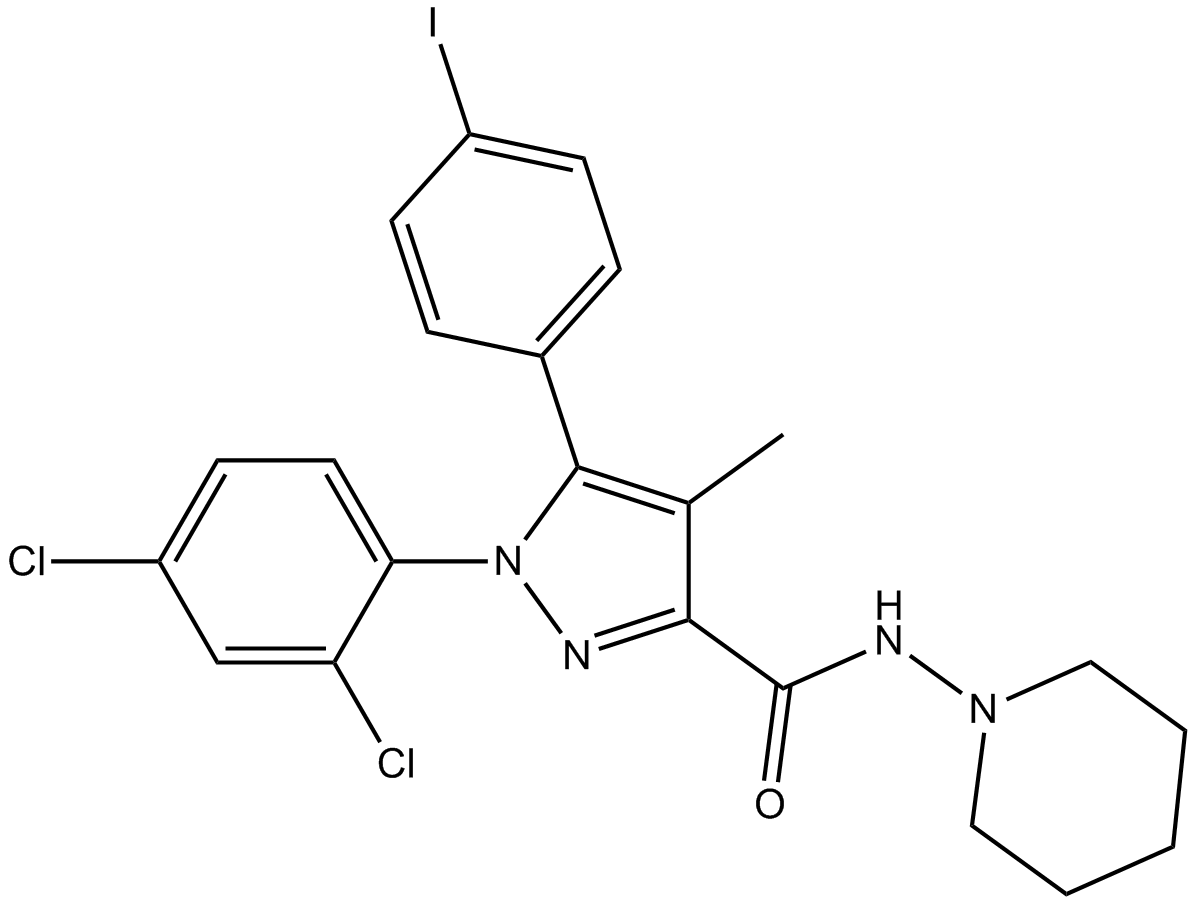
| Chemical Name | 1-(2,4-dichlorophenyl)-5-(4-iodophenyl)-4-methyl-N-piperidin-1-ylpyrazole-3-carboxamide | ||
| Canonical SMILES | CC1=C(N(N=C1C(=O)NN2CCCCC2)C3=C(C=C(C=C3)Cl)Cl)C4=CC=C(C=C4)I | ||
| Formula | C22H21Cl2IN4O | M.Wt | 555.24 |
| Solubility | ≥ 55.5mg/mL in DMSO with gentle warming | Storage | Store at -20°C |
| General tips | Please select the appropriate solvent to prepare the stock solution according to the
solubility of the product in different solvents; once the solution is prepared, please store it in
separate packages to avoid product failure caused by repeated freezing and thawing.Storage method
and period of the stock solution: When stored at -80°C, please use it within 6 months; when stored
at -20°C, please use it within 1 month. To increase solubility, heat the tube to 37°C and then oscillate in an ultrasonic bath for some time. |
||
| Shipping Condition | Evaluation sample solution: shipped with blue ice. All other sizes available: with RT, or with Blue Ice upon request. | ||
| Prepare stock solution | |||

|
1 mg | 5 mg | 10 mg |
| 1 mM | 1.801 mL | 9.0051 mL | 18.0102 mL |
| 5 mM | 360.2 μL | 1.801 mL | 3.602 mL |
| 10 mM | 180.1 μL | 900.5 μL | 1.801 mL |
Step 1: Enter information below (Recommended: An additional animal making an allowance for loss during the experiment)
 g
μL
g
μL
Step 2: Enter the in vivo formulation (This is only the calculator, not formulation. Please contact us first if there is no in vivo formulation at the solubility Section.)
Calculation results:
Working concentration: mg/ml;
Method for preparing DMSO master liquid: mg drug pre-dissolved in μL DMSO ( Master liquid concentration mg/mL, Please contact us first if the concentration exceeds the DMSO solubility of the batch of drug. )
Method for preparing in vivo formulation: Take μL DMSO master liquid, next addμL PEG300, mix and clarify, next addμL Tween 80, mix and clarify, next add μL saline, mix and clarify.
Method for preparing in vivo formulation: Take μL DMSO master liquid, next add μL Corn oil, mix and clarify.
Note: 1. Please make sure the liquid is clear before adding the next solvent.
2. Be sure to add the solvent(s) in order. You must ensure that the solution obtained, in the previous addition, is a clear solution before proceeding to add the next solvent. Physical methods such as vortex, ultrasound or hot water bath can be used to aid dissolving.
3. All of the above co-solvents are available for purchase on the GlpBio website.
Quality Control & SDS
- View current batch:
- Purity: >98.50% Appearance: A solid
- COA (Certificate of Analysis)
- SDS (Safety Data Sheet)
- Datasheet
-
Related Biological Data

Expressions of CB1, PI3K, AKT and STAT3 were detected using western-blot assay.(A) Western-blot stripes.
Animals were randomly allocated to five experiment groups (n = 12 per group) using random number table by investigators: the control group, SD group, Tan IIA-L (20 mg/kg, i. g.) group, Tan IIA-H (40 mg/kg, i. g.) group, and Tan IIA-L + AM251 (GLPBIO) group (1 mg/kg, i. p.).
Front Pharmacol 13 (2022): 823732. PMID: 35295327 IF: 5.8106 -
Related Biological Data

Blockage effects of AM251 and AM630 on hypolocomotion, hypothermia, and analgesia effects induced by the three indazole drugs in mice. (A) Influence of AM251 and AM630 on mice locomotor activity.
AM251 (GLPBIO) or AM630 at a dose of 6 mg/kg was administered 30 min prior to SCs injection.
Addict Biol 29.2 (2024): e13372. PMID: 38380735 IF: 3.4
Average Rating: 5 (Based on Reviews and 39 reference(s) in Google Scholar.)