

Astaxanthin |
Katalog-Nr.GC31350
 One-Click Copy Product Info
|

Astaxanthin, das rote diÄtetische Carotinoid, ist ein oral wirksames und starkes Antioxidans.
Products are for research use only. Not for human use. We do not sell to patients.
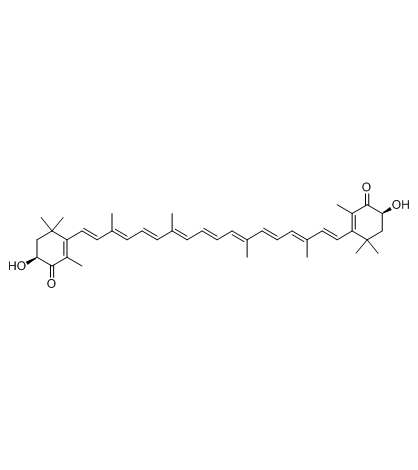
Cas No.: 472-61-7
Sample solution is provided at 25 µL, 10mM.
_1-3.$$$39978408@51.jpg');)
_1-9.$$$38538795@65.jpg');)
_1-9.$$$39112701@51.jpg');)
_1-7.$$$37316672@70.jpg');)
_366-372.$$$36198801@70.jpg');)
.$$$38565142@65.jpg');)
_1867-1883.$$$33248023@67.jpg');)
_eads6055.$$$39977546@45.jpg');)
_eadm9805.$$$40080571@45.jpg');)
_eadj3020.$$$39666821@45.jpg');)
_1-20.$$$39757301@28.jpg');)
_1-24.$$$38898113@28.jpg');)
_273-287.$$$36806353@46.jpg');)
_1-16.$$$37156877@44.jpg');)
_1-19.$$$37460805@44.jpg');)
_1291-1307.$$$34518654@46.jpg');)
Astaxanthin is a natural ketolutenoid and a potent antioxidant. Astaxanthin scavenges reactive oxygen species and activates the Nrf2/HO-1 pathway to upregulate endogenous antioxidant enzymes such as SOD, CAT, and GPx. Astaxanthin inhibits NF-κB activation to reduce the release of inflammatory factors including TNF-α, IL-6, and IL-1β. Astaxanthin can be used in studies on oxidative stress, skin photoaging, cardiovascular diseases, and neurodegenerative diseases[1-4].
In vitro, treatment of SH-SY5Y cells with 0.032-20μM Astaxanthin for 24h reduced amyloid β aggregation and deposition around the cells, inhibited amyloid β fibril formation, suppressed amyloid β-induced early apoptosis, and restored impaired cell migration speed and directional persistence[5]. Treatment of A172 cells with 50μM-100μM Astaxanthin for 24-48h decreased cell migration and invasion abilities, downregulated MMP-2 expression, and attenuated MMP-9 activity[6]. Treatment of KATO-III and SNU-1 cells with 10-100μM Astaxanthin for 24h inhibited cell proliferation, increased the proportion of cells in the G0/G1 phase, decreased the proportion of cells in the S phase, and reduced p-ERK levels[7].
In vivo, intraperitoneal injection of 40mg/kg Astaxanthin into Swiss albino mice for 5 consecutive days followed by indomethacin administration increased gastric juice pH, restored gastric tissue reduced glutathione levels to normal, decreased malondialdehyde levels, attenuated NF-κB and caspase-3 expression in gastric tissue, and reduced gastric mucosal ulcer damage[8]. Intraperitoneal injection of 10-30mg/kg Astaxanthin into BALB/c mice 30min before tert-butyl hydroperoxide administration for 60 consecutive days improved learning and memory performance, decreased ROS, Cyt-C, Apaf-1, Casp-3, and CAD levels and Bax expression in hippocampal tissue, increased GSH and Bcl-2 expression, and downregulated p-ERK1/2, FOS, and JUN expression while increasing phospho-CREB levels[9]. Gavage of 5mg/mL Astaxanthin at 0.5mL per day for 4 weeks in a C57BL/6 mouse model of oligoasthenospermia increased body weight, improved sperm concentration and forward motility, promoted spermatogenesis, decreased MDA and iron ion levels in testicular tissue, enhanced GSH-Px activity, and upregulated GPX4, GLS2, Steap3, and VDAC expression to regulate ferroptosis and fatty acid metabolism, reduce mitochondrial oxidative stress damage, and promote spermatogenesis[10].
References:
[1] Si P, Zhu C. Biological and neurological activities of astaxanthin (Review). Mol Med Rep. 2022 Oct;26(4):300.
[2] Higuera-Ciapara I, Félix-Valenzuela L, Goycoolea FM. Astaxanthin: a review of its chemistry and applications. Crit Rev Food Sci Nutr. 2006;46(2):185-96.
[3] Snell TW, Carberry J. Astaxanthin Bioactivity Is Determined by Stereoisomer Composition and Extraction Method. Nutrients. 2022 Apr 6;14(7):1522.
[4] Sun L, Li Y, Yang A, et al. Astaxanthin: A comprehensive review of synthesis, biological activities and applications. Food Chem. 2025 Oct 1;488:144847.
[5] Ananda SH, Kuragano M, Tokuraku K. Elucidation of the Neuroprotective Effects of Astaxanthin Against Amyloidβ Toxicity in the SH-SY5Y Human Neuroblastoma Cell Line. Molecules. 2025 Nov;30(21):4271.
[6] Siangcham T, Vivithanaporn P, Sangpairoj K, et al. Anti-Migration and Invasion Effects of Astaxanthin against A172 Human Glioblastoma Cell Line. Asian Pac J Cancer Prev. 2020 Jul;21(7):2029-33.
[7] Kim JH, Park JJ, Lee BJ, et al. Astaxanthin Inhibits Proliferation of Human Gastric Cancer Cell Lines by Interrupting Cell Cycle Progression. Gut Liver. 2016 May;10(3):369-374.
[8] Aly MH, Said AK, Farghaly AM, et al. Protective effect of astaxanthin on indomethacin-induced gastric ulcerations in mice. Naunyn-Schmiedeberg's Archives of Pharmacology. 2024;397(10):9897-9907.
[9] Xiong Z, Li Z, Sima X, et al. Astaxanthin reduces TBPH-induced neurobehavioral deficits in mice by the ROS-ERK1/2-FOS pathway. Ecotoxicology and Environmental Safety. 2024;281:116674.
[10] Liu H, Chen X, Feng X, et al. Astaxanthin Promotes Spermatogenesis in by Reducing Mitochondrial Oxidative Stress Damage and Regulating Fatty Acid Metabolism and Ferroptosis. Drug Des Devel Ther. 2025;19:7777-7794.
| Cell experiment [1]: | |
|
Cell lines |
A172 cells (human glioblastoma cell line) |
|
Preparation Method |
A172 cells were treated with Astaxanthin at 50-100μM for 24-48h. After treatment, cell migration was assessed by scratch assays, invasion was assessed by Boyden chamber assays, MMP-2 expression was observed by immunoblotting, and MMP-9 activity was analyzed by gelatin zymography. |
|
Reaction Conditions |
50-100μM; 24-48h |
|
Applications |
Astaxanthin decreased migration and invasion of A172 cells. Astaxanthin reduced MMP-2 expression and attenuated MMP-9 activity. |
| Animal experiment [2]: | |
|
Animal models |
Swiss albino mice |
|
Preparation Method |
Mice were intraperitoneally administered Astaxanthin (40mg/kg) for 5 days, then fasted 24h and given a single oral dose of indomethacin (40mg/kg); 4h after indomethacin, mice were sacrificed for gastric juice pH, ulcer scoring, histopathology, GSH, MDA, NF-kB and caspase-3 assessment. |
|
Dosage form |
40mg/kg; i.p.; 5 days |
|
Applications |
Astaxanthin pre-treatment elevated gastric juice pH, normalized gastric tissue GSH levels, lowered MDA levels, and reduced NF-kB and caspase-3 expression in gastric tissue of indomethacin-treated mice. |
References: [1] Siangcham T, Vivithanaporn P, Sangpairoj K, et al. Anti-Migration and Invasion Effects of Astaxanthin against A172 Human Glioblastoma Cell Line. Asian Pac J Cancer Prev. 2020 Jul;21(7):2029-33. [2] Aly MH, Said AK, Farghaly AM, et al. Protective effect of astaxanthin on indomethacin-induced gastric ulcerations in mice. Naunyn-Schmiedeberg's Archives of Pharmacology. 2024;397(10):9897-9907. | |
| Cas No. | 472-61-7 | SDF | |
| Canonical SMILES | CC(/C=C/C(C(C)(C[C@H](O)C1=O)C)=C1C)=C\C=C\C(C)=C\C=C\C=C(C)\C=C\C=C(C)\C=C\C(C(C)(C[C@H](O)C2=O)C)=C2C | ||
| Formula | C40H52O4 | M.Wt | 596.84 |
| Löslichkeit | DMSO : 2 mg/mL (3.35 mM), Acetone : < 1 mg/mL (insoluble) | Storage | -20°C, protect from light, stored under nitrogen,unstable in solution, ready to use. |
| General tips | Please select the appropriate solvent to prepare the stock solution according to the
solubility of the product in different solvents; once the solution is prepared, please store it in
separate packages to avoid product failure caused by repeated freezing and thawing.Storage method
and period of the stock solution: When stored at -80°C, please use it within 6 months; when stored
at -20°C, please use it within 1 month. To increase solubility, heat the tube to 37°C and then oscillate in an ultrasonic bath for some time. |
||
| Shipping Condition | Evaluation sample solution: shipped with blue ice. All other sizes available: with RT, or with Blue Ice upon request. | ||
| Prepare stock solution | |||

|
1 mg | 5 mg | 10 mg |
| 1 mM | 1.6755 mL | 8.3775 mL | 16.7549 mL |
| 5 mM | 335.1 μL | 1.6755 mL | 3.351 mL |
| 10 mM | 167.5 μL | 837.7 μL | 1.6755 mL |
Step 1: Enter information below (Recommended: An additional animal making an allowance for loss during the experiment)
 g
μL
g
μL
Step 2: Enter the in vivo formulation (This is only the calculator, not formulation. Please contact us first if there is no in vivo formulation at the solubility Section.)
Calculation results:
Working concentration: mg/ml;
Method for preparing DMSO master liquid: mg drug pre-dissolved in μL DMSO ( Master liquid concentration mg/mL, Please contact us first if the concentration exceeds the DMSO solubility of the batch of drug. )
Method for preparing in vivo formulation: Take μL DMSO master liquid, next addμL PEG300, mix and clarify, next addμL Tween 80, mix and clarify, next add μL saline, mix and clarify.
Method for preparing in vivo formulation: Take μL DMSO master liquid, next add μL Corn oil, mix and clarify.
Note: 1. Please make sure the liquid is clear before adding the next solvent.
2. Be sure to add the solvent(s) in order. You must ensure that the solution obtained, in the previous addition, is a clear solution before proceeding to add the next solvent. Physical methods such as vortex, ultrasound or hot water bath can be used to aid dissolving.
3. All of the above co-solvents are available for purchase on the GlpBio website.
Quality Control & SDS
- View current batch:
- Purity: >98.00% Appearance: A solid
- COA (Certificate of Analysis)
- SDS (Safety Data Sheet)
- Datasheet
Average Rating: 5 (Based on Reviews and 22 reference(s) in Google Scholar.)