

B022 |
Katalog-Nr.GC39280
 One-Click Copy Product Info
|

B022 ist ein potenter und selektiver Inhibitor der NF-κB-induzierenden Kinase (NIK) (Ki von 4,2 nM; IC50=15,1 nM).
Products are for research use only. Not for human use. We do not sell to patients.
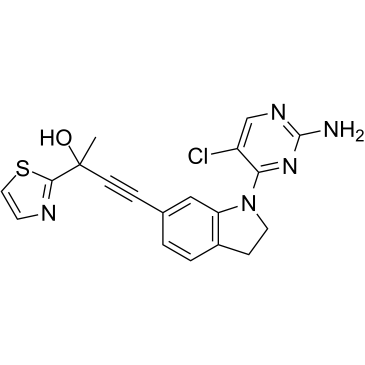
Cas No.: 1202764-53-1
Sample solution is provided at 25 µL, 10mM.
B022 is a potent and selective inhibitor of NF-κB-inducing kinase (NIK) with an IC50 value of 15.1nM [1]. B022 can prevent fat formation and inhibit the non-classical NF-κB signaling pathway, and reduce the phosphorylation level of RelA in the cytoplasm[2]. B022 has been widely used to inhibit the production of nitric oxide and alleviate liver damage[3].
In vitro, B022 treatment (20μM) for 48 hours significantly inhibited LTα1/β2-stimulated nuclear translocation of RelB and p52 in SNU-1196 cells[4]. Treatment with 10μM B022 for 16 hours significantly inhibited H2O2-induced cell death in INS-1 832/13 cells, and reversed the inhibitory effect of NIK on insulin secretion-related genes (such as Insulin1/2, Pdx-1, and Neurod1)[5].
In vivo, B022 was injected into the tail vein every 3 hours at the 25μg/kg dose for a total of 9 hours, which could alleviate the acute liver inflammation and damage induced by CCl4 in mice[6]. Intraperitoneal injection of 30mg/kg dose of B022 once a day for 10 consecutive days can alleviate the clinical symptoms of experimental autoimmune myasthenia gravis (EAMG) rats, reduce serum antibody levels, and improve the morphological changes at the neuromuscular junction and complement deposition[7].
References:
[1] Li Z, Li X, Su M B, et al. Discovery of a potent and selective NF-κB-inducing kinase (NIK) inhibitor that has anti-inflammatory effects in vitro and in vivo[J]. Journal of medicinal chemistry, 2020, 63(8): 4388-4407.
[2] Haselager M V, Eldering E. The therapeutic potential of targeting NIK in B cell malignancies[J]. Frontiers in immunology, 2022, 13: 930986.
[3] Zhang N, Shen S, Yang M, et al. Design, synthesis, and biological evaluation of a novel NIK inhibitor with anti-inflammatory and hepatoprotective effects for sepsis treatment[J]. Journal of Medicinal Chemistry, 2024, 67(7): 5617-5641.
[4] Xu K, Kessler A, Nichetti F, et al. Lymphotoxin beta‐activated LTBR/NIK/RELB axis drives proliferation in cholangiocarcinoma[J]. Liver international, 2024, 44(11): 2950-2963.
[5] Li X, Wu Y, Song Y, et al. Activation of NF-κB-inducing kinase in islet β cells causes β cell failure and diabetes[J]. Molecular Therapy, 2020, 28(11): 2430-2441.
[6] Ren X, Li X, Jia L, et al. A small‐molecule inhibitor of NF‐κB‐inducing kinase (NIK) protects liver from toxin‐induced inflammation, oxidative stress, and injury[J]. The FASEB Journal, 2017, 31(2): 711-718.
[7] Huang X, Zhang Z, Wang Z, et al. Targeting NF-kappaB-inducing kinase shapes B-cell homeostasis in myasthenia gravis[J]. Journal of Neuroinflammation, 2025, 22(1): 17.
| Cell experiment [1]: | |
|
Cell lines |
INS-1 832/13 cells |
|
Preparation Method |
INS-1 832/13 cells were cultured at 37°C and 5% CO2 in RPMI-1640 medium supplemented with 10% fetal bovine serum (FBS) and 50mM β-mercaptoethanol. INS-1 832/13 cells were treated with H2O2 (50μM) in the presence of B022 at different doses (0, 1, 5, and 10μM) for 16h and cell viability was measured. |
|
Reaction Conditions |
0, 1, 5, and 10μM; 16h |
|
Applications |
B022 treatment significantly inhibited H2O2-induced cell death in INS-1 832/13 cells in a concentration-dependent manner. |
| Animal experiment [2]: | |
|
Animal models |
Lewis rats |
|
Preparation Method |
Female Lewis rats (6-8 weeks old) weighing 160-180g were housed in temperature (23±2°C) and light-controlled (12:12-hour light-dark cycle) animal care facility with food and tap water ad libitum. The rats were provided with standard rat chow and water. The EAMG rat model was induced with rat AChR97-116 peptide (DGDFAIVKFTKVLLDYTGHI). The rats were immunized subcutaneously at the tail base with a total 200μl emulsion containing 75μg of rat AChR97-116 peptide in phosphate buffer saline emulsified in an equal volume of complete Freund’s adjuvant containing 1mg mycobacterium tuberculosis strain H37RA. Then, the rats were boosted on day 30 with the same dose of AChR97-116 peptide in incomplete Freund’s adjuvant. After the second immunization, clinical scores were assessed every day, and then we selected ongoing EAMG rats with onset clinical scores of 1-1.5 for therapeutic experiments. EAMG rats in the B022 group were intraperitoneally given 30mg/kg B022 for 10 days and the EAMG model group was injected with an equal volume of cosolvent. |
|
Dosage form |
30mg/kg/day for 10 days; i.p. |
|
Applications |
B022 treatment alleviated the clinical symptoms of EAMG rats and exhibited protective consequences in the EAMG rat model. |
|
References: |
|
| Cas No. | 1202764-53-1 | SDF | |
| Canonical SMILES | CC(C1=NC=CS1)(C#CC2=CC3=C(CCN3C4=NC(N)=NC=C4Cl)C=C2)O | ||
| Formula | C19H16ClN5OS | M.Wt | 397.88 |
| Löslichkeit | DMSO: 250 mg/mL (628.33 mM) | Storage | Store at -20°C |
| General tips | Please select the appropriate solvent to prepare the stock solution according to the
solubility of the product in different solvents; once the solution is prepared, please store it in
separate packages to avoid product failure caused by repeated freezing and thawing.Storage method
and period of the stock solution: When stored at -80°C, please use it within 6 months; when stored
at -20°C, please use it within 1 month. To increase solubility, heat the tube to 37°C and then oscillate in an ultrasonic bath for some time. |
||
| Shipping Condition | Evaluation sample solution: shipped with blue ice. All other sizes available: with RT, or with Blue Ice upon request. | ||
| Prepare stock solution | |||

|
1 mg | 5 mg | 10 mg |
| 1 mM | 2.5133 mL | 12.5666 mL | 25.1332 mL |
| 5 mM | 502.7 μL | 2.5133 mL | 5.0266 mL |
| 10 mM | 251.3 μL | 1.2567 mL | 2.5133 mL |
Step 1: Enter information below (Recommended: An additional animal making an allowance for loss during the experiment)
 g
μL
g
μL
Step 2: Enter the in vivo formulation (This is only the calculator, not formulation. Please contact us first if there is no in vivo formulation at the solubility Section.)
Calculation results:
Working concentration: mg/ml;
Method for preparing DMSO master liquid: mg drug pre-dissolved in μL DMSO ( Master liquid concentration mg/mL, Please contact us first if the concentration exceeds the DMSO solubility of the batch of drug. )
Method for preparing in vivo formulation: Take μL DMSO master liquid, next addμL PEG300, mix and clarify, next addμL Tween 80, mix and clarify, next add μL saline, mix and clarify.
Method for preparing in vivo formulation: Take μL DMSO master liquid, next add μL Corn oil, mix and clarify.
Note: 1. Please make sure the liquid is clear before adding the next solvent.
2. Be sure to add the solvent(s) in order. You must ensure that the solution obtained, in the previous addition, is a clear solution before proceeding to add the next solvent. Physical methods such as vortex, ultrasound or hot water bath can be used to aid dissolving.
3. All of the above co-solvents are available for purchase on the GlpBio website.
Quality Control & SDS
- View current batch:
- Purity: >99.50% Appearance: A solid
- COA (Certificate of Analysis)
- SDS (Safety Data Sheet)
- Datasheet
Average Rating: 5 (Based on Reviews and 10 reference(s) in Google Scholar.)