

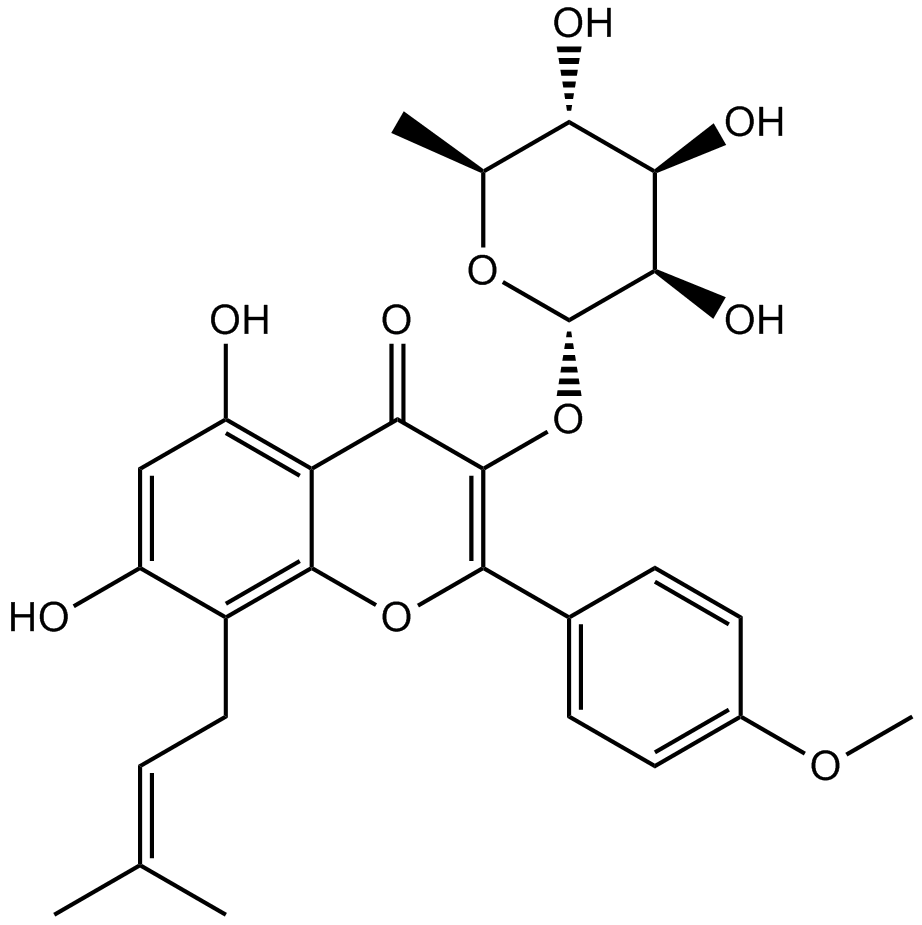
Baohuoside I (Synonyms: Icariin II, Icariside II) |
Katalog-Nr.GN10507
 One-Click Copy Product Info
|

Baohuoside I, ein aus Epimedium koreanum Nakai isoliertes Flavonoid, hemmt CXCR4, reduziert dessen Expressionsniveau, induziert Apoptose und zeigt antitumorale Aktivität.
Products are for research use only. Not for human use. We do not sell to patients.
Cas No.: 113558-15-9
Sample solution is provided at 25 µL, 10mM.
_1-3.$$$39978408@51.jpg');)
_1-9.$$$38538795@65.jpg');)
_1-9.$$$39112701@51.jpg');)
_1-7.$$$37316672@70.jpg');)
_366-372.$$$36198801@70.jpg');)
.$$$38565142@65.jpg');)
_1867-1883.$$$33248023@67.jpg');)
_eads6055.$$$39977546@45.jpg');)
_eadm9805.$$$40080571@45.jpg');)
_eadj3020.$$$39666821@45.jpg');)
_1-20.$$$39757301@28.jpg');)
_1-24.$$$38898113@28.jpg');)
_273-287.$$$36806353@46.jpg');)
_1-16.$$$37156877@44.jpg');)
_1-19.$$$37460805@44.jpg');)
_1291-1307.$$$34518654@46.jpg');)
Baohuoside I, ein aus Epimedium koreanum Nakai isoliertes Flavonoid, hemmt CXCR4, reduziert dessen Expressionsniveau, induziert Apoptose und zeigt antitumorale Aktivität[1].
Baohuoside I hemmte die α-Glucosidase stark, während Icariin sowie Epimedin A, B und C nur schwach oder gar nicht wirkten. Alle Verbindungen zeigten keine Aktivität gegen die pankreatische α-Amylase. Der IC50-Wert von Baohuoside I war 28.9 μmol/L[2]. A549-Zellen wurden durch Baohuoside I zeit- und konzentrationsabhängig gehemmt. Der IC50-Wert war nach 24 Stunden etwa 25.1 μM, nach 48 Stunden 11.5μM und nach 72 Stunden 9.6 μM[3].
Baohuoside I verlängerte das Transplantat-Überleben bei Ratten. In der Negativkontrollgruppe betrug die mittlere Überlebenszeit 6.5±0.5 Tage. Die Monotherapie mit einer subtherapeutischen oralen Dosis von Baohuoside I (8.0 mg/kg/Tag) oder FK506 (1.0 mg/kg/Tag) verlängerte erheblich das Überleben des Herztransplantats auf bis zu 9.0±2.0 Tage bzw. 16.4±6.3 Tage im Vergleich zur Negativkontrolle. Ergebnisse mit der Kombinationstherapie dieser beiden Substanzen in denselben Dosierungen(25.0±2.0 Tage) deuten auf eine additive Verlängerung des Transplantat-Überlebens im Vergleich zur Monotherapie mit Baohuoside I oder FK506 hin[4].
References:
[1]. Kim B, et al. Baohuoside I suppresses invasion of cervical and breast cancer cells through the downregulation of CXCR4 chemokine receptor expression. Biochemistry. 2014 Dec 9;53(48):7562-9.
[2]. M.A.T. Phan, J. Wang, J.Y. Tang, et al. Evaluation of α-glucosidase inhibition potential of some flavonoids from Epimedium brevicornum L. WT-Food Science and Technology, 53 (2013), pp. 492-498.
[3]. Song J, et al. Reactive oxygen species-mediated mitochondrial pathway is involved in Baohuoside I-induced apoptosis in human non-small cell lung cancer. Chem Biol Interact. 2012 Jul 30;199(1):9-17.
[4].A. Ma, S. Qi, D. Xu, X. Zhang, P. Daloze, H. Chen . Baohuoside-1, a novel immunosuppressive molecule, inhibits lymphocyte activation in vitro and in vivo. Transplantation, 78 (2004), pp. 831-838.
| Zellexperiment [1]: | |
Zelllinien | Menschliche Gebärmutterhalskrebszellen(HeLa-Zellen) |
Vorbereitungsmethode | Baohuoside I wurde in Dimethylsulfoxid(DMSO) als 10 mM Stammlösung gelöst und bei 4℃ gelagert. |
Reaktionsbedingungen | Invasionsassay mit Polycarbonat-Membranen mit einer Porengröße von 8 μm, 25 μM baohuoside I |
Anwendungen | Baohuoside I korreliert mit der Herunterregulierung des CXC-Chemokinrezeptors 4 in Gebärmutterhalskrebszellen. CXCL12 induzierte die Invasion von Gebärmutterhalskrebszellen, und Baohuoside I hob diese effektiv auf. |
| Tierversuch [2]: | |
Tiermodelle | Inzuchtweibchen C57/BL/6J-Mäuse |
Vorbereitungsmethode | Baohuoside I wird in reinem Ethanol gelagert und in 0.9%iger steriler Kochsalzlösung zur intraperitonealen Injektion suspendiert. |
Dosierungsform | Intraperitoneale Injektion, 20 mg/kg/Tag |
Anwendungen | Mäusen wurde Baohuoside I vom Tag 0 bis zum Tag 4 täglich intraperitoneal injiziert. Sie wurden am Tag 0 mit Schafserythrozyten(SRBC) immunisiert und am Tag 5 Blut abgenommen. Die Ergebnisse zeigten eine erhebliche Unterdrückung der Anti-SRBC-Antikörper-Reaktionen bei Dosierungen von 18.8 mg/ kg/Tag und darüber(P<0.001). |
References: | |
| Cas No. | 113558-15-9 | SDF | |
| Überlieferungen | Icariin II, Icariside II | ||
| Chemical Name | 5,7-dihydroxy-2-(4-methoxyphenyl)-8-(3-methylbut-2-enyl)-3-[(2S,3R,4R,5R,6S)-3,4,5-trihydroxy-6-methyloxan-2-yl]oxychromen-4-one | ||
| Canonical SMILES | CC1C(C(C(C(O1)OC2=C(OC3=C(C2=O)C(=CC(=C3CC=C(C)C)O)O)C4=CC=C(C=C4)OC)O)O)O | ||
| Formula | C27H30O10 | M.Wt | 514.18 |
| Löslichkeit | DMF: 10 mg/ml,DMSO: 10 mg/ml,Ethanol: 0.5 mg/ml,PBS (pH 7.2): 0.1 mg/ml | Storage | Store at -20°C |
| General tips | Please select the appropriate solvent to prepare the stock solution according to the
solubility of the product in different solvents; once the solution is prepared, please store it in
separate packages to avoid product failure caused by repeated freezing and thawing.Storage method
and period of the stock solution: When stored at -80°C, please use it within 6 months; when stored
at -20°C, please use it within 1 month. To increase solubility, heat the tube to 37°C and then oscillate in an ultrasonic bath for some time. |
||
| Shipping Condition | Evaluation sample solution: shipped with blue ice. All other sizes available: with RT, or with Blue Ice upon request. | ||
| Prepare stock solution | |||

|
1 mg | 5 mg | 10 mg |
| 1 mM | 1.9448 mL | 9.7242 mL | 19.4484 mL |
| 5 mM | 389 μL | 1.9448 mL | 3.8897 mL |
| 10 mM | 194.5 μL | 972.4 μL | 1.9448 mL |
Step 1: Enter information below (Recommended: An additional animal making an allowance for loss during the experiment)
 g
μL
g
μL
Step 2: Enter the in vivo formulation (This is only the calculator, not formulation. Please contact us first if there is no in vivo formulation at the solubility Section.)
Calculation results:
Working concentration: mg/ml;
Method for preparing DMSO master liquid: mg drug pre-dissolved in μL DMSO ( Master liquid concentration mg/mL, Please contact us first if the concentration exceeds the DMSO solubility of the batch of drug. )
Method for preparing in vivo formulation: Take μL DMSO master liquid, next addμL PEG300, mix and clarify, next addμL Tween 80, mix and clarify, next add μL saline, mix and clarify.
Method for preparing in vivo formulation: Take μL DMSO master liquid, next add μL Corn oil, mix and clarify.
Note: 1. Please make sure the liquid is clear before adding the next solvent.
2. Be sure to add the solvent(s) in order. You must ensure that the solution obtained, in the previous addition, is a clear solution before proceeding to add the next solvent. Physical methods such as vortex, ultrasound or hot water bath can be used to aid dissolving.
3. All of the above co-solvents are available for purchase on the GlpBio website.
Quality Control & SDS
- View current batch:
- Purity: >98.00% Appearance: A solid
- COA (Certificate of Analysis)
- SDS (Safety Data Sheet)
- Datasheet
Average Rating: 5 (Based on Reviews and 30 reference(s) in Google Scholar.)