

CW069 |
Katalog-Nr.GC11252
 One-Click Copy Product Info
|

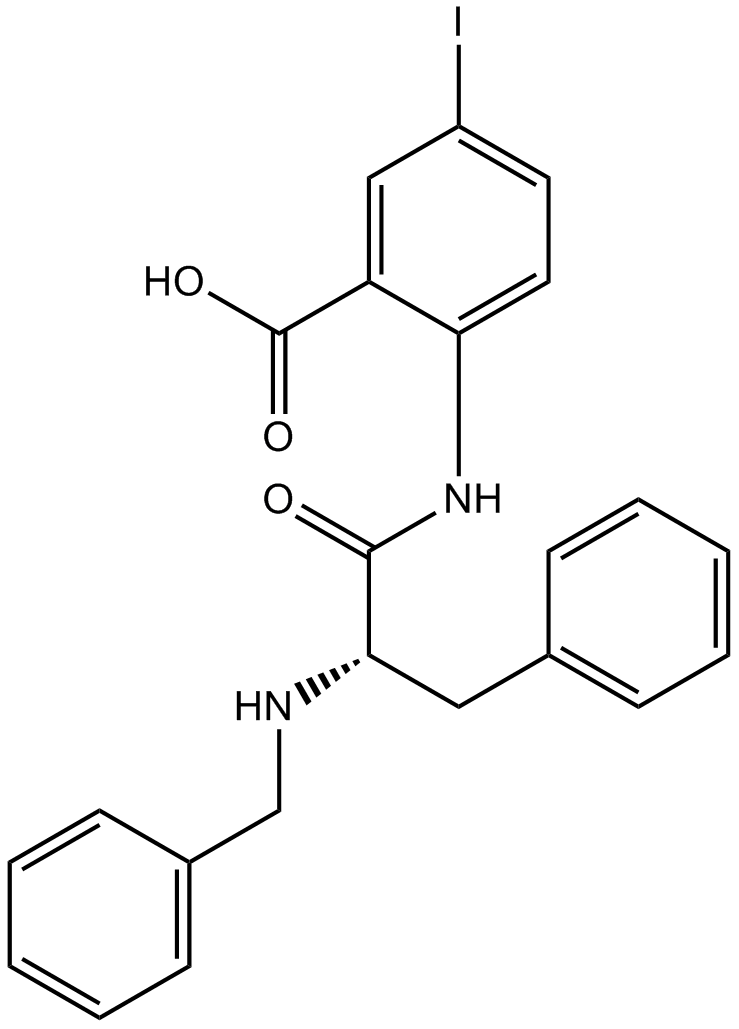
CW069 ist ein allosterischer Inhibitor des Mikrotubuli-Motorproteins HSET mit einem IC50 von 75 μM.
Products are for research use only. Not for human use. We do not sell to patients.
Cas No.: 1594094-64-0
Sample solution is provided at 25 µL, 10mM.
_1-3.$$$39978408@51.jpg');)
_1-9.$$$38538795@65.jpg');)
_1-9.$$$39112701@51.jpg');)
_1-7.$$$37316672@70.jpg');)
_366-372.$$$36198801@70.jpg');)
.$$$38565142@65.jpg');)
_1867-1883.$$$33248023@67.jpg');)
_eads6055.$$$39977546@45.jpg');)
_eadm9805.$$$40080571@45.jpg');)
_eadj3020.$$$39666821@45.jpg');)
_1-20.$$$39757301@28.jpg');)
_1-24.$$$38898113@28.jpg');)
_273-287.$$$36806353@46.jpg');)
_1-16.$$$37156877@44.jpg');)
_1-19.$$$37460805@44.jpg');)
_1291-1307.$$$34518654@46.jpg');)
CW069 is a selective allosteric inhibitor of HSET with IC50 value of 75 μM [1].
HSET is a minus-end microtubule (MT) motor protein and is encoded by KIFC1 and Kifc5a in humans and mice, respectively. HSET plays an important role in the assembly of a functional mitotic spindle [1].
CW069 is a selective allosteric inhibitor of HSET. CW069 exhibited significant selectivity over KSP. In silico model for HSET binding, the highly favorable hydrogen bond formed between the carboxylate of CW069 and the guanidinium group of Arg521 in HSET. Also, a cation-πinteraction formed between the exposed phenyl group of CW069 and the Arg521 side chain. Arg521 was critical for CW069 selectivity. The enantiomer of CW069 bound more weakly to HSET due to a weak interaction between the carboxylate of the ligand and Arg521 in HSET. In N1E-115 cancer cells, CW069 significantly increased multipolar spindle formation due to a lack of centrosome clustering. In MDA-MB-231 and BT549 breast cancer cells, CW069 significantly increased multipolar spindles. In N1E-115 cells, CW069 (200 μM) induced multipolar anaphase formation and apoptosis [1].
Reference:
[1]. Watts CA, Richards FM, Bender A, et al. Design, synthesis, and biological evaluation of an allosteric inhibitor of HSET that targets cancer cells with supernumerary centrosomes. Chem Biol, 2013, 20(11): 1399-1410.
Kinase experiment: | The protocol is optimized for use with full-length, N-terminal, 6His-tagged HSET and KSP, and measured the MT-stimulated activity of the proteins. Inhibition of the Gsp synthetase activity of HSET/KSP is observed spectrophotometrically by coupling the hydrolysis of ATP to oxidation of NADH via pyruvate kinase/lactate dehydrogenase reactions. The assay is initiated by adding purified Gsp synthetase/amidase (12.8 nM) to an assay mixture containing the following components (final concentration): 6 nM protein, 0.07 mg/mL MTs, 1.56 mM glutathione, 10 mM spermidine, 2 mM ATP, 2.7 mM MgCl2, 1 mM phospho(enol)-pyruvate, 0.2 mM NADH, 50 μg/mL lactate dehydrogenase, 100 μg/mL pyruvate kinase, and various concentrations of inhibitor (CW-069) all in 50 mM Na PIPES (pH 6.8) at 37°C. The ADP-Glo detection assay is performed. All compound additions are performed using a multidrop BioMek Nxp. Plates are read using a Pherastar microplate reader[1]. |
Cell experiment: | NHDF cells, HeLa cells, BT549, MCF-7 and MDA-MB-231 cells are verified by STR genotyping and all tested negative for mycoplasma. Cells are cultured in Dulbecco’s modified Eagle’s medium (DMEM) supplemented with 10% fetal calf serum (FCS) at 37°C and 5% CO2. All compounds (CW-069) used in the Sulforhodamine B colorimetric (SRB) assay are dissolved in DMSO and diluted in culture medium to a final concentration of 0.2% DMSO. For the SRB assay and live-cell imaging, cells are seeded in 96-well plates at a density of 2,500 cells per well. After 24 hr, the cells are treated with compound (CW-069) for 72 hr, with triplicate wells for each concentration. For the SRB assay, the cells are then fixed with trichloroacetic acid (TCA) and stained with SRB. Fluorescence is quantified using an Infinite 200 PRO plate-reader at a wavelength of 545 nm. Compound (CW-069)-treated wells are compared with solvent control wells and the concentration of compound that resulted in 50% of the solvent-control cell growth is designated as the IC50 concentration, calculated using Graphpad PRISM 6. At least three biological replicates are performed for each assay[1]. |
References: [1]. Watts CA, et al. Design, synthesis, and biological evaluation of an allosteric inhibitor of HSET that targets cancer cells with supernumerary centrosomes. Chem Biol. 2013 Nov 21;20(11):1399-410. | |
| Cas No. | 1594094-64-0 | SDF | |
| Chemical Name | 2-[[(2S)-2-(benzylamino)-3-phenylpropanoyl]amino]-5-iodobenzoic acid | ||
| Canonical SMILES | C1=CC=C(C=C1)CC(C(=O)NC2=C(C=C(C=C2)I)C(=O)O)NCC3=CC=CC=C3 | ||
| Formula | C23H21IN2O3 | M.Wt | 500.33 |
| Löslichkeit | ≥ 50mg/mL in DMSO | Storage | Store at -20° C |
| General tips | Please select the appropriate solvent to prepare the stock solution according to the
solubility of the product in different solvents; once the solution is prepared, please store it in
separate packages to avoid product failure caused by repeated freezing and thawing.Storage method
and period of the stock solution: When stored at -80°C, please use it within 6 months; when stored
at -20°C, please use it within 1 month. To increase solubility, heat the tube to 37°C and then oscillate in an ultrasonic bath for some time. |
||
| Shipping Condition | Evaluation sample solution: shipped with blue ice. All other sizes available: with RT, or with Blue Ice upon request. | ||
| Prepare stock solution | |||

|
1 mg | 5 mg | 10 mg |
| 1 mM | 1.9987 mL | 9.9934 mL | 19.9868 mL |
| 5 mM | 399.7 μL | 1.9987 mL | 3.9974 mL |
| 10 mM | 199.9 μL | 999.3 μL | 1.9987 mL |
Step 1: Enter information below (Recommended: An additional animal making an allowance for loss during the experiment)
 g
μL
g
μL
Step 2: Enter the in vivo formulation (This is only the calculator, not formulation. Please contact us first if there is no in vivo formulation at the solubility Section.)
Calculation results:
Working concentration: mg/ml;
Method for preparing DMSO master liquid: mg drug pre-dissolved in μL DMSO ( Master liquid concentration mg/mL, Please contact us first if the concentration exceeds the DMSO solubility of the batch of drug. )
Method for preparing in vivo formulation: Take μL DMSO master liquid, next addμL PEG300, mix and clarify, next addμL Tween 80, mix and clarify, next add μL saline, mix and clarify.
Method for preparing in vivo formulation: Take μL DMSO master liquid, next add μL Corn oil, mix and clarify.
Note: 1. Please make sure the liquid is clear before adding the next solvent.
2. Be sure to add the solvent(s) in order. You must ensure that the solution obtained, in the previous addition, is a clear solution before proceeding to add the next solvent. Physical methods such as vortex, ultrasound or hot water bath can be used to aid dissolving.
3. All of the above co-solvents are available for purchase on the GlpBio website.
Quality Control & SDS
- View current batch:
- Purity: >99.50% Appearance: A solid
- COA (Certificate of Analysis)
- SDS (Safety Data Sheet)
- Datasheet
Average Rating: 5 (Based on Reviews and 32 reference(s) in Google Scholar.)