

Tucidinostat (Synonyms: CS 055, HBI 8000, Tucidinostat) |
Katalog-Nr.GC37845
 One-Click Copy Product Info
|

Tucidinostat, auch als Chidamide oder CS055/HBI-8000 bekannt, ist ein Inhibitor von HDAC1, HDAC2, HDAC3 und HDAC10 mit IC50-Werten von 95 nM, 160 nM, 67 nM bzw. 78 nM.
Products are for research use only. Not for human use. We do not sell to patients.
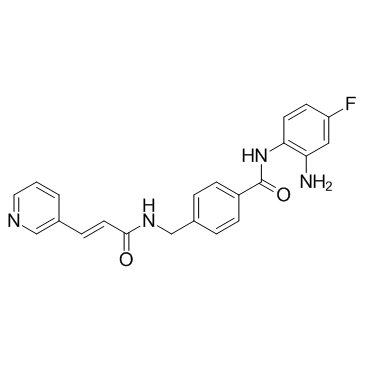
Cas No.: 1616493-44-7
Sample solution is provided at 25 µL, 10mM.
_1-3.$$$39978408@51.jpg');)
_1-9.$$$38538795@65.jpg');)
_1-9.$$$39112701@51.jpg');)
_1-7.$$$37316672@70.jpg');)
_366-372.$$$36198801@70.jpg');)
.$$$38565142@65.jpg');)
_1867-1883.$$$33248023@67.jpg');)
_eads6055.$$$39977546@45.jpg');)
_eadm9805.$$$40080571@45.jpg');)
_eadj3020.$$$39666821@45.jpg');)
_1-20.$$$39757301@28.jpg');)
_1-24.$$$38898113@28.jpg');)
_273-287.$$$36806353@46.jpg');)
_1-16.$$$37156877@44.jpg');)
_1-19.$$$37460805@44.jpg');)
_1291-1307.$$$34518654@46.jpg');)
Tucidinostat, auch als Chidamide oder CS055/HBI-8000 bekannt, ist ein Inhibitor von HDAC1, HDAC2, HDAC3 und HDAC10 mit IC50-Werten von 95 nM, 160 nM, 67 nM bzw. 78 nM. Es gehört zur Klasse der selektiven HDAC-Inhibitoren der Benzamide und fördert die Histon-H3-Acetylierung. Tucidinostat hat sich bei der Hemmung des Tumorwachstums bei verschiedenen malignen Tumoren als wirksam erwiesen[1-2].
Tucidinostat(0.25-8 uM; 24-96 Stunden) hemmte die Proliferation von K562-Zellen dosis- und zeitabhängig. Es wurde durch die Blockierung von Zellen in der G0/G1-Phase durch Herunterregulierung der Cyclin-abhängigen Kinase 4 (CDK4) erreicht[3]. Tucidinostat(0.1-6uM ;72 Stunden) führte zu Wachstumshemmung und Zellzyklusarrest in Rituximab-resistenten B-Zell-Lymphomzelllinien(RRCL) [4]. Tucidinostat(0, 2.5 und 10 μM; 48 Stunden) erhöhte erheblich die E-Cadherin-Expression in TGF-β-behandelten Zellen und unterdrückte die Migration von Lungenkrebszellen[5].
Tucidinostat(25 mg/kg; p.o; dreimal wöchentlich für 2 Wochen) hemmte die Bildung subkutaner Lukämietumoren. Nach der Behandlung mit Tucidinostat reduzierte sich die Tumorgröße erheblich[6]. Tucidinostat in einer Dosierung von 5 mg/kg in Kombination mit Fluzoparib hemmte das Neoplasmawachstum signifikanter als die Monotherapie[7].
[1]. Ning ZQ, Li ZB, et al. Chidamide (CS055/HBI-8000): a new histone deacetylase inhibitor of the benzamide class with antitumor activity and the ability to enhance immune cell-mediated tumor cell cytotoxicity. Cancer Chemother Pharm. 2012;69:901–9.
[2]. Liu L, Chen B, et al. A novel histone deacetylase inhibitor Chidamide induces apoptosis of human colon cancer cells. Biochem Biophys Res Commun. 2010 Feb 5;392(2):190-5. doi: 10.1016/j.bbrc.2010.01.011. Epub 2010 Jan 7. PMID: 20060381.
[3]. Liang S, Zhou X, et al. Chidamide Inhibits Cell Proliferation via the PI3K/AKT Pathway in K562 Cells Based on Network Pharmacology and Experimental Validation. Curr Pharm Des. 2021;27(26):2990-2998. doi: 10.2174/1381612827666210701152250. PMID: 34218775.
[4]. Xue K, Wu JC, et al. Chidamide triggers BTG1-mediated autophagy and reverses the chemotherapy resistance in the relapsed/refractory B-cell lymphoma. Cell Death Dis. 2021 Oct 1;12(10):900. doi: 10.1038/s41419-021-04187-5. PMID: 34599153; PMCID: PMC8486747.
[5]. Lin SH, Wang BY, et al. Chidamide alleviates TGF-β-induced epithelial-mesenchymal transition in lung cancer cell lines. Mol Biol Rep. 2016 Jul;43(7):687-95. doi: 10.1007/s11033-016-4005-z. Epub 2016 May 17. PMID: 27188428.
[6]. Xue K, Wu JC, et al. Chidamide triggers BTG1-mediated autophagy and reverses the chemotherapy resistance in the relapsed/refractory B-cell lymphoma. Cell Death Dis. 2021 Oct 1;12(10):900. doi: 10.1038/s41419-021-04187-5. PMID: 34599153; PMCID: PMC8486747.
[7]. Li X, Yuan X, et al. Chidamide Reverses Fluzoparib Resistance in Triple-Negative Breast Cancer Cells. Front Oncol. 2022 Feb 18;12:819714. doi: 10.3389/fonc.2022.819714. PMID: 35251986; PMCID: PMC8894594.
| Zellexperiment [1]: | |
Zelllinien | K562-Zellen |
Vorbereitungsmethode | Die Zellen wurden einer Tucidinostat-Behandlung ausgesetzt und die anschließenden Zellproliferationsraten quantitativ ermittelt. |
Reaktionsbedingungen | 0.25, 0.5, 1, 2, 4 und 8uM; 24, 48, 72 und 96 Stunden |
Anwendungen | Tucidinostat zeigte eine dosis- und zeitabhängige Hemmung der K562-Zellproliferation. |
| Tierversuch [2]: | |
Tiermodelle | Weibliche BALB/c–Nacktmäuse(SKM-1 Lukämiemodell) |
Vorbereitungsmethode | Die Mäuse wurden nach dem Zufallsprinzip in zwei Gruppen aufgeteilt. Eine Gruppe erhielt oral Tucidinostat in einer Dosis von 25 mg/kg Körpergewicht, gelöst in 0.2% Carboxymethylcellulosen und 0.1% Tween 80 (200 μl). Die andere Gruppe erhielt zwei Wochen lang dreimal wöchentlich 1% DMSO oral. |
Dosierungsform | 25 mg/kg; p.o; dreimal wöchentlich für 2 Wochen |
Anwendungen | Tucidinostat unterdrückt wirksam die Proliferation akuter myeloischer Leukämiezellen in vivo. Nach der Behandlung mit Tucidinostat wurde eine deutliche Verringerung der Tumorgröße beobachtet. |
References: | |
| Cas No. | 1616493-44-7 | SDF | |
| Überlieferungen | CS 055, HBI 8000, Tucidinostat | ||
| Canonical SMILES | O=C(C1=CC=C(CNC(/C=C/C2=CN=CC=C2)=O)C=C1)NC(C=CC(F)=C3)=C3N | ||
| Formula | C22H19FN4O2 | M.Wt | 390.41 |
| Löslichkeit | DMSO: ≥ 50 mg/mL (128.07 mM) | Storage | Store at -20°C |
| General tips | Please select the appropriate solvent to prepare the stock solution according to the
solubility of the product in different solvents; once the solution is prepared, please store it in
separate packages to avoid product failure caused by repeated freezing and thawing.Storage method
and period of the stock solution: When stored at -80°C, please use it within 6 months; when stored
at -20°C, please use it within 1 month. To increase solubility, heat the tube to 37°C and then oscillate in an ultrasonic bath for some time. |
||
| Shipping Condition | Evaluation sample solution: shipped with blue ice. All other sizes available: with RT, or with Blue Ice upon request. | ||
| Prepare stock solution | |||

|
1 mg | 5 mg | 10 mg |
| 1 mM | 2.5614 mL | 12.807 mL | 25.6141 mL |
| 5 mM | 512.3 μL | 2.5614 mL | 5.1228 mL |
| 10 mM | 256.1 μL | 1.2807 mL | 2.5614 mL |
Step 1: Enter information below (Recommended: An additional animal making an allowance for loss during the experiment)
 g
μL
g
μL
Step 2: Enter the in vivo formulation (This is only the calculator, not formulation. Please contact us first if there is no in vivo formulation at the solubility Section.)
Calculation results:
Working concentration: mg/ml;
Method for preparing DMSO master liquid: mg drug pre-dissolved in μL DMSO ( Master liquid concentration mg/mL, Please contact us first if the concentration exceeds the DMSO solubility of the batch of drug. )
Method for preparing in vivo formulation: Take μL DMSO master liquid, next addμL PEG300, mix and clarify, next addμL Tween 80, mix and clarify, next add μL saline, mix and clarify.
Method for preparing in vivo formulation: Take μL DMSO master liquid, next add μL Corn oil, mix and clarify.
Note: 1. Please make sure the liquid is clear before adding the next solvent.
2. Be sure to add the solvent(s) in order. You must ensure that the solution obtained, in the previous addition, is a clear solution before proceeding to add the next solvent. Physical methods such as vortex, ultrasound or hot water bath can be used to aid dissolving.
3. All of the above co-solvents are available for purchase on the GlpBio website.
Quality Control & SDS
- View current batch:
- Purity: >98.00% Appearance: A solid
- COA (Certificate of Analysis)
- SDS (Safety Data Sheet)
- Datasheet
Average Rating: 5 (Based on Reviews and 18 reference(s) in Google Scholar.)