

Tucidinostat (Synonyms: CS 055, HBI 8000, Tucidinostat) |
Catalog No.GC37845
 One-Click Copy Product Info
|

Tucidinostat, also known as Chidamide or CS055/HBI-8000, is an inhibitor of HDAC1, HDAC2, HDAC3, and HDAC10, with IC50 values of 95 nM, 160 nM, 67 nM, and 78 nM, respectively.
Products are for research use only. Not for human use. We do not sell to patients.
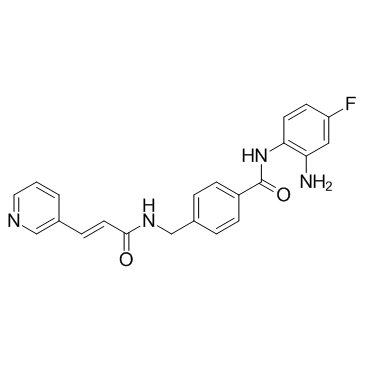
Cas No.: 1616493-44-7
Sample solution is provided at 25 µL, 10mM.
_1-3.$$$39978408@51.jpg');)
_1-9.$$$38538795@65.jpg');)
_1-9.$$$39112701@51.jpg');)
_1-7.$$$37316672@70.jpg');)
_366-372.$$$36198801@70.jpg');)
.$$$38565142@65.jpg');)
_1867-1883.$$$33248023@67.jpg');)
_eads6055.$$$39977546@45.jpg');)
_eadm9805.$$$40080571@45.jpg');)
_eadj3020.$$$39666821@45.jpg');)
_1-20.$$$39757301@28.jpg');)
_1-24.$$$38898113@28.jpg');)
_273-287.$$$36806353@46.jpg');)
_1-16.$$$37156877@44.jpg');)
_1-19.$$$37460805@44.jpg');)
_1291-1307.$$$34518654@46.jpg');)
Tucidinostat, also known as Chidamide or CS055/HBI-8000, is an inhibitor of HDAC1, HDAC2, HDAC3, and HDAC10, with IC50 values of 95 nM, 160 nM, 67 nM, and 78 nM, respectively. It belongs to the benzamide class of selective HDAC inhibitors and is capable of promoting histone H3 acetylation. Tucidinostat has demonstrated efficacy in inhibiting tumor growth across a range of malignant tumors[1-2].
Tucidinostat(0.25-8uM; 24-96h) inhibited the proliferation of K562 cells in a dose- and time-dependent manner. It achieved this by blocking cells in the G0/G1 phase through downregulation of cyclin-dependent kinase 4 (CDK4). Additionally, Tucidinostat induced apoptosis by upregulating Bax and downregulating Bcl-2[3]. Tucidinostat(0.1-6uM ;72 h) elicited growth inhibition and cell cycle arrest in rituximab-resistant B-cell lymphoma cell lines (RRCL) [4]. Tucidinostat(0, 2.5, and 10 μM; 48 h) significantly upregulated E-cadherin expression in TGF-β-treated cells and suppressed the migration of lung cancer cells[5].
Tucidinostat(25 mg/kg; p.o; thrice weekly for 2 weeks) inhibited the formation of subcutaneous leukemia tumors. Following treatment with Tucidinostat, the tumor size was significantly reduced[6]. Tucidinostat, at a dosage of 5 mg/kg, combined with fluzoparib, more significantly inhibited neoplasm growth compared to monotherapy[7].
[1]. Ning ZQ, Li ZB, et al. Chidamide (CS055/HBI-8000): a new histone deacetylase inhibitor of the benzamide class with antitumor activity and the ability to enhance immune cell-mediated tumor cell cytotoxicity. Cancer Chemother Pharm. 2012;69:901–9.
[2]. Liu L, Chen B, et al. A novel histone deacetylase inhibitor Chidamide induces apoptosis of human colon cancer cells. Biochem Biophys Res Commun. 2010 Feb 5;392(2):190-5. doi: 10.1016/j.bbrc.2010.01.011. Epub 2010 Jan 7. PMID: 20060381.
[3]. Liang S, Zhou X, et al. Chidamide Inhibits Cell Proliferation via the PI3K/AKT Pathway in K562 Cells Based on Network Pharmacology and Experimental Validation. Curr Pharm Des. 2021;27(26):2990-2998. doi: 10.2174/1381612827666210701152250. PMID: 34218775.
[4]. Xue K, Wu JC, et al. Chidamide triggers BTG1-mediated autophagy and reverses the chemotherapy resistance in the relapsed/refractory B-cell lymphoma. Cell Death Dis. 2021 Oct 1;12(10):900. doi: 10.1038/s41419-021-04187-5. PMID: 34599153; PMCID: PMC8486747.
[5]. Lin SH, Wang BY, et al. Chidamide alleviates TGF-β-induced epithelial-mesenchymal transition in lung cancer cell lines. Mol Biol Rep. 2016 Jul;43(7):687-95. doi: 10.1007/s11033-016-4005-z. Epub 2016 May 17. PMID: 27188428.
[6]. Xue K, Wu JC, et al. Chidamide triggers BTG1-mediated autophagy and reverses the chemotherapy resistance in the relapsed/refractory B-cell lymphoma. Cell Death Dis. 2021 Oct 1;12(10):900. doi: 10.1038/s41419-021-04187-5. PMID: 34599153; PMCID: PMC8486747.
[7]. Li X, Yuan X, et al. Chidamide Reverses Fluzoparib Resistance in Triple-Negative Breast Cancer Cells. Front Oncol. 2022 Feb 18;12:819714. doi: 10.3389/fonc.2022.819714. PMID: 35251986; PMCID: PMC8894594.
| Cell experiment [1]: | |
Cell lines | K562 cells |
Preparation Method | Cells were exposed to Tucidinostat treatment, and subsequent cell proliferation rates were quantitatively assessed. |
Reaction Conditions | 0.25, 0.5, 1, 2, 4 and 8uM; 24, 48, 72 and 96h |
Applications | Tucidinostat showed a dose-dependent and time-dependent inhibition of K562 cell proliferation. |
| Animal experiment [2]: | |
Animal models | Female BALB/c–nude mice(SKM-1 leukemia model) |
Preparation Method | Mice were divided into two groups randomly. One group received oral administration of Tucidinostat at a dose of 25 mg/kg of body weight, Tucidinostat dissolved in 0.2% carboxymethyl cellulose and 0.1% Tween 80 (200 μl). The other group was orally administered 1% DMSO three times weekly for a duration of 2 weeks. |
Dosage form | 25 mg/kg; p.o; thrice weekly for 2 weeks |
Applications | Tucidinostat effectively suppresses the proliferation of acute myeloid leukemia cells in vivo. Following Tucidinostat treatment, a notable reduction in tumor size was observed. |
References: [1]:Liang S, Zhou X, et,al. Chidamide Inhibits Cell Proliferation via the PI3K/AKT Pathway in K562 Cells Based on Network Pharmacology and Experimental Validation. Curr Pharm Des. 2021;27(26):2990-2998. doi: 10.2174/1381612827666210701152250. PMID: 34218775. [2]:Liang S, Zhou X, et,al. Chidamide Inhibits Cell Proliferation via the PI3K/AKT Pathway in K562 Cells Based on Network Pharmacology and Experimental Validation. Curr Pharm Des. 2021;27(26):2990-2998. doi: 10.2174/1381612827666210701152250. PMID: 34218775. | |
| Cas No. | 1616493-44-7 | SDF | |
| Synonyms | CS 055, HBI 8000, Tucidinostat | ||
| Canonical SMILES | O=C(C1=CC=C(CNC(/C=C/C2=CN=CC=C2)=O)C=C1)NC(C=CC(F)=C3)=C3N | ||
| Formula | C22H19FN4O2 | M.Wt | 390.41 |
| Solubility | DMSO: ≥ 50 mg/mL (128.07 mM) | Storage | Store at -20°C |
| General tips | Please select the appropriate solvent to prepare the stock solution according to the
solubility of the product in different solvents; once the solution is prepared, please store it in
separate packages to avoid product failure caused by repeated freezing and thawing.Storage method
and period of the stock solution: When stored at -80°C, please use it within 6 months; when stored
at -20°C, please use it within 1 month. To increase solubility, heat the tube to 37°C and then oscillate in an ultrasonic bath for some time. |
||
| Shipping Condition | Evaluation sample solution: shipped with blue ice. All other sizes available: with RT, or with Blue Ice upon request. | ||
| Prepare stock solution | |||

|
1 mg | 5 mg | 10 mg |
| 1 mM | 2.5614 mL | 12.807 mL | 25.6141 mL |
| 5 mM | 512.3 μL | 2.5614 mL | 5.1228 mL |
| 10 mM | 256.1 μL | 1.2807 mL | 2.5614 mL |
Step 1: Enter information below (Recommended: An additional animal making an allowance for loss during the experiment)
 g
μL
g
μL
Step 2: Enter the in vivo formulation (This is only the calculator, not formulation. Please contact us first if there is no in vivo formulation at the solubility Section.)
Calculation results:
Working concentration: mg/ml;
Method for preparing DMSO master liquid: mg drug pre-dissolved in μL DMSO ( Master liquid concentration mg/mL, Please contact us first if the concentration exceeds the DMSO solubility of the batch of drug. )
Method for preparing in vivo formulation: Take μL DMSO master liquid, next addμL PEG300, mix and clarify, next addμL Tween 80, mix and clarify, next add μL saline, mix and clarify.
Method for preparing in vivo formulation: Take μL DMSO master liquid, next add μL Corn oil, mix and clarify.
Note: 1. Please make sure the liquid is clear before adding the next solvent.
2. Be sure to add the solvent(s) in order. You must ensure that the solution obtained, in the previous addition, is a clear solution before proceeding to add the next solvent. Physical methods such as vortex, ultrasound or hot water bath can be used to aid dissolving.
3. All of the above co-solvents are available for purchase on the GlpBio website.
Quality Control & SDS
- View current batch:
- Purity: >98.00% Appearance: A solid
- COA (Certificate of Analysis)
- SDS (Safety Data Sheet)
- Datasheet
Average Rating: 5 (Based on Reviews and 18 reference(s) in Google Scholar.)