

GSK2795039 |
Katalog-Nr.GC32681
 One-Click Copy Product Info
|

GSK2795039 ist ein Inhibitor der NADPH-Oxidase 2 (NOX2) mit einem mittleren pIC50 von 6 in verschiedenen zellfreien Assays. GSK2795039 hemmt die Produktion reaktiver Sauerstoffspezies (ROS) und den NADPH-Verbrauch. GSK2795039 reduziert die Apoptose.
Products are for research use only. Not for human use. We do not sell to patients.
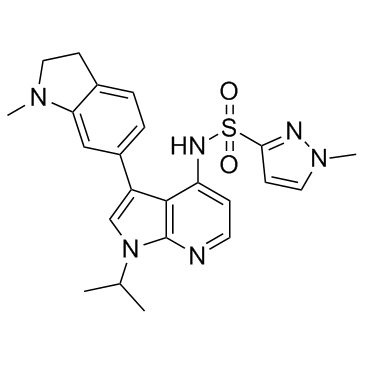
Cas No.: 1415925-18-6
Sample solution is provided at 25 µL, 10mM.
GSK2795039 is a potent inhibitor of NADPH oxidase 2 (NOX2) enzyme with an IC50 value of 0.18μM[1]. GSK2795039 showed antiviral activity against H1N1 influenza A virus both in vitro and in vivo[2]. GSK2795039 has been extensively used to inhibit reactive oxygen species (ROS) formation and utilization of the enzyme substrates NADPH and oxygen in cellular, mouse, and rat models[3].
In vitro, GSK2795039 treatment (25μM) for 24h significantly inhibited cell death of in the presence of 10uM amyloid-beta (Aβ) and reduced Aβ-induced ROS production[4]. Treatment with 20μM GSK2795039 for 16h reversed the enhanced reductive carboxylation in A549 cells after rotenone treatment[5]. GSK2795039 treatment at 100μM for 24 hours increased the phosphorylation of p38-MAPK and inhibited cell viability in FLT3-mutant MV4-11 cells[6].
In vivo, GSK2795039 treatment via twice-daily intragastric gavage (2.5mg/kg) for 38 days improved survival and left ventricular function, suppressed protein expression of Nox2, p22phox, p47phox and p67phox, and alleviated myocardial oxidative stress in mice with doxorubicin-induced cardiomyopathy[7]. Intraperitoneal injection of GSK2795039 at a dose of 100mg/kg/day for 15 days improved cardiac dysfunction and cardiac remodeling and reduced cardiomyocyte apoptosis and collagen deposition in a mouse model of myocardial infarction[8].
References:
[1] Mason H, Rai G, Kozyr A, et al. Development of an improved and specific inhibitor of NADPH oxidase 2 to treat traumatic brain injury[J]. Redox Biology, 2023, 60: 102611.
[2] Xue N, Wang L, Wang B, et al. NOX2 oxidase inhibitor GSK2795039 possess antiviral activity against H1N1 influenza A virus in vitro and vivo[J]. Microbial Pathogenesis, 2023, 174: 105942.
[3]Hirano K, Chen W S, Chueng A L W, et al. Discovery of GSK2795039, a novel small molecule NADPH oxidase 2 inhibitor[J]. Antioxidants & redox signaling, 2015, 23(5): 358-374.
[4] Potapov K V, Platonov D N, Belyy A Y, et al. Improved Synthesis of Effective 3-(Indolin-6-yl)-4-(N-pyrazole-sulfonamide)-1 H-pyrrolo [2, 3-b] pyridine-Based Inhibitors of NADPH Oxidase 2[J]. International Journal of Molecular Sciences, 2025, 26(8): 3647.
[5] Zhang R, Chen D, Fan H, et al. Cellular signals converge at the NOX2-SHP-2 axis to induce reductive carboxylation in cancer cells[J]. Cell chemical biology, 2022, 29(7): 1200-1208. e6.
[6] Germon Z P, Sillar J R, Mannan A, et al. Blockade of ROS production inhibits oncogenic signaling in acute myeloid leukemia and amplifies response to precision therapies[J]. Science Signaling, 2023, 16(778): eabp9586.
[7] Zhang X J, Li L, Wang A L, et al. GSK2795039 prevents RIP1-RIP3-MLKL-mediated cardiomyocyte necroptosis in doxorubicin-induced heart failure through inhibition of NADPH oxidase-derived oxidative stress[J]. Toxicology and applied pharmacology, 2023, 463: 116412.
[8] Liu Y, Wu Z, Ji M, et al. NADPH oxidase 2 inhibitor GSK2795039 prevents against cardiac remodeling after MI through reducing oxidative stress and mitochondrial dysfunction[J]. European Journal of Pharmacology, 2025, 997: 177483.
| Cell experiment [1]: | |
|
Cell lines |
HMC3 cell |
|
Preparation Method |
HMC3 cells were cultured in minimal essential medium (MEM) containing 10% fetal bovine serum, 100U/mL penicillin, 100µg/mL streptomycin, sodium pyruvate, and glutamate. Cells were grown at 37°C in a humidified atmosphere with 5% CO2. HMC3 cells were seeded in 12-well plates and cultured at 37°C for 24 hours. Cells were then treated with Aβ (10µM) in the presence and absence of GSK2795039 (25µM) for 24h, followed by incubation with DHR dye for 15min at 37°C in the dark. Then, the cells were incubated with 10μg/mL propidium iodide (PI) for 1min before flow cytometry analysis. |
|
Reaction Conditions |
25µM; 24h |
|
Applications |
GSK2795039 treatment reduced the cell death of HMC3 cells caused by Aβ. |
| Animal experiment [2]: | |
|
Animal models |
Male C57BL/6J mice |
|
Preparation Method |
Eight-week-old male C57BL/6J mice were randomly divided into three experimental groups: (1) control group (n=9), mice received normal saline (NS)(i.p.); (2) Doxorubicin (DOX) group (n=22), mice received DOX intraperitoneal injection at a cumulative dose of 15mg/kg (2.5mg/kg; once every other day for 6 times); (3) DOX plus GSK2795039 group (n=19), mice received intraperitoneal injection of DOX 15mg/kg (2.5mg/kg; once every other day for 6 times) and intragastric gavage of GSK 2.5mg/kg (twice a day for 38 days) from the second day after DOX injection. Mouse survival rate was recorded, and mouse heart samples were collected for analysis. |
|
Dosage form |
2.5mg/kg twice a day for 38 days; i.g. |
|
Applications |
GSK2795039 treatment improved survival and left ventricular function in mice with DOX-induced cardiomyopathy. |
|
References: |
|
| Cas No. | 1415925-18-6 | SDF | |
| Canonical SMILES | CC(C)N1C=C(C2=CC=C(CCN3C)C3=C2)C4=C1N=CC=C4NS(C5=NN(C)C=C5)(=O)=O | ||
| Formula | C23H26N6O2S | M.Wt | 450.56 |
| Löslichkeit | DMSO : ≥ 32 mg/mL (71.02 mM) | Storage | Store at -20°C |
| General tips | Please select the appropriate solvent to prepare the stock solution according to the
solubility of the product in different solvents; once the solution is prepared, please store it in
separate packages to avoid product failure caused by repeated freezing and thawing.Storage method
and period of the stock solution: When stored at -80°C, please use it within 6 months; when stored
at -20°C, please use it within 1 month. To increase solubility, heat the tube to 37°C and then oscillate in an ultrasonic bath for some time. |
||
| Shipping Condition | Evaluation sample solution: shipped with blue ice. All other sizes available: with RT, or with Blue Ice upon request. | ||
| Prepare stock solution | |||

|
1 mg | 5 mg | 10 mg |
| 1 mM | 2.2195 mL | 11.0973 mL | 22.1946 mL |
| 5 mM | 443.9 μL | 2.2195 mL | 4.4389 mL |
| 10 mM | 221.9 μL | 1.1097 mL | 2.2195 mL |
Step 1: Enter information below (Recommended: An additional animal making an allowance for loss during the experiment)
 g
μL
g
μL
Step 2: Enter the in vivo formulation (This is only the calculator, not formulation. Please contact us first if there is no in vivo formulation at the solubility Section.)
Calculation results:
Working concentration: mg/ml;
Method for preparing DMSO master liquid: mg drug pre-dissolved in μL DMSO ( Master liquid concentration mg/mL, Please contact us first if the concentration exceeds the DMSO solubility of the batch of drug. )
Method for preparing in vivo formulation: Take μL DMSO master liquid, next addμL PEG300, mix and clarify, next addμL Tween 80, mix and clarify, next add μL saline, mix and clarify.
Method for preparing in vivo formulation: Take μL DMSO master liquid, next add μL Corn oil, mix and clarify.
Note: 1. Please make sure the liquid is clear before adding the next solvent.
2. Be sure to add the solvent(s) in order. You must ensure that the solution obtained, in the previous addition, is a clear solution before proceeding to add the next solvent. Physical methods such as vortex, ultrasound or hot water bath can be used to aid dissolving.
3. All of the above co-solvents are available for purchase on the GlpBio website.
Quality Control & SDS
- View current batch:
- Purity: >98.00% Appearance: A solid
- COA (Certificate of Analysis)
- SDS (Safety Data Sheet)
- Datasheet
Average Rating: 5 (Based on Reviews and 14 reference(s) in Google Scholar.)