

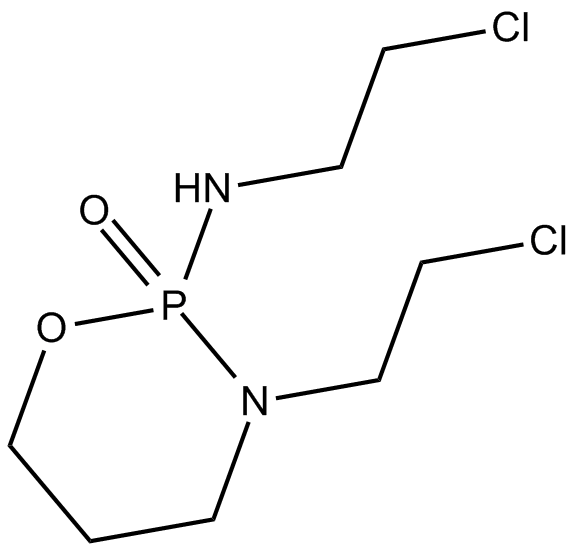
Ifosfamide (Synonyms: Isophosphamide, NSC 109724) |
Katalog-Nr.GC16003
 One-Click Copy Product Info
|

Ifosfamid ist ein alkylierendes Chemotherapeutikum mit AktivitÄt gegen ein breites Spektrum von Tumoren.
Products are for research use only. Not for human use. We do not sell to patients.
Cas No.: 3778-73-2
Sample solution is provided at 25 µL, 10mM.
_1-3.$$$39978408@51.jpg');)
_1-9.$$$38538795@65.jpg');)
_1-9.$$$39112701@51.jpg');)
_1-7.$$$37316672@70.jpg');)
_366-372.$$$36198801@70.jpg');)
.$$$38565142@65.jpg');)
_1867-1883.$$$33248023@67.jpg');)
_eads6055.$$$39977546@45.jpg');)
_eadm9805.$$$40080571@45.jpg');)
_eadj3020.$$$39666821@45.jpg');)
_1-20.$$$39757301@28.jpg');)
_1-24.$$$38898113@28.jpg');)
_273-287.$$$36806353@46.jpg');)
_1-16.$$$37156877@44.jpg');)
_1-19.$$$37460805@44.jpg');)
_1291-1307.$$$34518654@46.jpg');)
Ifosfamide is an alkylating chemotherapeutic agent with activity against a wide range of tumors.
Ifosfamide is an alkylating chemotherapeutic agent with activity against a wide range of tumors[1]. Ifosfamide is activated by the cytochrome P450 family. Ifosfamide (0-5 mM) suppresses the viability of CYP2B1-expressing C8III-1 cells, while it is cytotoxic to the non-CYP2B1-expressing CrFK cells only at high concentration (5 mM)[2]. CYP BM3 mutants activates Ifosfamide, and Ifosfamide shows inhibitory activity against human U2OS cells[3].
Ifosfamide (50 mg/kg, i.p.) treatment before mating increases percentage of post-implantation loss and resorbs fetuses in pregnant rats. Ifosfamide also (50 mg/kg, i.p.) decreases the progesterone in the serum of pregnant rats. However, Ifosfamide causes no obvious difference with the control rats at 25 mg/kg. Ifosfamide (25, 50 mg/kg, i.p.) induces apoptosis and histological changes in the placentas and prenatal rats, most sensitive fetal organs are the brain, liver and kidney[1].
References:
[1]. Helal M. Prenatal effects of transplacental exposure to ifosfamide in rats. Biotech Histochem. 2016 Jul;91(5):357-68.
[2]. Karle P, et al. Necrotic, rather than apoptotic, cell death caused by cytochrome P450-activated ifosfamide. Cancer Gene Ther. 2001 Mar;8(3):220-30.
[3]. Vredenburg G, et al. Activation of the anticancer drugs cyclophosphamide and ifosfamide by cytochrome P450 BM3 mutants. Toxicol Lett. 2015 Jan 5;232(1):182-92.
Cell experiment: | In a 3-cm dish, 4 × 10⁴ cells are seeded in 2 mL of medium. The next day, Ifosfamide is added to final concentrations from 0 to 5 mM. After six additional days the medium is removed, the cells washed with PBS, and either stained or counted[2]. |
Animal experiment: | Rats[1]Prior to mating, female rats are divided into four groups of eight: group 1, untreated negative controls; group 2, rats injected i.p. with 1 mL 0.9% NaCl; group 3, rats injected i.p. with 25 mg/kg Ifosfamide; group 4, rats injected i.p. with 50 mg/kg Ifosfamide. After injection of Ifosfamide once daily for 5 consecutive days, three females are placed in a cage with one untreated male for up to 1 week. Vaginal smears are examined daily to determine pregnancy. The first 24 h period following mating is designated day one of pregnancy if sperm are detected. The pregnant females are housed singly and observed daily for signs of toxicity and abortion. All pregnant animals are sacrificed by decapitation on day 18 of gestation. Cardiac blood (2.5 -3 mL/rat) is collected in nonheparinized test tubes, centrifuged at 3,000× g for 30 min and the serum is decanted and stored at -70°C until used for hormone assay. After blood collection, uteri and both ovaries are removed, washed in saline solution and the corpora lutea of pregnancy are counted visually, and the number of implantation sites, resorption sites and viable fetuses are counted in each uterine horn. Each fetus is removed from its umbilical cord, weighed and the crown rump (CR) length is measured. Fetuses are examined for external malformation and the placental weights are recorded. Fetuses and placentas of control and treated groups are fixed in 10% neutral buffered formalin for immunohistochemical and histological examination[1]. |
References: [1]. Helal M. Prenatal effects of transplacental exposure to ifosfamide in rats. Biotech Histochem. 2016 Jul;91(5):357-68. | |
| Cas No. | 3778-73-2 | SDF | |
| Überlieferungen | Isophosphamide, NSC 109724 | ||
| Chemical Name | N,3-bis(2-chloroethyl)-2-oxo-1,3,2λ5-oxazaphosphinan-2-amine | ||
| Canonical SMILES | C1CN(P(=O)(OC1)NCCCl)CCCl | ||
| Formula | C7H15Cl2N2O2P | M.Wt | 261.09 |
| Löslichkeit | ≥ 13.05mg/mL in DMSO | Storage | 4°C, protect from light ,unstable in solution, ready to use. |
| General tips | Please select the appropriate solvent to prepare the stock solution according to the
solubility of the product in different solvents; once the solution is prepared, please store it in
separate packages to avoid product failure caused by repeated freezing and thawing.Storage method
and period of the stock solution: When stored at -80°C, please use it within 6 months; when stored
at -20°C, please use it within 1 month. To increase solubility, heat the tube to 37°C and then oscillate in an ultrasonic bath for some time. |
||
| Shipping Condition | Evaluation sample solution: shipped with blue ice. All other sizes available: with RT, or with Blue Ice upon request. | ||
| Prepare stock solution | |||

|
1 mg | 5 mg | 10 mg |
| 1 mM | 3.8301 mL | 19.1505 mL | 38.301 mL |
| 5 mM | 766 μL | 3.8301 mL | 7.6602 mL |
| 10 mM | 383 μL | 1.915 mL | 3.8301 mL |
Step 1: Enter information below (Recommended: An additional animal making an allowance for loss during the experiment)
 g
μL
g
μL
Step 2: Enter the in vivo formulation (This is only the calculator, not formulation. Please contact us first if there is no in vivo formulation at the solubility Section.)
Calculation results:
Working concentration: mg/ml;
Method for preparing DMSO master liquid: mg drug pre-dissolved in μL DMSO ( Master liquid concentration mg/mL, Please contact us first if the concentration exceeds the DMSO solubility of the batch of drug. )
Method for preparing in vivo formulation: Take μL DMSO master liquid, next addμL PEG300, mix and clarify, next addμL Tween 80, mix and clarify, next add μL saline, mix and clarify.
Method for preparing in vivo formulation: Take μL DMSO master liquid, next add μL Corn oil, mix and clarify.
Note: 1. Please make sure the liquid is clear before adding the next solvent.
2. Be sure to add the solvent(s) in order. You must ensure that the solution obtained, in the previous addition, is a clear solution before proceeding to add the next solvent. Physical methods such as vortex, ultrasound or hot water bath can be used to aid dissolving.
3. All of the above co-solvents are available for purchase on the GlpBio website.
Quality Control & SDS
- View current batch:
- Purity: >98.00% Appearance: A solid
- COA (Certificate of Analysis)
- SDS (Safety Data Sheet)
- Datasheet
Average Rating: 5 (Based on Reviews and 32 reference(s) in Google Scholar.)