

KRAS inhibitor-9 |
Katalog-Nr.GC60969
 One-Click Copy Product Info
|

KRAS-Inhibitor-9, ein potenter KRAS-Inhibitor (Kd = 92 μM), blockiert die Bildung von GTP-KRAS und die nachgeschaltete Aktivierung von KRAS. KRAS-Inhibitor-9 bindet mit mÄßiger BindungsaffinitÄt an KRAS G12D-, KRAS G12C- und KRAS Q61H-Protein. KRAS-Inhibitor-9 verursacht einen Stopp des G2/M-Zellzyklus und induziert Apoptose. KRAS-Inhibitor-9 hemmt selektiv die Proliferation von NSCLC-Zellen mit KRAS-Mutation, aber nicht von normalen Lungenzellen.
Products are for research use only. Not for human use. We do not sell to patients.
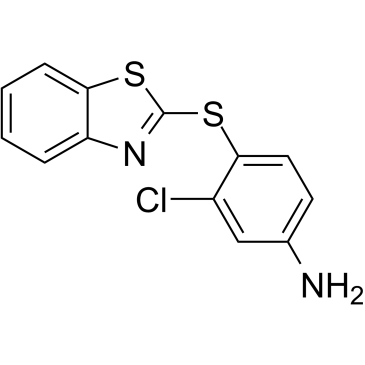
Cas No.: 300809-71-6
Sample solution is provided at 25 µL, 10mM.
_1-3.$$$39978408@51.jpg');)
_1-9.$$$38538795@65.jpg');)
_1-9.$$$39112701@51.jpg');)
_1-7.$$$37316672@70.jpg');)
_366-372.$$$36198801@70.jpg');)
.$$$38565142@65.jpg');)
_1867-1883.$$$33248023@67.jpg');)
_eads6055.$$$39977546@45.jpg');)
_eadm9805.$$$40080571@45.jpg');)
_eadj3020.$$$39666821@45.jpg');)
_1-20.$$$39757301@28.jpg');)
_1-24.$$$38898113@28.jpg');)
_273-287.$$$36806353@46.jpg');)
_1-16.$$$37156877@44.jpg');)
_1-19.$$$37460805@44.jpg');)
_1291-1307.$$$34518654@46.jpg');)
KRAS inhibitor-9, a potent KRAS inhibitor (Kd=92 μM), blocks the formation of GTP-KRAS and downstream activation of KRAS. KRAS inhibitor-9 binds to KRAS G12D, KRAS G12C and KRAS Q61H protein with a moderate binding affinity. KRAS inhibitor-9 causes G2/M cell cycle arrest and induces apoptosis. KRAS inhibitor-9 selectively inhibits the proliferation of NSCLC cells with KRAS mutation but not normal lung cells[1].
KRAS inhibitor-9 bound to KRASG12D, KRAS G12C and KRAS Q61H protein with a moderate binding affinity of -5.38, -5.41, and -3.97 kcal/mol, respectively[1]. KRAS inhibitor-9 (0-100 μM) shows strong inhibition selectivity in NSCLC cells with IC50s ranging from 39.56 to 66.02 μM for H2122, H358 and H460 cells (at 72 hours)[1].KRAS inhibitor-9 (0-100 μM; 24 hours) blocks GTP-KRAS formation in H2122, H358 and H460 cells[1].KRAS inhibitor-9 (25-100 μM; 48 hours) inhibits the activation of KRAS downstream signaling pathway[1].KRAS inhibitor-9 (0-100 μM; 24-72 hours) induces cell cycle arrest and apoptosis in NSCLC[1]. Cell Viability Assay[1] Cell Line: H2122 (KRAS G12C), H358 (KRAS G12C) and H460 (KRAS Q61H) cell lines
[1]. Xie C, et al. Identification of a New Potent Inhibitor Targeting KRAS in Non-small Cell Lung Cancer Cells. Front Pharmacol. 2017;8:823. Published 2017 Nov 14.
| Cas No. | 300809-71-6 | SDF | |
| Canonical SMILES | NC1=CC=C(SC2=NC3=CC=CC=C3S2)C(Cl)=C1 | ||
| Formula | C13H9ClN2S2 | M.Wt | 292.81 |
| Löslichkeit | DMSO: 250 mg/mL (853.80 mM) | Storage | Store at -20°C |
| General tips | Please select the appropriate solvent to prepare the stock solution according to the
solubility of the product in different solvents; once the solution is prepared, please store it in
separate packages to avoid product failure caused by repeated freezing and thawing.Storage method
and period of the stock solution: When stored at -80°C, please use it within 6 months; when stored
at -20°C, please use it within 1 month. To increase solubility, heat the tube to 37°C and then oscillate in an ultrasonic bath for some time. |
||
| Shipping Condition | Evaluation sample solution: shipped with blue ice. All other sizes available: with RT, or with Blue Ice upon request. | ||
| Prepare stock solution | |||

|
1 mg | 5 mg | 10 mg |
| 1 mM | 3.4152 mL | 17.0759 mL | 34.1518 mL |
| 5 mM | 683 μL | 3.4152 mL | 6.8304 mL |
| 10 mM | 341.5 μL | 1.7076 mL | 3.4152 mL |
Step 1: Enter information below (Recommended: An additional animal making an allowance for loss during the experiment)
 g
μL
g
μL
Step 2: Enter the in vivo formulation (This is only the calculator, not formulation. Please contact us first if there is no in vivo formulation at the solubility Section.)
Calculation results:
Working concentration: mg/ml;
Method for preparing DMSO master liquid: mg drug pre-dissolved in μL DMSO ( Master liquid concentration mg/mL, Please contact us first if the concentration exceeds the DMSO solubility of the batch of drug. )
Method for preparing in vivo formulation: Take μL DMSO master liquid, next addμL PEG300, mix and clarify, next addμL Tween 80, mix and clarify, next add μL saline, mix and clarify.
Method for preparing in vivo formulation: Take μL DMSO master liquid, next add μL Corn oil, mix and clarify.
Note: 1. Please make sure the liquid is clear before adding the next solvent.
2. Be sure to add the solvent(s) in order. You must ensure that the solution obtained, in the previous addition, is a clear solution before proceeding to add the next solvent. Physical methods such as vortex, ultrasound or hot water bath can be used to aid dissolving.
3. All of the above co-solvents are available for purchase on the GlpBio website.
Quality Control & SDS
- View current batch:
- Purity: >99.50% Appearance: A solid
- COA (Certificate of Analysis)
- SDS (Safety Data Sheet)
- Datasheet
Average Rating: 5 (Based on Reviews and 33 reference(s) in Google Scholar.)