

L-Thyroxine (Synonyms: Levothyroxine, LT4, NSC 36397) |
Katalog-Nr.GC11268
 One-Click Copy Product Info
|

L-Thyroxin (Levothyroxin; T4) ist ein synthetisches Hormon zur Erforschung der Hypothyreose.
Products are for research use only. Not for human use. We do not sell to patients.
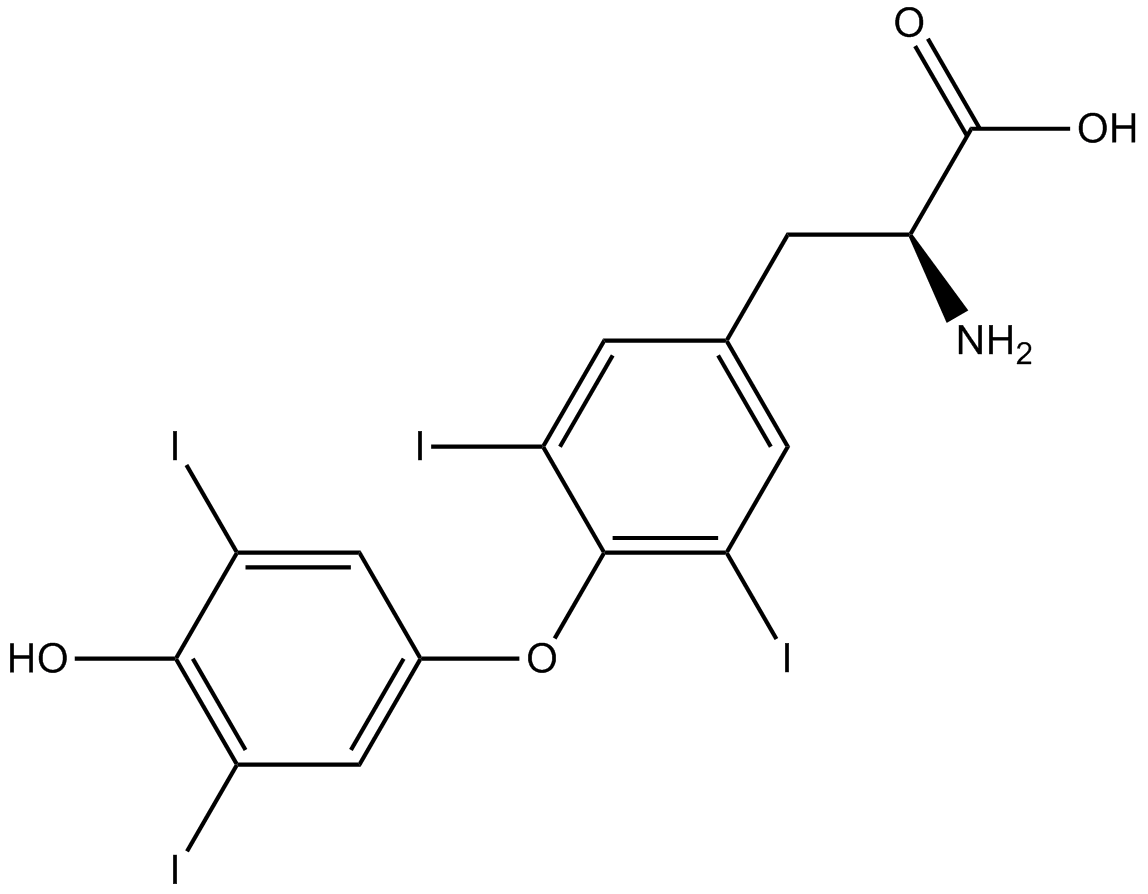
Cas No.: 51-48-9
Sample solution is provided at 25 µL, 10mM.
_1-3.$$$39978408@51.jpg');)
_1-9.$$$38538795@65.jpg');)
_1-9.$$$39112701@51.jpg');)
_1-7.$$$37316672@70.jpg');)
_366-372.$$$36198801@70.jpg');)
.$$$38565142@65.jpg');)
_1867-1883.$$$33248023@67.jpg');)
_eads6055.$$$39977546@45.jpg');)
_eadm9805.$$$40080571@45.jpg');)
_eadj3020.$$$39666821@45.jpg');)
_1-20.$$$39757301@28.jpg');)
_1-24.$$$38898113@28.jpg');)
_273-287.$$$36806353@46.jpg');)
_1-16.$$$37156877@44.jpg');)
_1-19.$$$37460805@44.jpg');)
_1291-1307.$$$34518654@46.jpg');)
L-Thyroxine is a synthetic thyroid hormone that mimics the natural thyroxine secreted by the thyroid gland and plays a crucial role in regulating metabolism and promoting growth and development[1]. L-Thyroxine is commonly used to treat hypothyroidism and other thyroid-related diseases[2]. Additionally, L-Thyroxine is used in diagnostic tests for thyroid function[3] and has been shown to protect myocardial function[4].
In vitro, treatment of U2OS and MG63 osteoblast-like cells with L-Thyroxine (2.5–10μM) for 1 hour significantly increased the expression of Angiopoietin-1 (Ang1) in a dose-dependent manner. L-Thyroxine also significantly enhanced alkaline phosphatase (ALP) activity and cell mineralization capacity. Moreover, it significantly upregulated the expression of osteoblast-related protein markers, such as COL1A1, OC, BSP, Dlx5, Runx2, and OSX[5]. When human bronchial smooth muscle cells (ASM) were treated with L-Thyroxine (1–100nM) in combination with TGF-β1 (2ng/ml) for 28 hours, L-Thyroxine (100nM) significantly enhanced the proliferative response of ASM cells and reduced the expression of contractile proteins induced by TGF-β1 [6].
In vivo, L-Thyroxine (1μg/kg) was administered subcutaneously to mice, which were then exposed to gamma radiation (6Gy) or intraperitoneally injected with cisplatin (15mg/kg) to induce nephrotoxicity. L-Thyroxine significantly improved elevated renal function biomarkers, oxidative stress, and protected renal tissue from subsequent cellular damage[7]. In Ames dwarf mice, L-Thyroxine (0.1μg/g) in combination with growth hormone (GH, 6μg/g) was administered via subcutaneous injection twice a week starting at 2 weeks of age for 6 weeks. This treatment significantly promoted the growth of Ames dwarf mice[8].
References:
[1] Darbinyan L, Simonyan K, Hambardzumyan L, et al. Impact of L-thyroxine on hippocampal activity, morphology, and behavioral performance in thyroidectomized rats. Metab Brain Dis. 2025 Mar 10;40(3):140.
[2] McDermott MT. Hypothyroidism. Ann Intern Med. 2020 Jul 7;173(1):ITC1-ITC16.
[3] Fugazzola L, Persani L, Mannavola D, et al. Recombinant human TSH testing is a valuable tool for differential diagnosis of congenital hypothyroidism during L-thyroxine replacement. Clin Endocrinol (Oxf). 2003 Aug;59(2):230-6.
[4] Wang Y, Zhu S, Liu H, et al. Thyroxine Alleviates Energy Failure, Prevents Myocardial Cell Apoptosis, and Protects against Doxorubicin-Induced Cardiac Injury and Cardiac Dysfunction via the LKB1/AMPK/mTOR Axis in Mice. Dis Markers. 2019 Dec 16;2019:7420196.
[5] Park SH, Lee J, Kang MA, et al. Potential of l-thyroxine to differentiate osteoblast-like cells via Angiopoietin1. Biochem Biophys Res Commun. 2016 Sep 23;478(3):1409-15.
[6] Dekkers BG, Naeimi S, Bos IS, et al. L-thyroxine promotes a proliferative airway smooth muscle phenotype in the presence of TGF-β1. Am J Physiol Lung Cell Mol Physiol. 2015 Feb 1;308(3):L301-6.
[7] El-Hamoly T, El-Sharawy DM, El Refaye MS, et al. L-thyroxine modifies nephrotoxicity by regulating the apoptotic pathway: The possible role of CD38/ADP-ribosyl cyclase-mediated calcium mobilization. PLoS One. 2017 Sep 11;12(9):e0184157.
[8] Do A, Menon V, Zhi X, Gesing A, et al. Thyroxine modifies the effects of growth hormone in Ames dwarf mice. Aging (Albany NY). 2015 Apr;7(4):241-55.
| Cell experiment [1]: | |
Cell lines | Human airway smooth muscle (ASM) cells |
Preparation Method | ASM cells were cultured in Dulbecco's modified Eagle's medium (DMEM) supplemented with streptomycin (50U/ml), penicillin (50µg/ml), and fetal bovine serum (10% vol/vol) at 37°C, 5% CO₂. Cells were serum-starved for 72 hours in serum-free DMEM supplemented with streptomycin, penicillin, and 1% ITS (insulin, transferrin, selenium) before treatment. Cell treated with L-Thyroxine (T4) at 100nM in combination with TGF-β1 (2ng/ml) for 28 hours. |
Reaction Conditions | 100nM; 28h |
Applications | L-Thyroxine significantly increased ASM cell proliferation in the presence of TGF-β1. L-Thyroxine also decreased the expression of contractile proteins (smooth muscle α-actin and calponin) in TGF-β1-treated cultures. |
| Animal experiment [1]: | |
Animal models | Ames dwarf (df/df) mice |
Preparation Method | Juvenile Ames dwarf mice (both male and female) were treated with a combination of growth hormone (GH, 6μg/g body weight) and L-Thyroxine (0.1μg/g body weight) via subcutaneous injections. GH was administered twice daily, while L-Thyroxine was given three times per week. The treatment started at 2 weeks of age and continued for 6 weeks. |
Dosage form | 0.1μg/g body weight; subcutaneous injections |
Applications | The combination treatment with GH and L-Thyroxine significantly increased body weight in Ames dwarf mice. GH + L-Thyroxine treatment reduced the expression of genes such as insulin receptor (IR), insulin receptor substrate-1 (IRS-1), phosphoinositide 3-kinase (PI3K), and GLUT4 in these tissues, compared to GH alone. |
References: | |
| Cas No. | 51-48-9 | SDF | |
| Überlieferungen | Levothyroxine, LT4, NSC 36397 | ||
| Chemical Name | (2S)-2-amino-3-[4-(4-hydroxy-3,5-diiodophenoxy)-3,5-diiodophenyl]propanoic acid | ||
| Canonical SMILES | C1=C(C=C(C(=C1I)OC2=CC(=C(C(=C2)I)O)I)I)CC(C(=O)O)N | ||
| Formula | C15H11I4NO4 | M.Wt | 776.87 |
| Löslichkeit | ≥ 27.35mg/mL in DMSO | Storage | Store at 2-8°C |
| General tips | Please select the appropriate solvent to prepare the stock solution according to the
solubility of the product in different solvents; once the solution is prepared, please store it in
separate packages to avoid product failure caused by repeated freezing and thawing.Storage method
and period of the stock solution: When stored at -80°C, please use it within 6 months; when stored
at -20°C, please use it within 1 month. To increase solubility, heat the tube to 37°C and then oscillate in an ultrasonic bath for some time. |
||
| Shipping Condition | Evaluation sample solution: shipped with blue ice. All other sizes available: with RT, or with Blue Ice upon request. | ||
| Prepare stock solution | |||

|
1 mg | 5 mg | 10 mg |
| 1 mM | 1.2872 mL | 6.4361 mL | 12.8722 mL |
| 5 mM | 257.4 μL | 1.2872 mL | 2.5744 mL |
| 10 mM | 128.7 μL | 643.6 μL | 1.2872 mL |
Step 1: Enter information below (Recommended: An additional animal making an allowance for loss during the experiment)
 g
μL
g
μL
Step 2: Enter the in vivo formulation (This is only the calculator, not formulation. Please contact us first if there is no in vivo formulation at the solubility Section.)
Calculation results:
Working concentration: mg/ml;
Method for preparing DMSO master liquid: mg drug pre-dissolved in μL DMSO ( Master liquid concentration mg/mL, Please contact us first if the concentration exceeds the DMSO solubility of the batch of drug. )
Method for preparing in vivo formulation: Take μL DMSO master liquid, next addμL PEG300, mix and clarify, next addμL Tween 80, mix and clarify, next add μL saline, mix and clarify.
Method for preparing in vivo formulation: Take μL DMSO master liquid, next add μL Corn oil, mix and clarify.
Note: 1. Please make sure the liquid is clear before adding the next solvent.
2. Be sure to add the solvent(s) in order. You must ensure that the solution obtained, in the previous addition, is a clear solution before proceeding to add the next solvent. Physical methods such as vortex, ultrasound or hot water bath can be used to aid dissolving.
3. All of the above co-solvents are available for purchase on the GlpBio website.
Quality Control & SDS
- View current batch:
- Purity: >98.00% Appearance: A solid
- COA (Certificate of Analysis)
- SDS (Safety Data Sheet)
- Datasheet
Average Rating: 5 (Based on Reviews and 18 reference(s) in Google Scholar.)