

Methimazole (Synonyms: NSC 38608) |
Katalog-Nr.GC10416
 One-Click Copy Product Info
|

Methimazol ist ein Thyreostatikum, das hÄufig fÜr die Erforschung von Hyperthyreose verwendet wird.
Products are for research use only. Not for human use. We do not sell to patients.
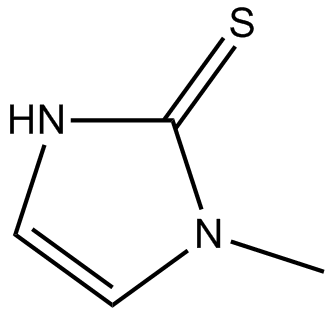
Cas No.: 60-56-0
Sample solution is provided at 25 µL, 10mM.
_1-3.$$$39978408@51.jpg');)
_1-9.$$$38538795@65.jpg');)
_1-9.$$$39112701@51.jpg');)
_1-7.$$$37316672@70.jpg');)
_366-372.$$$36198801@70.jpg');)
.$$$38565142@65.jpg');)
_1867-1883.$$$33248023@67.jpg');)
_eads6055.$$$39977546@45.jpg');)
_eadm9805.$$$40080571@45.jpg');)
_eadj3020.$$$39666821@45.jpg');)
_1-20.$$$39757301@28.jpg');)
_1-24.$$$38898113@28.jpg');)
_273-287.$$$36806353@46.jpg');)
_1-16.$$$37156877@44.jpg');)
_1-19.$$$37460805@44.jpg');)
_1291-1307.$$$34518654@46.jpg');)
Methimazole is an antithyroid agent and has anti-inflammatory activity, with an IC50 value of 10µM for inhibiting prostaglandin H synthase [1]. Methimazole prevents oxidation and tyrosine coupling of iodide absorbed into the thyroid gland, which in turn inhibits thyroxine synthesis [2]. Methimazole has been widely used to regulate the mitochondrial function of liver cells and to reduce the level of glutathione[3].
In vitro, Methimazole treatment (40mM) for 48 hours significantly inhibited the viability of PANC-1 cells and increased the production of reactive oxygen species (ROS)[4]. Treatment with 2mM Methimazole for 24 hours significantly caused S-phase arrest in FRTL5 thyroid cells[5]. Treatment with 10mM Methimazole for 3 days significantly increased the sensitivity of thyroid epithelial cells (TECs) to H2O2, promoted cell apoptosis, and caused irregular shapes of the cell nuclei[6].
In vivo, Methimazole treatment via a single intraperitoneal injection at a dose of 400mg/kg for 5 hours significantly induced a decrease in the liver mitochondrial membrane potential of the mice, and reduced the contents of ATP and glutathione in the liver mitochondria[7]. Administering 60mg/kg of Methimazole orally daily for 4 weeks resulted in a decrease in rectal temperature and body weight in Wistar rats and caused cell damage in the liver, kidneys, spleen, and heart[8].
References:
[1] Lagorce J F, Moulard T, Rousseau A, et al. Anti-inflammatory action of methimazole[J]. Pharmacology, 1997, 55(4): 173-178.
[2] Liu Y, Li Q, Xu Y, et al. Comparison of the safety between propylthiouracil and methimazole with hyperthyroidism in pregnancy: A systematic review and meta-analysis[J]. PLoS One, 2023, 18(5): e0286097.
[3] Heidari R, Babaei H, Eghbal M. Mechanisms of methimazole cytotoxicity in isolated rat hepatocytes[J]. Drug and chemical toxicology, 2013, 36(4): 403-411.
[4] Yazıcı Ö, Kara M, Boran T, et al. The role of endoplasmic reticulum stress in cell injury induced by methimazole on pancreatic cells[J]. Advanced pharmaceutical bulletin, 2022, 13(1): 196.
[5] Smerdely P, Pitsiavas V, Boyages S C. Methimazole inhibits FRTL5 thyroid cell proliferation by inducing S-phase arrest of the cell cycle[J]. Endocrinology, 1993, 133(5): 2403-2406.
[6] Landex N L, Thomsen J, Kayser L. Methimazole increases H2O2 toxicity in human thyroid epithelial cells[J]. Acta histochemica, 2006, 108(6): 431-439.
[7] Niknahad H, Jamshidzadeh A, Heidari R, et al. Paradoxical effect of methimazole on liver mitochondria: in vitro and in vivo[J]. Toxicology letters, 2016, 259: 108-115.
[8] Cano-Europa E, Blas-Valdivia V, Franco-Colin M, et al. Methimazole-induced hypothyroidism causes cellular damage in the spleen, heart, liver, lung and kidney[J]. Acta histochemica, 2011, 113(1): 1-5.
| Cell experiment [1]: | |
Cell lines | PANC-1 cells |
Preparation Method | PANC-1 cells were grown in Dulbecco's Modified Eagle Medium (DMEM) with 10% (v/v) fetal bovine serum (FBS), 100μg/ml streptomycin, and 100U/ml penicillin at 37°C in 5% CO2/atmosphere. PANC-1 cells (1×10⁴) were seeded into each well of a 96-well plate for 24h. For cytotoxicity assessment, different concentrations of Methimazole (0, 10, 20, 40, 100, and 200mM) were used for 48h exposure. The medium was used for control. After 48 hours exposure, the cell viability was analyzed. |
Reaction Conditions | 0, 10, 20, 40, 100, and 200mM; 48h |
Applications | Methimazole treatment significantly decreased the cell viability of PANC-1 cells in a dose-dependent manner. |
| Animal experiment [2]: | |
Animal models | Male Wistar rats |
Preparation Method | Male Wistar rats were housed singly in 20cm×30cm×18cm metal cages with food and water ad libitum. The cages were located together in racks (to maintain auditory and olfactory contact) in a light (08:00-20:00 light on) and temperature (21±1°C) controlled room. The rats were allowed to acclimatize to the colony-room conditions for at least 1 week before starting the experiments. Rats received 60mg/kg/day of Methimazole in drinking water daily for 4 weeks. The spleen, heart, liver, lung, and kidney of rats were removed for analysis. |
Dosage form | 60mg/kg/day for 4 weeks; p.o. |
Applications | Methimazole treatment significantly caused cellular damage in the liver, kidneys, spleen, and heart in rats. |
References: | |
| Cas No. | 60-56-0 | SDF | |
| Überlieferungen | NSC 38608 | ||
| Chemical Name | 3-methyl-1H-imidazole-2-thione | ||
| Canonical SMILES | CN1C=CNC1=S | ||
| Formula | C4H6N2S | M.Wt | 114.17 |
| Löslichkeit | ≥ 5.8mg/mL in DMSO | Storage | Store at -20°C |
| General tips | Please select the appropriate solvent to prepare the stock solution according to the
solubility of the product in different solvents; once the solution is prepared, please store it in
separate packages to avoid product failure caused by repeated freezing and thawing.Storage method
and period of the stock solution: When stored at -80°C, please use it within 6 months; when stored
at -20°C, please use it within 1 month. To increase solubility, heat the tube to 37°C and then oscillate in an ultrasonic bath for some time. |
||
| Shipping Condition | Evaluation sample solution: shipped with blue ice. All other sizes available: with RT, or with Blue Ice upon request. | ||
| Prepare stock solution | |||

|
1 mg | 5 mg | 10 mg |
| 1 mM | 8.7589 mL | 43.7943 mL | 87.5887 mL |
| 5 mM | 1.7518 mL | 8.7589 mL | 17.5177 mL |
| 10 mM | 875.9 μL | 4.3794 mL | 8.7589 mL |
Step 1: Enter information below (Recommended: An additional animal making an allowance for loss during the experiment)
 g
μL
g
μL
Step 2: Enter the in vivo formulation (This is only the calculator, not formulation. Please contact us first if there is no in vivo formulation at the solubility Section.)
Calculation results:
Working concentration: mg/ml;
Method for preparing DMSO master liquid: mg drug pre-dissolved in μL DMSO ( Master liquid concentration mg/mL, Please contact us first if the concentration exceeds the DMSO solubility of the batch of drug. )
Method for preparing in vivo formulation: Take μL DMSO master liquid, next addμL PEG300, mix and clarify, next addμL Tween 80, mix and clarify, next add μL saline, mix and clarify.
Method for preparing in vivo formulation: Take μL DMSO master liquid, next add μL Corn oil, mix and clarify.
Note: 1. Please make sure the liquid is clear before adding the next solvent.
2. Be sure to add the solvent(s) in order. You must ensure that the solution obtained, in the previous addition, is a clear solution before proceeding to add the next solvent. Physical methods such as vortex, ultrasound or hot water bath can be used to aid dissolving.
3. All of the above co-solvents are available for purchase on the GlpBio website.
Quality Control & SDS
- View current batch:
- Purity: >99.50% Appearance: A solid
- COA (Certificate of Analysis)
- SDS (Safety Data Sheet)
- Datasheet
Average Rating: 5 (Based on Reviews and 17 reference(s) in Google Scholar.)