

MRT68921 |
Katalog-Nr.GC14086
 One-Click Copy Product Info
|

MRT68921 ist ein potenter Inhibitor von ULK1 und ULK2 mit IC50-Werten von 2,9 nM bzw. 1,1 nM.
Products are for research use only. Not for human use. We do not sell to patients.
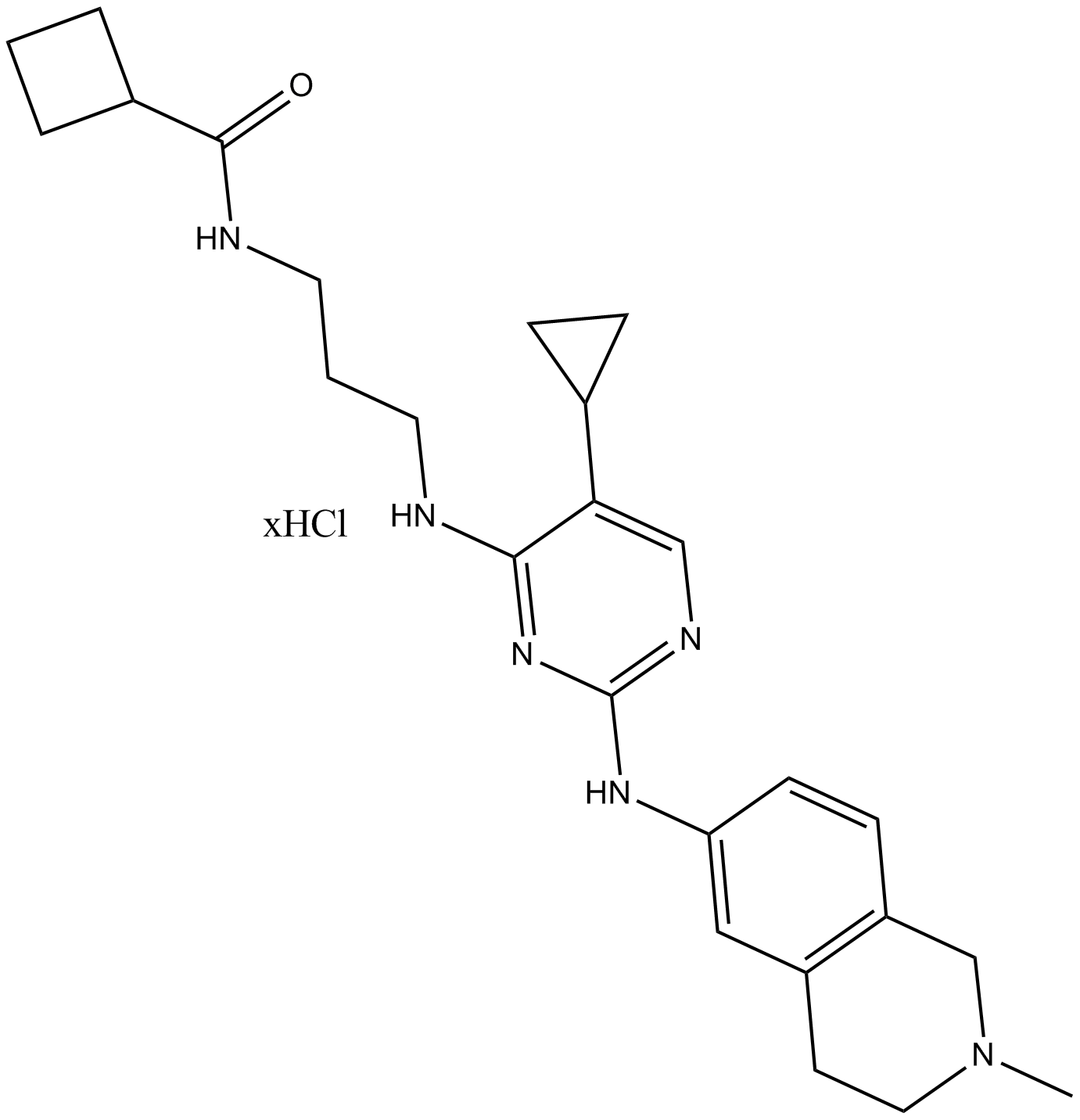
Cas No.: 1190379-70-4
Sample solution is provided at 25 µL, 10mM.
_1-3.$$$39978408@51.jpg');)
_1-9.$$$38538795@65.jpg');)
_1-9.$$$39112701@51.jpg');)
_1-7.$$$37316672@70.jpg');)
_366-372.$$$36198801@70.jpg');)
.$$$38565142@65.jpg');)
_1867-1883.$$$33248023@67.jpg');)
_eads6055.$$$39977546@45.jpg');)
_eadm9805.$$$40080571@45.jpg');)
_eadj3020.$$$39666821@45.jpg');)
_1-20.$$$39757301@28.jpg');)
_1-24.$$$38898113@28.jpg');)
_273-287.$$$36806353@46.jpg');)
_1-16.$$$37156877@44.jpg');)
_1-19.$$$37460805@44.jpg');)
_1291-1307.$$$34518654@46.jpg');)
MRT68921 is a potent dual inhibitor of ULK1 and ULK2 with IC50 values of 2.9nM and 1.1nM, respectively [1]. MRT68921 can induce the lipidation of LC3-II, the formation of GFP/LC3 aggregates, leading to an increase in the phosphorylation level of AMPKα (T712) and promoting cellular apoptosis [2]. MRT68921 has been widely used to inhibit the growth of cancer cells and to develop new combined therapies for the elimination of tumor cells[3].
In vitro, MRT68921 treatment for 20 hours significantly inhibited the viability of THP-1 cells and HL60, with the IC50 values being 3.6μM and 2.6μM, respectively[4]. Treatment with 10μM MRT68921 for 12 hours can induce spindle microtubule disarray and abnormal mitosis in HeLa cells[5]. Treatment with 2μM MRT68921 for 24 hours inhibited autophagy in serum-starved p53−/− mouse embryonic stem cells (mESCs) and increased caspase activity[6].
In vivo, MRT68921 treatment via intravenous injection at a dose of 20mg/kg/day for 7 consecutive days significantly inhibited the metastasis of cancer cells in the 4T1 murine breast cancer model, reduced tumor burden, and improved the survival rate of the mice[7]. Intraperitoneal injection of MRT68921 twice a week at a dose of 20mg/kg, in combination with SAR405 (20mg/kg; i.p.) and paclitaxel (5mg/kg; i.p.) for 21 days, significantly inhibited tumor growth in the MDA-MB231 xenograft mouse model [8].
References:
[1] Petherick K J, Conway O J L, Mpamhanga C, et al. Pharmacological inhibition of ULK1 kinase blocks mammalian target of rapamycin (mTOR)-dependent autophagy[J]. Journal of Biological Chemistry, 2015, 290(18): 11376-11383.
[2] Jang J, Jeung H, Seol S Y, et al. Inhibition of Unc-51-like Kinase 1 (ULK1) with novel small molecular inhibitor MRT68921 preferentially induces apoptosis and autophagy in FLT3-ITD-mutated acute myeloid leukemia[J]. Blood, 2018, 132: 3499.
[3] Xu Z, Bao J, Jin X, et al. The effects of cinobufagin on hepatocellular carcinoma cells enhanced by MRT68921, an autophagy inhibitor[J]. The American Journal of Chinese Medicine, 2023, 51(06): 1595-1611.
[4] Yang W, Li Y, Liu S, et al. Inhibition of ULK1 promotes the death of leukemia cell in an autophagy irrelevant manner and exerts the antileukemia effect[J]. Clinical and Translational Medicine, 2021, 11(1): e282.
[5] Ji X, Zhang X, Li Z. ULK1 inhibitor induces spindle microtubule disorganization and inhibits phosphorylation of Ser10 of histone H3[J]. FEBS open bio, 2020, 10(11): 2452-2463.
[6] Vorobev M L, Alhasan B A, Suvorova I I. The upregulation of Ulk1-dependent autophagy does not require the p53 activity in mouse embryonic stem cells[J]. Biochemical and biophysical research communications, 2021, 552: 78-83.
[7] Chen Y, Xie X, Wang C, et al. Dual targeting of NUAK1 and ULK1 using the multitargeted inhibitor MRT68921 exerts potent antitumor activities[J]. Cell death & disease, 2020, 11(8): 712.
[8] Abd El-Aziz Y S, du Toit-Thompson T, McKay M J, et al. Novel combinatorial autophagy inhibition therapy for triple negative breast cancers[J]. European Journal of Pharmacology, 2024, 973: 176568.
| Cell experiment [1]: | |
Cell lines | HeLa cells |
Preparation Method | HeLa cells were cultured in DMEM medium supplemented with 10% fetal bovine serum (FBS), 2mM GlutaMAX, and 1% penicillin-streptomycin at 37℃ in the presence of 5% CO2. Cells were seeded at 1×10³ cells/well in a 96-well flat-bottomed plate for 24h, treated with varying concentrations of MRT68921 (0, 1, 5, 10, 20, 50, and 100µM) and incubated for an additional 24h, then analyzed the cell viability. |
Reaction Conditions | 0, 1, 5, 10, 20, 50, and 100µM; 24h |
Applications | MRT68921 treatment significantly reduced the cell viability of HeLa cells in a dose-dependent manner. |
| Animal experiment [2]: | |
Animal models | BALB/c mice |
Preparation Method | BALB/c mice (5-week-old) were at constant room temperature with a 12h light/12h dark cycle and fed a standard rodent diet and water. 4T1 cells were harvested and injected intravenously (2×10⁵ cells in 100μl of PBS) into BALB/c mice. The treatment started on the third day after injection. All mice were randomly and blindly divided into different groups. The mice were intravenously injected with DMSO or MRT68921 (20mg/kg) every day until the seventh treatment. The Kaplan-Meier method was used to measure overall survival. Lung tissues were excised, fixed, and stained by H&E for the counting of metastatic nodes. |
Dosage form | 20mg/kg/day for 7 days; i.v. |
Applications | MRT68921 treatment inhibited the metastasis of cancer cells in the 4T1 murine breast cancer model, decreased metastatic nodules in the lungs, and improved the survival rate of the mice. |
References: | |
| Cas No. | 1190379-70-4 | SDF | |
| Canonical SMILES | O=C(C1CCC1)NCCCNC2=NC(NC3=CC4=C(CN(C)CC4)C=C3)=NC=C2C5CC5.[xHCl] | ||
| Formula | C25H34N6O·xHCl | M.Wt | 434.58 |
| Löslichkeit | ≥ 2.2mg/mL in DMSO with ultrasonic and warming | Storage | Store at -20°C |
| General tips | Please select the appropriate solvent to prepare the stock solution according to the
solubility of the product in different solvents; once the solution is prepared, please store it in
separate packages to avoid product failure caused by repeated freezing and thawing.Storage method
and period of the stock solution: When stored at -80°C, please use it within 6 months; when stored
at -20°C, please use it within 1 month. To increase solubility, heat the tube to 37°C and then oscillate in an ultrasonic bath for some time. |
||
| Shipping Condition | Evaluation sample solution: shipped with blue ice. All other sizes available: with RT, or with Blue Ice upon request. | ||
| Prepare stock solution | |||

|
1 mg | 5 mg | 10 mg |
| 1 mM | 2.3011 mL | 11.5054 mL | 23.0107 mL |
| 5 mM | 460.2 μL | 2.3011 mL | 4.6021 mL |
| 10 mM | 230.1 μL | 1.1505 mL | 2.3011 mL |
Step 1: Enter information below (Recommended: An additional animal making an allowance for loss during the experiment)
 g
μL
g
μL
Step 2: Enter the in vivo formulation (This is only the calculator, not formulation. Please contact us first if there is no in vivo formulation at the solubility Section.)
Calculation results:
Working concentration: mg/ml;
Method for preparing DMSO master liquid: mg drug pre-dissolved in μL DMSO ( Master liquid concentration mg/mL, Please contact us first if the concentration exceeds the DMSO solubility of the batch of drug. )
Method for preparing in vivo formulation: Take μL DMSO master liquid, next addμL PEG300, mix and clarify, next addμL Tween 80, mix and clarify, next add μL saline, mix and clarify.
Method for preparing in vivo formulation: Take μL DMSO master liquid, next add μL Corn oil, mix and clarify.
Note: 1. Please make sure the liquid is clear before adding the next solvent.
2. Be sure to add the solvent(s) in order. You must ensure that the solution obtained, in the previous addition, is a clear solution before proceeding to add the next solvent. Physical methods such as vortex, ultrasound or hot water bath can be used to aid dissolving.
3. All of the above co-solvents are available for purchase on the GlpBio website.
Quality Control & SDS
- View current batch:
- Purity: >98.00% Appearance: A solid
- COA (Certificate of Analysis)
- SDS (Safety Data Sheet)
- Datasheet
Average Rating: 5 (Based on Reviews and 10 reference(s) in Google Scholar.)