

Nintedanib (BIBF 1120) (Synonyms: Vargatef) |
Katalog-Nr.GC11705
 One-Click Copy Product Info
|

Nintedanib (BIBF 1120) is an orally available triple tyrosine kinase inhibitor that can inhibit vascular endothelial growth factor receptor (VEGFR) -1, -2, and -3, fibroblast growth factor receptor (FGFR) -1, -2, and -3, as well as platelet-derived growth factor receptor (PDGFR) α and β tyrosine kinases with an IC50 value of 4.16±0.04μM, 5.62±2.64μM, and 6.32±1.18μM for HNE-1, CNE-2, and HONE-1, respectively.
Products are for research use only. Not for human use. We do not sell to patients.
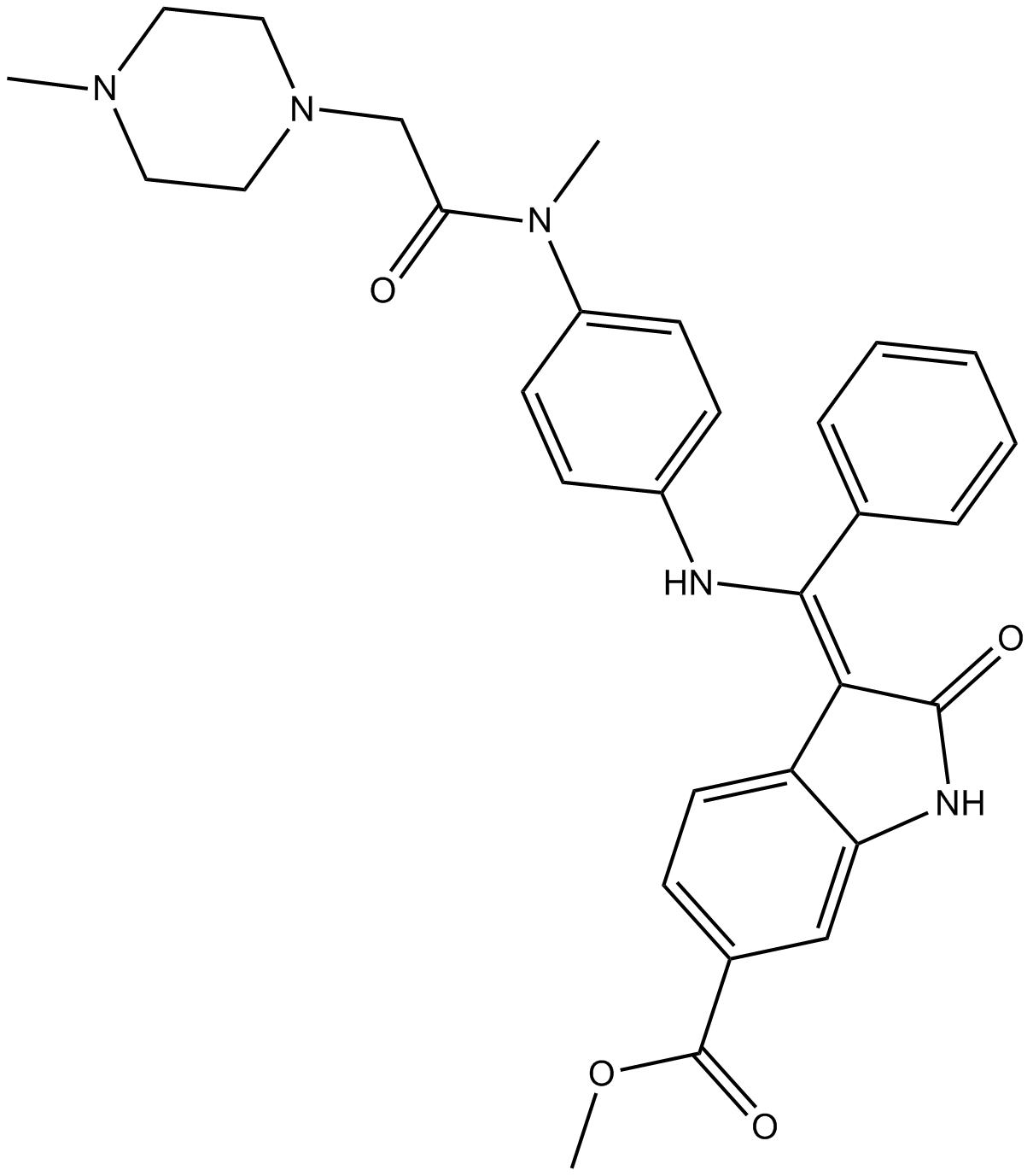
Cas No.: 656247-17-5
Sample solution is provided at 25 µL, 10mM.
_1-3.$$$39978408@51.jpg');)
_1-9.$$$38538795@65.jpg');)
_1-9.$$$39112701@51.jpg');)
_1-7.$$$37316672@70.jpg');)
_366-372.$$$36198801@70.jpg');)
.$$$38565142@65.jpg');)
_1867-1883.$$$33248023@67.jpg');)
_eads6055.$$$39977546@45.jpg');)
_eadm9805.$$$40080571@45.jpg');)
_eadj3020.$$$39666821@45.jpg');)
_1-20.$$$39757301@28.jpg');)
_1-24.$$$38898113@28.jpg');)
_273-287.$$$36806353@46.jpg');)
_1-16.$$$37156877@44.jpg');)
_1-19.$$$37460805@44.jpg');)
_1291-1307.$$$34518654@46.jpg');)
Nintedanib (BIBF 1120) is an orally available triple tyrosine kinase inhibitor that can inhibit vascular endothelial growth factor receptor (VEGFR) -1, -2, and -3, fibroblast growth factor receptor (FGFR) -1, -2, and -3, as well as platelet-derived growth factor receptor (PDGFR) α and β tyrosine kinases with an IC50 value of 4.16±0.04μM, 5.62±2.64μM, and 6.32±1.18μM for HNE-1, CNE-2, and HONE-1, respectively[1-3]. Nintedanib is also a potent antagonist of growth factors such as platelet-derived growth factor, vascular endothelial growth factor, and basic fibroblast growth factor[2]. Nintedanib has potent antitumor and antiangiogenic activity[4].
In vitro, after treating Hepatocellular carcinoma (HCC) cells with Nintedanib at different doses (0, 1, 5, 10, 15, 20μM) for 48 hours, Nintedanib significantly induced the accumulation of sub-G1-positive cells and apoptosis, and also significantly induced DNA fragmentation in a dose-dependent manner[5]. Three human nasopharyngeal carcinoma (NPC) cell lines, CNE-2, HNE-1, and HONE-1, were treated with Nintedanib (0-10μM) for 72 hours, which significantly inhibited the growth of these three cell lines in a dose-dependent manner. The IC50 values for the effect of Nintedanib on HNE-1, CNE-2, and HONE-1 were 4.16±0.04μM, 5.62±2.64μM, and 6.32±1.18μM, respectively[3].
In vivo, C57BL/6 male mice with lung fibrosis induced by intratracheal bleomycin or silica particles were treated with Nintedanib (30, 60, or 100mg/kg; gavage) daily, which inhibited platelet-derived growth factor (PDGF) receptor activation, fibroblast proliferation and transformation, and significantly reduced bronchoalveolar lavage (BAL) lymphocytes and neutrophils as well as decreased interleukin-1β, keratinocyte chemoattractant (KC), tissue inhibitor of metalloproteinase-1 (TIMP-1) and lung collagen[6]. After treating nude mice (with human tumor xenografts growing in vivo) with Nintedanib (25-100mg/kg daily p.o.), Nintedanib exerts its effects after 3 days of treatment, reduces vessel density and vessel integrity after 5 days, and induces significant tumor growth inhibition[7].
References:
[1] Antoniu SA. Nintedanib (BIBF 1120) for IPF: a tomorrow therapy?. Multidiscip Respir Med. 2012;7(1):41.
[2] Santos ES, Gomez JE, Raez LE. Targeting angiogenesis from multiple pathways simultaneously: BIBF 1120, an investigational novel triple angiokinase inhibitor. Invest New Drugs. 2012;30(3):1261-1269.
[3] Xue C, Tian Y, Zhang J, et al. Efficacy of BIBF 1120 or BIBF 1120 plus chemotherapy on nasopharyngeal carcinoma in vitro and in vivo. Drug Des Devel Ther. 2016;10:1173-1180.
[4] Kutluk Cenik B, Ostapoff KT, Gerber DE, Brekken RA. BIBF 1120 (nintedanib), a triple angiokinase inhibitor, induces hypoxia but not EMT and blocks progression of preclinical models of lung and pancreatic cancer. Mol Cancer Ther. 2013;12(6):992-1001.
[5] Tai WT, Shiau CW, Li YS, et al. Nintedanib (BIBF-1120) inhibits hepatocellular carcinoma growth independent of angiokinase activity. J Hepatol. 2014;61(1):89-97.
[6] Wollin L, Maillet I, Quesniaux V, Holweg A, Ryffel B. Antifibrotic and anti-inflammatory activity of the tyrosine kinase inhibitor nintedanib in experimental models of lung fibrosis. J Pharmacol Exp Ther. 2014;349(2):209-220.
[7] Hilberg F, Roth GJ, Krssak M, et al. BIBF 1120: triple angiokinase inhibitor with sustained receptor blockade and good antitumor efficacy. Cancer Res. 2008;68(12):4774-4782.
| Cell experiment [1]: | |
Cell lines | Hepatocellular carcinoma (HCC) |
Preparation Method | The antiproliferative effects of Nintedanib treatment were assessed in four human HCC cell lines, with cells exposed to Nintedanib at different doses for 48 hours and cell viability determined by MTT assay. |
Reaction Conditions | 0, 1, 5, 10, 15, 20μM; 48h |
Applications | Nintedanib significantly induced the accumulation of sub-G1-positive cells in HCC cells. The induction of apoptosis by Nintedanib was further confirmed by DNA fragmentation assay. Nintedanib exhibited a significant ratio of induction of DNA fragmentation at clinically relevant concentrations in a dose-dependent manner. |
| Animal experiment [2]: | |
Animal models | C57BL/6 male mice |
Preparation Method | Lung fibrosis was induced in mice by intratracheal bleomycin or silica particle administration. Nintedanib was administered every day by gavage at 30, 60, or 100mg/kg. |
Dosage form | 30, 60, or 100mg/kg; gavage |
Applications | Nintedanib inhibited platelet-derived growth factor (PDGF) receptor activation, fibroblast proliferation, and fibroblast to myofibroblast transformation. Nintedanib significantly reduced bronchoalveolar lavage (BAL) lymphocytes and neutrophils but not macrophages. Furthermore, interleukin-1β, keratinocyte chemoattractant (KC), tissue inhibitor of metalloproteinase-1 (TIMP-1), and lung collagen were significantly reduced. |
References: | |
| Cas No. | 656247-17-5 | SDF | |
| Überlieferungen | Vargatef | ||
| Chemical Name | methyl (3Z)-3-[[4-[methyl-[2-(4-methylpiperazin-1-yl)acetyl]amino]anilino]-phenylmethylidene]-2-oxo-1H-indole-6-carboxylate | ||
| Canonical SMILES | CN1CCN(CC1)CC(=O)N(C)C2=CC=C(C=C2)NC(=C3C4=C(C=C(C=C4)C(=O)OC)NC3=O)C5=CC=CC=C5 | ||
| Formula | C31H33N5O4 | M.Wt | 539.62 |
| Löslichkeit | 10mg/mL in DMSO | Storage | Store at -20°C |
| General tips | Please select the appropriate solvent to prepare the stock solution according to the
solubility of the product in different solvents; once the solution is prepared, please store it in
separate packages to avoid product failure caused by repeated freezing and thawing.Storage method
and period of the stock solution: When stored at -80°C, please use it within 6 months; when stored
at -20°C, please use it within 1 month. To increase solubility, heat the tube to 37°C and then oscillate in an ultrasonic bath for some time. |
||
| Shipping Condition | Evaluation sample solution: shipped with blue ice. All other sizes available: with RT, or with Blue Ice upon request. | ||
| Prepare stock solution | |||

|
1 mg | 5 mg | 10 mg |
| 1 mM | 1.8532 mL | 9.2658 mL | 18.5316 mL |
| 5 mM | 370.6 μL | 1.8532 mL | 3.7063 mL |
| 10 mM | 185.3 μL | 926.6 μL | 1.8532 mL |
Step 1: Enter information below (Recommended: An additional animal making an allowance for loss during the experiment)
 g
μL
g
μL
Step 2: Enter the in vivo formulation (This is only the calculator, not formulation. Please contact us first if there is no in vivo formulation at the solubility Section.)
Calculation results:
Working concentration: mg/ml;
Method for preparing DMSO master liquid: mg drug pre-dissolved in μL DMSO ( Master liquid concentration mg/mL, Please contact us first if the concentration exceeds the DMSO solubility of the batch of drug. )
Method for preparing in vivo formulation: Take μL DMSO master liquid, next addμL PEG300, mix and clarify, next addμL Tween 80, mix and clarify, next add μL saline, mix and clarify.
Method for preparing in vivo formulation: Take μL DMSO master liquid, next add μL Corn oil, mix and clarify.
Note: 1. Please make sure the liquid is clear before adding the next solvent.
2. Be sure to add the solvent(s) in order. You must ensure that the solution obtained, in the previous addition, is a clear solution before proceeding to add the next solvent. Physical methods such as vortex, ultrasound or hot water bath can be used to aid dissolving.
3. All of the above co-solvents are available for purchase on the GlpBio website.
Quality Control & SDS
- View current batch:
- Purity: >99.50% Appearance: A solid
- COA (Certificate of Analysis)
- SDS (Safety Data Sheet)
- Datasheet
Average Rating: 5 (Based on Reviews and 30 reference(s) in Google Scholar.)