

Polygodial (Synonyms: Tadeonal) |
Katalog-Nr.GC12580
 One-Click Copy Product Info
|

Polygodial (Poligodial) ist ein antimykotischer Potenziator.
Products are for research use only. Not for human use. We do not sell to patients.
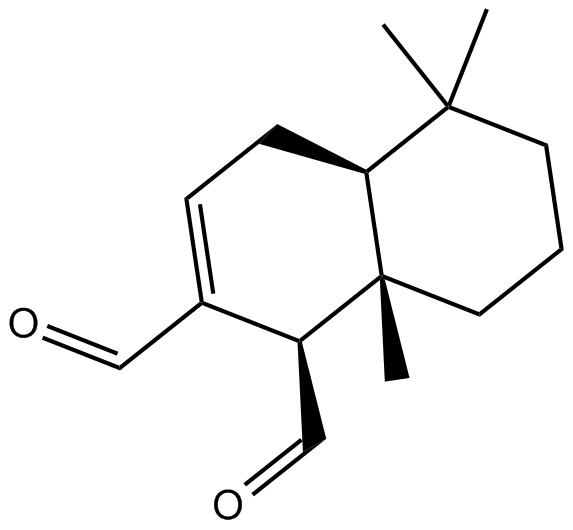
Cas No.: 6754-20-7
Sample solution is provided at 25 µL, 10mM.
_1-3.$$$39978408@51.jpg');)
_1-9.$$$38538795@65.jpg');)
_1-9.$$$39112701@51.jpg');)
_1-7.$$$37316672@70.jpg');)
_366-372.$$$36198801@70.jpg');)
.$$$38565142@65.jpg');)
_1867-1883.$$$33248023@67.jpg');)
_eads6055.$$$39977546@45.jpg');)
_eadm9805.$$$40080571@45.jpg');)
_eadj3020.$$$39666821@45.jpg');)
_1-20.$$$39757301@28.jpg');)
_1-24.$$$38898113@28.jpg');)
_273-287.$$$36806353@46.jpg');)
_1-16.$$$37156877@44.jpg');)
_1-19.$$$37460805@44.jpg');)
_1291-1307.$$$34518654@46.jpg');)
Polygodial is a sesquiterpene dialdehyde compound with bactericidal rather than bacteriostatic properties. Polygodial has broad-spectrum antibacterial effects, especially against yeast and filamentous microorganisms. Polygodial's antibacterial effect is pH-dependent. Polygodial showed no antifungal activity against Saccharomyces cerevisiae, Candida utilis, Schizosaccharomyces pombe, or Hansenula anomala at pH 7.0 even at 25μg/mL, whereas its activity increased at acidic pH and was effective at 0.2μg/mL and 0.78μg/mL against Saccharomyces cerevisiae and Candida utilis, respectively, at pH 3.1. Polygodial exerts its activity by targeting the cytoplasmic membrane and disrupting organelles, leading to lethal leakage of intracellular components such as proteins and carbohydrates[1].
In vitro, Polygodial (0-100µM; 6d) were not toxic to hepatocytes and 3T3-J2 fibroblasts[2]. Polygodial (0-50μM; 24-72h) dose-dependently inhibited the viability of Taxane-Resistant castration-resistant prostate cancer (CRPC; PC3-TXR and DU145-TXR), with IC50 values of approximately 20μM in both cell lines[2]. Polygodial (5-20μM; 1-3w) substantially decreased the number of colonies in PC3-TXR and DU145-TXR cell lines in a concentration-dependent manner[2]. Polygodial (5-50μM; 24-72h) inhibited migration in PC3-TXR and DU145-TXR cell lines in a concentration-dependent manner[2]. Polygodial (5-50μM; 48h) induced apoptosis in PC3-TXR and DU145-TXR cell lines in a concentration-dependent manner[2].
In vivo, Polygodial (0.1-10mg/kg; i.p.; 0.5h) dose-dependently and almost completely inhibited acetic acid-, zymosan-, and kaolin-induced abdominal constrictions in male Swiss mice, with ID50 values of 0.8, 2.1, and 2.6mg/kg and maximal inhibitions of 90%, 97%, and 98%, respectively[3].
References:
[1] Kubo, I, and M Taniguchi. “Polygodial, an antifungal potentiator.” Journal of natural products vol. 51,1 (1988): 22-9.
[2] Venkatesan R, Hussein MA, Moses L, Liu JS, Khetani SR, Kornienko A, Munirathinam G. Polygodial, a Sesquiterpene Dialdehyde, Activates Apoptotic Signaling in Castration-Resistant Prostate Cancer Cell Lines by Inducing Oxidative Stress. Cancers. 2022; 14(21):5260.
[3] Mendes, G L et al. “Anti-hyperalgesic properties of the extract and of the main sesquiterpene polygodial isolated from the barks of Drymis winteri (Winteraceae).” Life sciences vol. 63,5 (1998): 369-81.
| Cell experiment [1]: | |
Cell lines | Hepatocytes and 3T3-J2 fibroblast |
Preparation Method | Hepatocyte/3T3-J2 fibroblast Micropatterned co-cultures (MPCCs) and 3T3-J2 fibroblast-only monocultures were cultured for 7 days. Cells were treated with various concentrations of Polygodial every other day for 6 days (i.e., three total treatments), and cell viability was measured on the 9th, 11th, and 13th day of culture. |
Reaction Conditions | 0-100µM; 6d |
Applications | Polygodial treatments were not toxic to hepatocytes and fibroblasts. |
| Animal experiment [2]: | |
Animal models | Male Swiss mice |
Preparation Method | Polygodial was dissolved in absolute ethanol. The final concentration of ethanol did not exceed 5% and did not cause any effect “per se”. The abdominal constrictions, which consisted of a contraction of the abdominal muscle together with a stretching of hind limbs, were induced by intraperitoneal injection of acetic acid (0.6%), zymosan suspension (40mg/kg) or kaolin suspension (50mg/kg).The compound polygodial was injected i.p. (0.1 to 10mg/kg) 0.5h before the injection of irritant substances. The number of abdominal constrictions was cumulatively counted over a period of 20min for acetic acid and kaolin or 15min for zymosan. Anti-hyperalgesic activity was expressed as the reduction of the number of abdominal constrictions. |
Dosage form | 0.1-10mg/kg; i.p.; 0.5h |
Applications | Polygodial induced significant, dose-related and almost complete inhibition of acetic acid-, zyrnosan- and kaolin-induced abdominal constrictions. The calculated mean ID50 values were 0.8, 2.1 and 2.6mg/kg and maximal inhibitions of 90, 97 and 98% against acetic acid, zymosan or kaolin, respectively |
References: | |
| Cas No. | 6754-20-7 | SDF | |
| Überlieferungen | Tadeonal | ||
| Chemical Name | (1R,4aS,8aS)-5,5,8a-trimethyl-1,4,4a,5,6,7,8,8a-octahydronaphthalene-1,2-dicarbaldehyde | ||
| Canonical SMILES | O=C[C@@H]1[C@]2(C)[C@@H](CC=C1C=O)C(C)(C)CCC2 | ||
| Formula | C15H22O2 | M.Wt | 234.33 |
| Löslichkeit | DMF: 14 mg/ml,DMSO: 20 mg/ml,Ethanol: 20 mg/ml,Ethanol:PBS (pH 7.2) (1:40): 0.02 mg/ml | Storage | Store at -20°C |
| General tips | Please select the appropriate solvent to prepare the stock solution according to the
solubility of the product in different solvents; once the solution is prepared, please store it in
separate packages to avoid product failure caused by repeated freezing and thawing.Storage method
and period of the stock solution: When stored at -80°C, please use it within 6 months; when stored
at -20°C, please use it within 1 month. To increase solubility, heat the tube to 37°C and then oscillate in an ultrasonic bath for some time. |
||
| Shipping Condition | Evaluation sample solution: shipped with blue ice. All other sizes available: with RT, or with Blue Ice upon request. | ||
| Prepare stock solution | |||

|
1 mg | 5 mg | 10 mg |
| 1 mM | 4.2675 mL | 21.3374 mL | 42.6749 mL |
| 5 mM | 853.5 μL | 4.2675 mL | 8.535 mL |
| 10 mM | 426.7 μL | 2.1337 mL | 4.2675 mL |
Step 1: Enter information below (Recommended: An additional animal making an allowance for loss during the experiment)
 g
μL
g
μL
Step 2: Enter the in vivo formulation (This is only the calculator, not formulation. Please contact us first if there is no in vivo formulation at the solubility Section.)
Calculation results:
Working concentration: mg/ml;
Method for preparing DMSO master liquid: mg drug pre-dissolved in μL DMSO ( Master liquid concentration mg/mL, Please contact us first if the concentration exceeds the DMSO solubility of the batch of drug. )
Method for preparing in vivo formulation: Take μL DMSO master liquid, next addμL PEG300, mix and clarify, next addμL Tween 80, mix and clarify, next add μL saline, mix and clarify.
Method for preparing in vivo formulation: Take μL DMSO master liquid, next add μL Corn oil, mix and clarify.
Note: 1. Please make sure the liquid is clear before adding the next solvent.
2. Be sure to add the solvent(s) in order. You must ensure that the solution obtained, in the previous addition, is a clear solution before proceeding to add the next solvent. Physical methods such as vortex, ultrasound or hot water bath can be used to aid dissolving.
3. All of the above co-solvents are available for purchase on the GlpBio website.
Quality Control & SDS
- View current batch:
- Purity: >98.00% Appearance: A solid
- COA (Certificate of Analysis)
- SDS (Safety Data Sheet)
- Datasheet
Average Rating: 5 (Based on Reviews and 24 reference(s) in Google Scholar.)