

Propylthiouracil (Synonyms: NSC 6498, NSC 70461, 6nPropylthiouracil, PTU) |
Katalog-Nr.GC11225
 One-Click Copy Product Info
|

Propylthiouracil (6-Propyl-2-thiouracil) ist ein Thyroperoxidase- und 5'-Deiodinase-Hemmer.
Products are for research use only. Not for human use. We do not sell to patients.
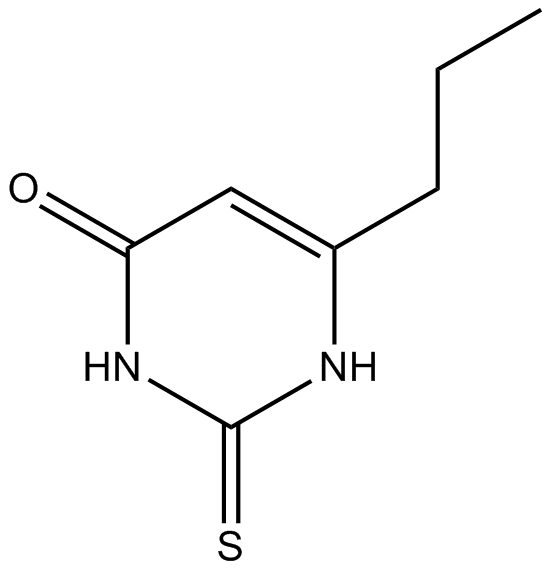
Cas No.: 51-52-5
Sample solution is provided at 25 µL, 10mM.
_1-3.$$$39978408@51.jpg');)
_1-9.$$$38538795@65.jpg');)
_1-9.$$$39112701@51.jpg');)
_1-7.$$$37316672@70.jpg');)
_366-372.$$$36198801@70.jpg');)
.$$$38565142@65.jpg');)
_1867-1883.$$$33248023@67.jpg');)
_eads6055.$$$39977546@45.jpg');)
_eadm9805.$$$40080571@45.jpg');)
_eadj3020.$$$39666821@45.jpg');)
_1-20.$$$39757301@28.jpg');)
_1-24.$$$38898113@28.jpg');)
_273-287.$$$36806353@46.jpg');)
_1-16.$$$37156877@44.jpg');)
_1-19.$$$37460805@44.jpg');)
_1291-1307.$$$34518654@46.jpg');)
Propylthiouracil is a thionamide antithyroid agent and an inhibitor of thyroid peroxidase (TPO)[1,4]. Propylthiouracil suppresses TPO-catalyzed iodination and coupling reactions and inhibits type 1 iodothyronine deiodinase (DIO1), reducing thyroid-hormone synthesis and conversion of thyroxine (T4) to triiodothyronine (T3)[1,4]. Propylthiouracil is used in research on thyroid-hormone biosynthesis, sodium/iodide symporter regulation, hypothyroidism models, steroidogenesis, developmental endocrinology, oxidative stress, and left-right embryonic patterning[1-7].
In vitro, Propylthiouracil (5mM; 24 or 48h) increased sodium/iodide symporter (NIS) mRNA, promoter activity, and protein abundance in thyroid-stimulating hormone-deprived rat FRTL-5 thyroid cells; Propylthiouracil (5mM; 0, 6, 24, 48, and 72h) increased NIS-dependent iodide uptake from 24 to 72h[1]. Propylthiouracil (3, 6, and 12mM; 1h) reduced basal and human chorionic gonadotropin (hCG)-stimulated testosterone secretion in rat testicular interstitial cells, and Propylthiouracil (12mM; 1h) reduced cytochrome P450 side-chain cleavage enzyme (P450scc) activity and conversion of cholesterol to pregnenolone[2]. Propylthiouracil (3, 6, and 12mM; 2h) reduced basal, hCG-stimulated, forskolin-stimulated, and 8-bromo-cyclic adenosine monophosphate (8-Br-cAMP)-stimulated progesterone secretion in rat granulosa cells; Propylthiouracil (12mM; 2h) inhibited P450scc and 3β-hydroxysteroid dehydrogenase (3β-HSD) activities and reduced hCG-induced steroidogenic acute regulatory protein (StAR) abundance[3].
In vivo, Propylthiouracil (1, 20, and 200mg/kg/day; oral gavage once daily for 1 month) reduced serum T3 and T4, increased thyroid-stimulating hormone (TSH), enlarged the thyroid gland, and induced thyroid follicular hypertrophy and hyperplasia in male Wistar Han rats[4]. Propylthiouracil (0.025%w/v in drinking water; ad libitum from gestational day 14 to offspring postnatal day 21) reduced absolute ovarian and uterine weights, increased relative thyroid weight approximately 2.8-fold, and altered thyroid, ovarian, uterine, and ovarian-fat-pad histology in female rat offspring[5]. Propylthiouracil (0.02%w/v in drinking water; ad libitum from postnatal day 1 to day 60) reduced serum thyroxine, increased escape latency and travel distance in the Morris water maze, reduced total thiol concentrations, and increased malondialdehyde concentrations in cortical and hippocampal tissues of male rat offspring[6].
References:[1] Sue M, Akama T, Kawashima A, Nakamura H, Hara T, Tanigawa K, et al. Propylthiouracil increases sodium/iodide symporter gene expression and iodide uptake in rat thyroid cells in the absence of TSH. Thyroid. 2012;22(8):844-852. doi:10.1089/thy.2011.0290.
[2] Chiao YC, Lin H, Wang SW, Wang PS. Direct effects of propylthiouracil on testosterone secretion in rat testicular interstitial cells. Br J Pharmacol. 2000;130(7):1477-1482. doi:10.1038/sj.bjp.0703444.
[3] Chen JJ, Wang SW, Chien EJ, Wang PS. Direct effect of propylthiouracil on progesterone release in rat granulosa cells. Br J Pharmacol. 2003;139(8):1564-1570. doi:10.1038/sj.bjp.0705392.
[4] Nambiar PR, Palanisamy GS, Okerberg C, Wolford A, Walters K, Buckbinder L, et al. Toxicities associated with 1-month treatment with propylthiouracil and methimazole in male rats. Toxicol Pathol. 2014;42(6):970-983. doi:10.1177/0192623313502708.
[5] Park JS, Lee SH. Effects of maternal hypothyroidism on the pubertal development in female rat offspring. Dev Reprod. 2021;25(2):83-91. doi:10.12717/DR.2021.25.2.83.
[6] Farrokhi E, Hosseini M, Beheshti F, Vafaee F, Hadjzadeh MAR, Dastgheib SS. Brain tissues oxidative damage as a possible mechanism of deleterious effects of propylthiouracil-induced hypothyroidism on learning and memory in neonatal and juvenile growth in rats. Basic Clin Neurosci. 2014;5(4):285-294.
| Cell experiment [1]: | |
|
Cell lines |
Rat FRTL-5 thyroid cells |
|
Preparation Method |
Dissolve Propylthiouracil directly in cell culture medium containing 0.2% serum without thyroid-stimulating hormone or insulin to obtain a final concentration of 5mM. Maintain rat thyroid FRTL-5 cells in medium without thyroid-stimulating hormone or insulin for 7 days and then treat the cells with Propylthiouracil for 48h. |
|
Reaction Conditions |
5mM; 24 or 48h |
|
Applications |
Propylthiouracil increased NIS messenger ribonucleic acid, promoter activity, and protein abundance and enhanced NIS-dependent iodide uptake in FRTL-5 cells. |
| Animal experiment [2]: | |
|
Animal models |
Hypothyroidism model in male Wistar Han rats |
|
Preparation Method |
Dissolve Propylthiouracil in 0.25% methylcellulose solution to prepare the oral dosing formulation. Administer Propylthiouracil to approximately 8-week-old adult male Sprague–Dawley rats by oral gavage at 10mg/kg/day with a dosing volume of 5mL/kg once daily for 14 consecutive days; administer an equal volume of 0.25% methylcellulose solution to the control group. |
|
Dosage form |
1, 20, and 200mg/kg/day; 1 month; i.g. |
|
Applications |
Propylthiouracil reduced serum T3 and T4, increased TSH and thyroid weight, and induced thyroid follicular hypertrophy and hyperplasia. |
| References: [1] Sue M, Akama T, Kawashima A, Nakamura H, Hara T, Tanigawa K, et al. Propylthiouracil increases sodium/iodide symporter gene expression and iodide uptake in rat thyroid cells in the absence of TSH. Thyroid. 2012;22(8):844-852. doi:10.1089/thy.2011.0290. [2] Nambiar PR, Palanisamy GS, Okerberg C, Wolford A, Walters K, Buckbinder L, et al. Toxicities associated with 1-month treatment with propylthiouracil and methimazole in male rats. Toxicol Pathol. 2014;42(6):970-983. doi:10.1177/0192623313502708. | |
| Cas No. | 51-52-5 | SDF | |
| Überlieferungen | NSC 6498, NSC 70461, 6nPropylthiouracil, PTU | ||
| Chemical Name | 6-propyl-2-sulfanylidene-1H-pyrimidin-4-one | ||
| Canonical SMILES | CCCC1=CC(=O)NC(=S)N1 | ||
| Formula | C7H10N2OS | M.Wt | 170.23 |
| Löslichkeit | ≥ 5.4mg/mL in DMSO | Storage | Store at RT |
| Shipping Condition | Evaluation sample solution: shipped with blue ice. All other sizes available: with RT, or with Blue Ice upon request. | ||
| Prepare stock solution | |||

|
1 mg | 5 mg | 10 mg |
| 1 mM | 5.8744 mL | 29.372 mL | 58.7441 mL |
| 5 mM | 1.1749 mL | 5.8744 mL | 11.7488 mL |
| 10 mM | 587.4 μL | 2.9372 mL | 5.8744 mL |
Step 1: Enter information below (Recommended: An additional animal making an allowance for loss during the experiment)
 g
μL
g
μL
Step 2: Enter the in vivo formulation (This is only the calculator, not formulation. Please contact us first if there is no in vivo formulation at the solubility Section.)
Calculation results:
Working concentration: mg/ml;
Method for preparing DMSO master liquid: mg drug pre-dissolved in μL DMSO ( Master liquid concentration mg/mL, Please contact us first if the concentration exceeds the DMSO solubility of the batch of drug. )
Method for preparing in vivo formulation: Take μL DMSO master liquid, next addμL PEG300, mix and clarify, next addμL Tween 80, mix and clarify, next add μL saline, mix and clarify.
Method for preparing in vivo formulation: Take μL DMSO master liquid, next add μL Corn oil, mix and clarify.
Note: 1. Please make sure the liquid is clear before adding the next solvent.
2. Be sure to add the solvent(s) in order. You must ensure that the solution obtained, in the previous addition, is a clear solution before proceeding to add the next solvent. Physical methods such as vortex, ultrasound or hot water bath can be used to aid dissolving.
3. All of the above co-solvents are available for purchase on the GlpBio website.
Quality Control & SDS
- View current batch:
- Purity: >99.00% Appearance: A solid
- COA (Certificate of Analysis)
- SDS (Safety Data Sheet)
- Datasheet
Average Rating: 5 (Based on Reviews and 7 reference(s) in Google Scholar.)