

Protopine |
Katalog-Nr.GN10237
 One-Click Copy Product Info
|

Protopine, an alkaloid derived from Corydalis ternata, inhibits acetylcholinesterase activity with an IC50 value of 50μM.
Products are for research use only. Not for human use. We do not sell to patients.
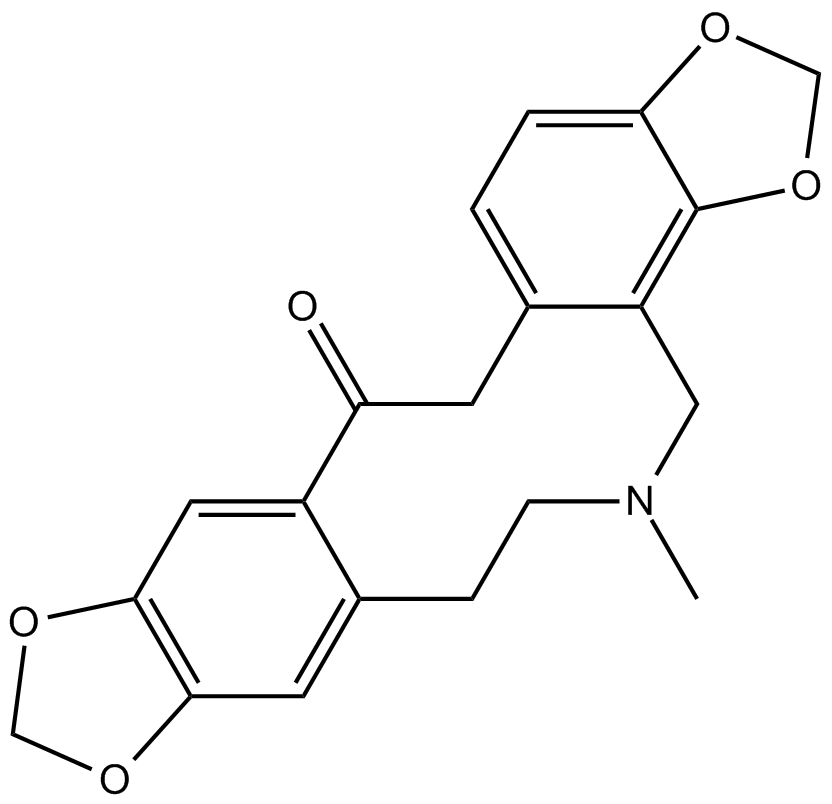
Cas No.: 130-86-9
Sample solution is provided at 25 µL, 10mM.
_1-3.$$$39978408@51.jpg');)
_1-9.$$$38538795@65.jpg');)
_1-9.$$$39112701@51.jpg');)
_1-7.$$$37316672@70.jpg');)
_366-372.$$$36198801@70.jpg');)
.$$$38565142@65.jpg');)
_1867-1883.$$$33248023@67.jpg');)
_eads6055.$$$39977546@45.jpg');)
_eadm9805.$$$40080571@45.jpg');)
_eadj3020.$$$39666821@45.jpg');)
_1-20.$$$39757301@28.jpg');)
_1-24.$$$38898113@28.jpg');)
_273-287.$$$36806353@46.jpg');)
_1-16.$$$37156877@44.jpg');)
_1-19.$$$37460805@44.jpg');)
_1291-1307.$$$34518654@46.jpg');)
Protopine, an alkaloid derived from Corydalis ternata, inhibits acetylcholinesterase activity with an IC50 value of 50μM [1]. Protopine inhibits the release and influx of platelet Ca2+, which in turn suppresses platelet aggregation[2]. Protopine has been widely used in cell and animal models as an anti-inflammatory agent to inhibit the expression of inflammatory factors[3].
In vitro, Protopine treatment for 48 hours significantly inhibited the proliferation of PC-3 and DU-145 cells, with IC50 values of 13.0 ± 1.7μM and 15.8 ± 1.6μM, respectively[4]. Treatment with 40μM Protopine for 24 hours significantly inhibited the viability of HepG2 cells and induced apoptosis through an endogenous pathway in a caspase-dependent manner, resulting in the accumulation of reactive oxygen species (ROS) within the cells[5]. 50μM of Protopine pretreatment for 30 minutes can effectively protect PC12 cells from damage caused by H2O2, resulting in a decrease in MDA levels and reversing the decline in SOD, glutathione peroxidase and catalase activities caused by H2O2[6].
In vivo, Protopine pretreatment via oral administration (11mg/kg) twice a day for two consecutive days in rats prior to exposure to CCl4 can prevent the increase in serum levels of aspartate transaminase (AST) and alanine transaminase (ALT) caused by CCl4[7]. Protopine pretreatment (3.92mg/kg/day; i.p.) for three days can reduce the cerebral infarction rate and serum lactate dehydrogenase activity in rats with focal cerebral ischemia, and improve the score of ischemic neurological dysfunction and the histological changes of brain tissue[8].
References:
[1] Kim S R, Hwang S Y, Jang Y P, et al. Protopine from Corydalis ternata has anticholinesterase and antiamnesic activities[J]. Planta medica, 1999, 65(03): 218-221.
[2] Saeed S A, Gilani A H, Majoo R U, et al. Anti-thrombotic and anti-inflammatory activities of protopine[J]. Pharmacological research, 1997, 36(1): 1-7.
[3] Huang W, Kong L, Cao Y, et al. Identification and quantification, metabolism and pharmacokinetics, pharmacological activities, and botanical preparations of protopine: A review[J]. Molecules, 2021, 27(1): 215.
[4] Chen C H, Liao C H, Chang Y L, et al. Protopine, a novel microtubule-stabilizing agent, causes mitotic arrest and apoptotic cell death in human hormone-refractory prostate cancer cell lines[J]. Cancer letters, 2012, 315(1): 1-11.
[5] Nie C, Wang B, Wang B, et al. Protopine triggers apoptosis via the intrinsic pathway and regulation of ROS/PI3K/Akt signalling pathway in liver carcinoma[J]. Cancer Cell International, 2021, 21(1): 396.
[6] Xiao X, Liu J, Hu J, et al. Protective effects of protopine on hydrogen peroxide-induced oxidative injury of PC12 cells via Ca2+ antagonism and antioxidant mechanisms[J]. European journal of pharmacology, 2008, 591(1-3): 21-27.
[7] Janbaz K H, Saeed S A, Gilani A H. An assessment of the potential of protopine to inhibit microsomal drug metabolising enzymes and prevent chemical-induced hepatotoxicity in rodents[J]. Pharmacological research, 1998, 38(3): 215-219.
[8] Xiao X, Liu J, Hu J, et al. Protective effect of protopine on the focal cerebral ischaemic injury in rats[J]. Basic & clinical pharmacology & toxicology, 2007, 101(2): 85-89.
| Cell experiment [1]: | |
Cell lines | HepG2 cells |
Preparation Method | HepG2 cells were cultured in RPMI1640 medium, which was supplemented with 10% fetal bovine serum (FBS) and 1% penicillin/streptomycin. The cells were cultured in a humidified incubator at 37℃ and 5% CO2. The cell migration was measured using the scratch healing assay. The cells were seeded at a density of 1×10⁴ cells per well in a 24-well plate. After 24 hours, the cells were cultured until 90% confluence was reached. A scratch was made on the monolayer cells using an aseptic pipette, and the cells were treated with different doses of Protopine (0, 10, 20, and 40μM). 24 hours later, the width of the scratch was measured at 100× magnification under an inverted microscope, and it was standardized to the initial distance at 0 hours. |
Reaction Conditions | 0, 10, 20, and 40μM; 24h |
Applications | Protopine treatment repressed the migration of HepG2 cells in a dose-dependent manner. |
| Animal experiment [2]: | |
Animal models | Male Sprague-Dawley rats |
Preparation Method | Male Sprague-Dawley rats, weighing 250-300g, were housed in a room with a temperature of 20-25°C, a relative humidity of 50-60%, and a 12-hour light:dark cycle, with free access to food and water. The rats were divided into 3 groups: the sham operation group, the vehicle group, and the Protopine treatment group (3.92mg/kg). The rats were intraperitoneally injected with Protopine 3 days before ischemia, once a day. The vehicle group rats were intraperitoneally injected with 0.9% normal saline in the same way. The rats in the sham operation group were intraperitoneally injected with 0.9% normal saline before the induction of cerebral ischemia. The middle cerebral artery occlusion for 24 hours was used to prepare the focal cerebral ischemia model by the intraluminal filament method. Then, the neurological deficit assessment and the determination of serum SOD activities were carried out. |
Dosage form | 3.92mg/kg/day for 3 days; i.p. |
Applications | Protopine treatment improved the score of ischemic neurological dysfunction in brain tissue, and increased the serum SOD activity in rats with middle cerebral artery occlusion. |
References: | |
| Cas No. | 130-86-9 | SDF | |
| Canonical SMILES | CN1CCC2=CC3=C(C=C2C(=O)CC4=C(C1)C5=C(C=C4)OCO5)OCO3 | ||
| Formula | C20H19NO5 | M.Wt | 353.37 |
| Löslichkeit | ≥ 17.65mg/mL in DMSO with ultrasonic | Storage | Store at 2-8°C |
| General tips | Please select the appropriate solvent to prepare the stock solution according to the
solubility of the product in different solvents; once the solution is prepared, please store it in
separate packages to avoid product failure caused by repeated freezing and thawing.Storage method
and period of the stock solution: When stored at -80°C, please use it within 6 months; when stored
at -20°C, please use it within 1 month. To increase solubility, heat the tube to 37°C and then oscillate in an ultrasonic bath for some time. |
||
| Shipping Condition | Evaluation sample solution: shipped with blue ice. All other sizes available: with RT, or with Blue Ice upon request. | ||
| Prepare stock solution | |||

|
1 mg | 5 mg | 10 mg |
| 1 mM | 2.8299 mL | 14.1495 mL | 28.299 mL |
| 5 mM | 566 μL | 2.8299 mL | 5.6598 mL |
| 10 mM | 283 μL | 1.4149 mL | 2.8299 mL |
Step 1: Enter information below (Recommended: An additional animal making an allowance for loss during the experiment)
 g
μL
g
μL
Step 2: Enter the in vivo formulation (This is only the calculator, not formulation. Please contact us first if there is no in vivo formulation at the solubility Section.)
Calculation results:
Working concentration: mg/ml;
Method for preparing DMSO master liquid: mg drug pre-dissolved in μL DMSO ( Master liquid concentration mg/mL, Please contact us first if the concentration exceeds the DMSO solubility of the batch of drug. )
Method for preparing in vivo formulation: Take μL DMSO master liquid, next addμL PEG300, mix and clarify, next addμL Tween 80, mix and clarify, next add μL saline, mix and clarify.
Method for preparing in vivo formulation: Take μL DMSO master liquid, next add μL Corn oil, mix and clarify.
Note: 1. Please make sure the liquid is clear before adding the next solvent.
2. Be sure to add the solvent(s) in order. You must ensure that the solution obtained, in the previous addition, is a clear solution before proceeding to add the next solvent. Physical methods such as vortex, ultrasound or hot water bath can be used to aid dissolving.
3. All of the above co-solvents are available for purchase on the GlpBio website.
Quality Control & SDS
- View current batch:
- Purity: >99.50% Appearance: A solid
- COA (Certificate of Analysis)
- SDS (Safety Data Sheet)
- Datasheet
Average Rating: 5 (Based on Reviews and 30 reference(s) in Google Scholar.)