

Sinefungin |
Katalog-Nr.GC34784
 One-Click Copy Product Info
|

Sinefungin ist ein potenter Inhibitor der Virion-mRNA(Guanin-7-)-Methyltransferase, mRNA(Nukleosid-2'-)-Methyltransferase und der Virusvermehrung.
Products are for research use only. Not for human use. We do not sell to patients.
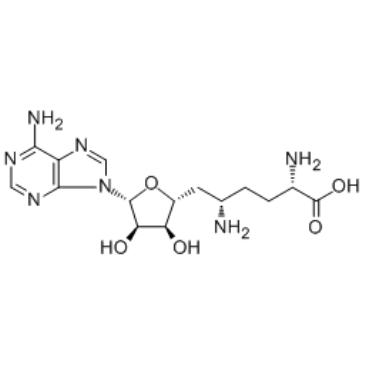
Cas No.: 58944-73-3
Sample solution is provided at 25 µL, 10mM.
_1-3.$$$39978408@51.jpg');)
_1-9.$$$38538795@65.jpg');)
_1-9.$$$39112701@51.jpg');)
_1-7.$$$37316672@70.jpg');)
_366-372.$$$36198801@70.jpg');)
.$$$38565142@65.jpg');)
_1867-1883.$$$33248023@67.jpg');)
_eads6055.$$$39977546@45.jpg');)
_eadm9805.$$$40080571@45.jpg');)
_eadj3020.$$$39666821@45.jpg');)
_1-20.$$$39757301@28.jpg');)
_1-24.$$$38898113@28.jpg');)
_273-287.$$$36806353@46.jpg');)
_1-16.$$$37156877@44.jpg');)
_1-19.$$$37460805@44.jpg');)
_1291-1307.$$$34518654@46.jpg');)
Sinefungin is a natural nucleoside antibiotic analog of S-adenosylmethionine that inhibits the activity of various methyltransferases (including protein, DNA, and RNA methyltransferases)[1-2]. Sinefungin can be used to explore epigenetic mechanisms and to support research in the development of antiviral, antiparasitic, and antifungal drugs[3-4].
In vitro, Sinefungin (10μM) applied to mouse L cells pre-infected with Newcastle disease virus and vaccinia virus for 72 hours significantly inhibited the formation of viral plaques[5]. Pretreatment of Candida albicans (C. albicans) strains with Sinefungin (0.25–4μM) for 5 days markedly inhibited hyphal elongation and long-term biofilm formation. Co-incubation of HEK293T and H1299 cells with C. albicans in the presence of Sinefungin for 2 hours reduced the ability of C. albicans to infect cells[6].
In vivo, pretreatment of mice with Sinefungin (10mg/kg/day) via intraperitoneal injection for 5 days, followed by induction of cardiac ischemia/reperfusion (I/R) model (left anterior descending coronary artery ligation for 45 minutes, reperfusion for 24 hours). Sinefungin significantly improves cardiac function (increased ejection fraction and fractional shortening), reduces myocardial infarct size, and loweres serum lactate dehydrogenase (LDH) levels[7]. Pretreatment of peritoneal fibrosis model C57/BL6 mice with Sinefungin (10mg/kg) via subcutaneous injection (once daily, 5 days/week for 3 weeks), significantly suppressed the increase in peritoneal cell density and thickening of the subperitoneal compact zone[8].
References:
[1] Neal RA, Iwobi MV, Robert-Gero M. Antileishmanial effect of free and encapsulated sinefungin against Leishmania donovani infections in BALB/c mice. C R Acad Sci III. 1989;308(18):485-8.
[2] Dube DK, Mpimbaza G, Allison AC, et al. Antitrypanosomal activity of sinefungin. Am J Trop Med Hyg. 1983 Jan;32(1):31-3.
[3] Bachrach U, Schnur LF, El-On J, et al. Inhibitory activity of sinefungin and SIBA (5'-deoxy-5'-S-isobutylthio-adenosine) on the growth of promastigotes and amastigotes of different species of Leishmania. FEBS Lett. 1980 Dec 1;121(2):287-91.
[4] Sala L, Franco-Valls H, Stanisavljevic J, et al. Abrogation of myofibroblast activities in metastasis and fibrosis by methyltransferase inhibition. Int J Cancer. 2019 Dec 1;145(11):3064-3077.
[5] Pugh CS, Borchardt RT, Stone HO. Sinefungin, a potent inhibitor of virion mRNA(guanine-7-)-methyltransferase, mRNA(nucleoside-2'-)-methyltransferase, and viral multiplication. J Biol Chem. 1978 Jun 25;253(12):4075-7.
[6] Nayak A, Khedri A, Chavarria A, et al. Sinefungin, a natural nucleoside analog of S-adenosyl methionine, impairs the pathogenicity of Candida albicans. NPJ Antimicrob Resist. 2024;2(1):23.
[7] Yu ST, Sun ZY, Li N, et al. Mettl1 knockdown alleviates cardiac I/R injury in mice by inactivating the Mettl1-CYLD-P53 positive feedback loop. Acta Pharmacol Sin. 2025 Mar;46(3):592-605.
[8] Tamura R, Doi S, Nakashima A, et al. Inhibition of the H3K4 methyltransferase SET7/9 ameliorates peritoneal fibrosis. PLoS One. 2018 May 3;13(5):e0196844.
| Cell experiment [1]: | |
Cell lines | HEK293T cells (human embryonic kidney epithelial cell line) and H1299 cells (human lung epithelial cell line) |
Preparation Method | HEK293T cells were cultured in DMEM, and H1299 cells were cultured in RPMI-1640. Both media were supplemented with penicillin-streptomycin and 10% fetal bovine serum (FBS) at 37°C, 5% CO₂. For adhesion assays, the SC5314 strain or clinical isolates of Candida albicanswere grown to exponential phase at 30°C in YPD medium. The yeast cells were then collected, washed with PBS, and added to the human epithelial cell cultures at a density of approximately 10⁶cells/mL. Co-cultures were incubated at 37°C with 5% CO₂ and gentle shaking for 2 hours. Human epithelial cells were treated with varying concentrations of Sinefungin (0.25–4μM; for 2h), which was added to the medium concurrently with the C. albicanscells. |
Reaction Conditions | 0.25-4μM; 2h |
Applications | Treatment of Candida albicans with low concentrations of Sinefungin (0.5µM) significantly reduced the adhesion of the fungal cells to both HEK293T and H1299 epithelial cell lines. |
| Animal experiment [2]: | |
Animal models | C57BL/6 mice |
Preparation Method | Mice were intraperitoneally administered Sinefungin (10mg/kg) once daily for five consecutive days. Cardiac ischemia/reperfusion (I/R) injury was induced by ligating the left anterior descending coronary artery (LAD) for 45 minutes, followed by 24 hours of reperfusion. |
Dosage form | 10mg/kg/day; i.p.; 5 days. |
Applications | Sinefungin significantly ameliorated cardiac I/R injury by reducing myocardial infarct size, improving cardiac function, and decreasing serum lactate dehydrogenase (LDH) levels. Sinefungin suppressed cardiomyocyte apoptosis. Mechanistically, Sinefungin inhibited METTL1-mediated m7G RNA methylation, leading to decreased CYLD mRNA stability and subsequent suppression of P53 protein accumulation via ubiquitination pathways. |
References: | |
| Cas No. | 58944-73-3 | SDF | |
| Canonical SMILES | O[C@H]([C@@H]1O)[C@@H](O[C@@H]1C[C@@H](N)CC[C@H](N)C(O)=O)N2C(N=CN=C3N)=C3N=C2 | ||
| Formula | C15H23N7O5 | M.Wt | 381.39 |
| Löslichkeit | Water : 100 mg/mL (262.20 mM) | Storage | Store at -20°C |
| General tips | Please select the appropriate solvent to prepare the stock solution according to the
solubility of the product in different solvents; once the solution is prepared, please store it in
separate packages to avoid product failure caused by repeated freezing and thawing.Storage method
and period of the stock solution: When stored at -80°C, please use it within 6 months; when stored
at -20°C, please use it within 1 month. To increase solubility, heat the tube to 37°C and then oscillate in an ultrasonic bath for some time. |
||
| Shipping Condition | Evaluation sample solution: shipped with blue ice. All other sizes available: with RT, or with Blue Ice upon request. | ||
| Prepare stock solution | |||

|
1 mg | 5 mg | 10 mg |
| 1 mM | 2.622 mL | 13.1099 mL | 26.2199 mL |
| 5 mM | 524.4 μL | 2.622 mL | 5.244 mL |
| 10 mM | 262.2 μL | 1.311 mL | 2.622 mL |
Step 1: Enter information below (Recommended: An additional animal making an allowance for loss during the experiment)
 g
μL
g
μL
Step 2: Enter the in vivo formulation (This is only the calculator, not formulation. Please contact us first if there is no in vivo formulation at the solubility Section.)
Calculation results:
Working concentration: mg/ml;
Method for preparing DMSO master liquid: mg drug pre-dissolved in μL DMSO ( Master liquid concentration mg/mL, Please contact us first if the concentration exceeds the DMSO solubility of the batch of drug. )
Method for preparing in vivo formulation: Take μL DMSO master liquid, next addμL PEG300, mix and clarify, next addμL Tween 80, mix and clarify, next add μL saline, mix and clarify.
Method for preparing in vivo formulation: Take μL DMSO master liquid, next add μL Corn oil, mix and clarify.
Note: 1. Please make sure the liquid is clear before adding the next solvent.
2. Be sure to add the solvent(s) in order. You must ensure that the solution obtained, in the previous addition, is a clear solution before proceeding to add the next solvent. Physical methods such as vortex, ultrasound or hot water bath can be used to aid dissolving.
3. All of the above co-solvents are available for purchase on the GlpBio website.
Quality Control & SDS
- View current batch:
- Purity: >95.00% Appearance: A solid
- COA (Certificate of Analysis)
- SDS (Safety Data Sheet)
- Datasheet
Average Rating: 5 (Based on Reviews and 24 reference(s) in Google Scholar.)