

Tobramycin Sulfate |
Katalog-Nr.GC16535
 One-Click Copy Product Info
|

Tobramycin-Sulfat (Nebramycin-Faktor-6-Sulfat) ist ein parenteral verabreichtes Breitspektrum-Aminoglykosid-Antibiotikum, das weithin zur Behandlung von mittelschweren bis schweren bakteriellen Infektionen durch empfindliche Organismen eingesetzt wird.
Products are for research use only. Not for human use. We do not sell to patients.
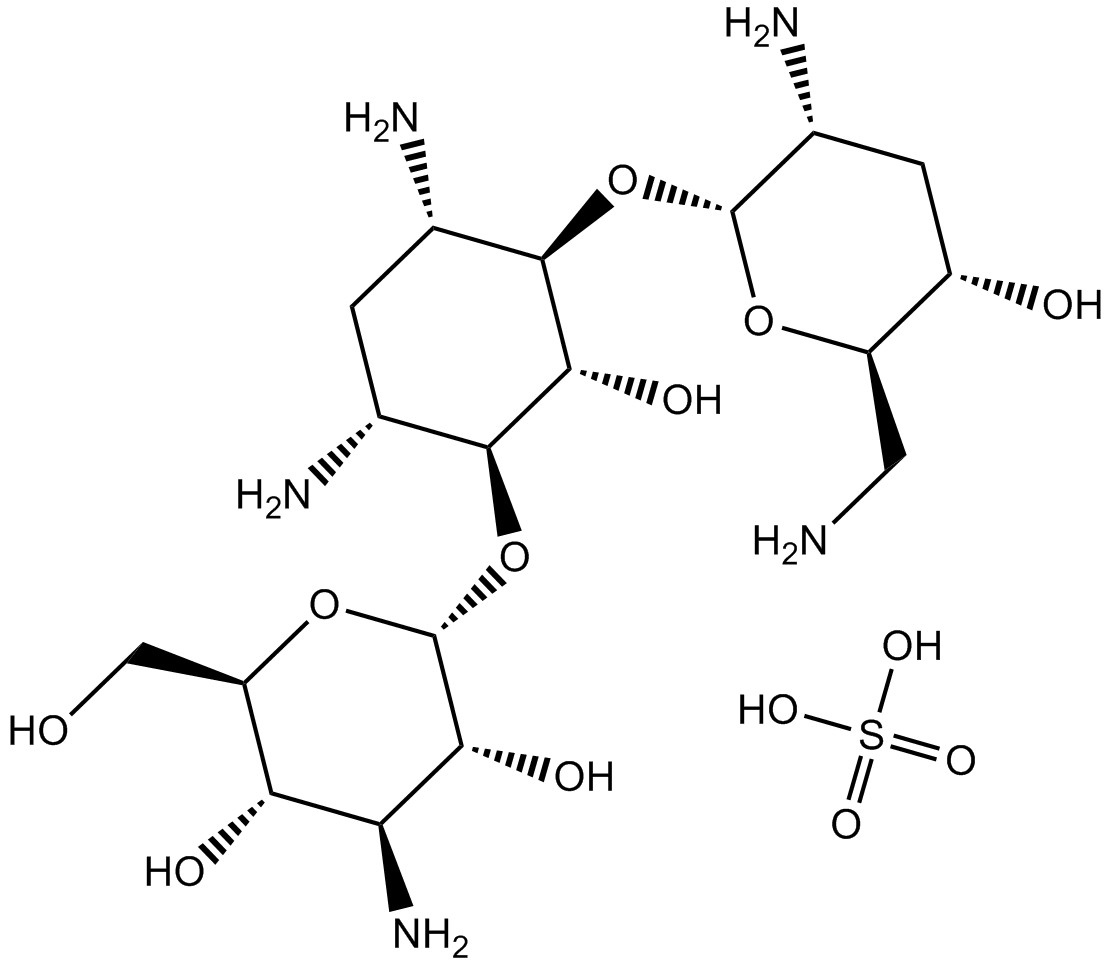
Cas No.: 79645-27-5; 49842-07-1
Sample solution is provided at 25 µL, 10mM.
_1-3.$$$39978408@51.jpg');)
_1-9.$$$38538795@65.jpg');)
_1-9.$$$39112701@51.jpg');)
_1-7.$$$37316672@70.jpg');)
_366-372.$$$36198801@70.jpg');)
.$$$38565142@65.jpg');)
_1867-1883.$$$33248023@67.jpg');)
_eads6055.$$$39977546@45.jpg');)
_eadm9805.$$$40080571@45.jpg');)
_eadj3020.$$$39666821@45.jpg');)
_1-20.$$$39757301@28.jpg');)
_1-24.$$$38898113@28.jpg');)
_273-287.$$$36806353@46.jpg');)
_1-16.$$$37156877@44.jpg');)
_1-19.$$$37460805@44.jpg');)
_1291-1307.$$$34518654@46.jpg');)
Tobramycin Sulfate is a parenterally administered aminoglycoside antibiotic with significant antibacterial activity against aerobic Gram-negative bacteria such as Pseudomonas aeruginosa[1]. Tobramycin Sulfate exerts its bactericidal effect by irreversibly binding to the bacterial 30S ribosomal subunit, thereby inhibiting protein synthesis[2]. Tobramycin Sulfate is commonly used to treat conditions such as ocular infections, respiratory tract infections in patients with cystic fibrosis, and urinary tract infections[3,4].
In vitro, treatment of 96 clinically isolated P. aeruginosa strains with Tobramycin Sulfate (0.39-25μg/mL) for 18h resulted in MICs ≤ 3.12μg/mL for 83/96 strains on Mueller Hinton agar, while its bacteriostatic activity was stronger in Mueller Hinton broth (MIC values were 2-8 times lower)[5]. Pretreatment of human lung microvascular endothelial cells (HLMVEC) with Tobramycin Sulfate (0.5mM) for 24h significantly inhibited platelet-induced T-cell migration (inhibition rate 66.5%)[6].
In vivo, combined administration of Tobramycin Sulfate (30mg/kg; once daily; s.c.) and Furanone C-30 (1mg/kg) to BALB/c mice implanted with a pre-infected P. aeruginosa silicone tube for up to 48h significantly reduced the bacterial load on the silicone implant. The synergistic clearance effect was significantly superior to monotherapy[7]. Intratracheal single-dose administration of Tobramycin Sulfate (250μg/mouse) on the first day after NMRI mice were infected with Klebsiella pneumoniae significantly increased the survival rate within 8 days post-infection by 33% compared to the untreated control group[8]. Treatment of CBA/Ca mice with Tobramycin Sulfate (200mg/kg/day; s.c. for 14 days) resulted in gap detection deficits in the gap pre-pulse inhibition of the acoustic startle (GPIAS) test in 36% of the mice, indicating tinnitus-like behavior. This behavior was most pronounced at 2 weeks post-administration and gradually diminished over time[9].
References:
[1] FIEL S B, ROESCH E A. The use of Tobramycin Sulfate for Pseudomonas aeruginosa: A review[J]. Expert Review of Respiratory Medicine, 2022, 16(5): 503-509.
[2] KRAUS L, DUCHARDT-FERNER E, BRÄUCHLE E, et al. Development of a novel Tobramycin Sulfate dependent riboswitch[J]. Nucleic Acids Research, 2023, 51(20): 11375-11385.
[3] CHEER S M, WAUGH J, NOBLE S. Inhaled Tobramycin Sulfate (TOBI®): A review of its use in the management of Pseudomonas aeruginosa infections in patients with cystic fibrosis[J]. Drugs, 2003, 63(22): 2501-2520.
[4] NEU H C. Tobramycin Sulfate: an overview[J]. The Journal of Infectious Diseases, 1976, S3-S19.
[5] MEYER R D, YOUNG L S, ARMSTRONG D. Tobramycin Sulfate (nebramycin factor 6): in vitro activity against Pseudomonas aeruginosa[J]. Applied Microbiology, 1971, 22(6): 1147-1151.
[6] GZIUT M, MACGREGOR H J, NEVELL T G, et al. Anti‐inflammatory effects of Tobramycin Sulfate and a copper–Tobramycin Sulfate complex with superoxide dismutase‐like activity[J]. British Journal of Pharmacology, 2013, 168(5): 1165-1181.
[7] CHRISTENSEN L D, VAN GENNIP M, JAKOBSEN T H, et al. Synergistic antibacterial efficacy of early combination treatment with Tobramycin Sulfate and quorum-sensing inhibitors against Pseudomonas aeruginosa in an intraperitoneal foreign-body infection mouse model[J]. Journal of Antimicrobial Chemotherapy, 2012, 67(5): 1198-1206.
[8] VAN‘T VEEN A, MOUTON J W, GOMMERS D, et al. Pulmonary surfactant as vehicle for intratracheally instilled Tobramycin Sulfate in mice infected with Klebsiella pneumoniae[J]. British Journal of Pharmacology, 1996, 119(6): 1145.
[9] LONGENECKER R J, GU R, HOMAN J, et al. Development of Tinnitus and Hyperacusis in a mouse model of Tobramycin Sulfate Cochleotoxicity[J]. Frontiers in Molecular Neuroscience, 2021, 14: 715952.
| Cell experiment [1]: | |
Cell lines | HLMVEC (human lung microvascular endothelial cells) |
Preparation Method | Tobramycin Sulfate (0.5mM) was co-incubated with HLMVEC for 24h, followed by co-culturing thrombin-activated platelets with pretreated HLMVEC to induce T cell migration. The migration inhibition effect was assessed by counting the number of T cells that migrated to the lower chamber of the Transwell. |
Reaction Conditions | 0.5mM; 24h |
Applications | Tobramycin Sulfate treatment significantly inhibited platelet-induced T cell migration (inhibition rate 66.5%). |
| Animal experiment [2]: | |
Animal models | CBA/Ca mice |
Preparation Method | Mice were given subcutaneous injections of Tobramycin Sulfate (200mg/kg/day) for 14 days. Gap prepulse inhibition of the acoustic startle reflex was used to assess behavioral evidence of tinnitus. GPIAS assessments were collected before (baseline), as well as at weeks 2, 6, 10, 14, and 18 from the start of Tobramycin Sulfate treatment. |
Dosage form | 200mg/kg/day; 14 days; s.c. |
Applications | Tobramycin Sulfate treatment resulted in gap detection defects in 36% of mice in the GPIAS test, exhibiting tinnitus-like behavior, which was most pronounced 2 weeks after administration and gradually decreased over time. |
References: | |
| Cas No. | 79645-27-5; 49842-07-1 | SDF | |
| Chemical Name | (2S,3R,4S,5S,6R)-4-amino-2-(((1S,2S,3R,4S,6R)-4,6-diamino-3-(((2R,3R,5S,6R)-3-amino-6-(aminomethyl)-5-hydroxytetrahydro-2H-pyran-2-yl)oxy)-2-hydroxycyclohexyl)oxy)-6-(hydroxymethyl)tetrahydro-2H-pyran-3,5-diol sulfate | ||
| Canonical SMILES | OS(O)(=O)=O.O[C@@H]([C@@H]([C@H]1N)O[C@H]([C@@H](C2)N)O[C@H](CN)[C@H]2O)[C@H]([C@@H](C1)N)O[C@H]([C@@H]([C@H]3N)O)O[C@H](CO)[C@H]3O | ||
| Formula | C18H39N5O13S | M.Wt | 565.59 |
| Löslichkeit | ≥ 57.4mg/mL in Water, <5.66mg/mL in DMSO | Storage | Store at -20°C |
| General tips | Please select the appropriate solvent to prepare the stock solution according to the
solubility of the product in different solvents; once the solution is prepared, please store it in
separate packages to avoid product failure caused by repeated freezing and thawing.Storage method
and period of the stock solution: When stored at -80°C, please use it within 6 months; when stored
at -20°C, please use it within 1 month. To increase solubility, heat the tube to 37°C and then oscillate in an ultrasonic bath for some time. |
||
| Shipping Condition | Evaluation sample solution: shipped with blue ice. All other sizes available: with RT, or with Blue Ice upon request. | ||
| Prepare stock solution | |||

|
1 mg | 5 mg | 10 mg |
| 1 mM | 1.7681 mL | 8.8403 mL | 17.6807 mL |
| 5 mM | 353.6 μL | 1.7681 mL | 3.5361 mL |
| 10 mM | 176.8 μL | 884 μL | 1.7681 mL |
Step 1: Enter information below (Recommended: An additional animal making an allowance for loss during the experiment)
 g
μL
g
μL
Step 2: Enter the in vivo formulation (This is only the calculator, not formulation. Please contact us first if there is no in vivo formulation at the solubility Section.)
Calculation results:
Working concentration: mg/ml;
Method for preparing DMSO master liquid: mg drug pre-dissolved in μL DMSO ( Master liquid concentration mg/mL, Please contact us first if the concentration exceeds the DMSO solubility of the batch of drug. )
Method for preparing in vivo formulation: Take μL DMSO master liquid, next addμL PEG300, mix and clarify, next addμL Tween 80, mix and clarify, next add μL saline, mix and clarify.
Method for preparing in vivo formulation: Take μL DMSO master liquid, next add μL Corn oil, mix and clarify.
Note: 1. Please make sure the liquid is clear before adding the next solvent.
2. Be sure to add the solvent(s) in order. You must ensure that the solution obtained, in the previous addition, is a clear solution before proceeding to add the next solvent. Physical methods such as vortex, ultrasound or hot water bath can be used to aid dissolving.
3. All of the above co-solvents are available for purchase on the GlpBio website.
Quality Control & SDS
- View current batch:
- Purity: >98.00% Appearance: A solid
- COA (Certificate of Analysis)
- SDS (Safety Data Sheet)
- Datasheet
Average Rating: 5 (Based on Reviews and 4 reference(s) in Google Scholar.)