

GTS 21 dihydrochloride (Synonyms: DMXB-A) |
Katalog-Nr.GC10913
 One-Click Copy Product Info
|

GTS 21 Dihydrochlorid ist ein selektiver alpha7-Nikotinacetylcholinrezeptor (α7-nAChR)-Agonist mit entzündungshemmenden und kognitionsfördernden Wirkungen.
Products are for research use only. Not for human use. We do not sell to patients.
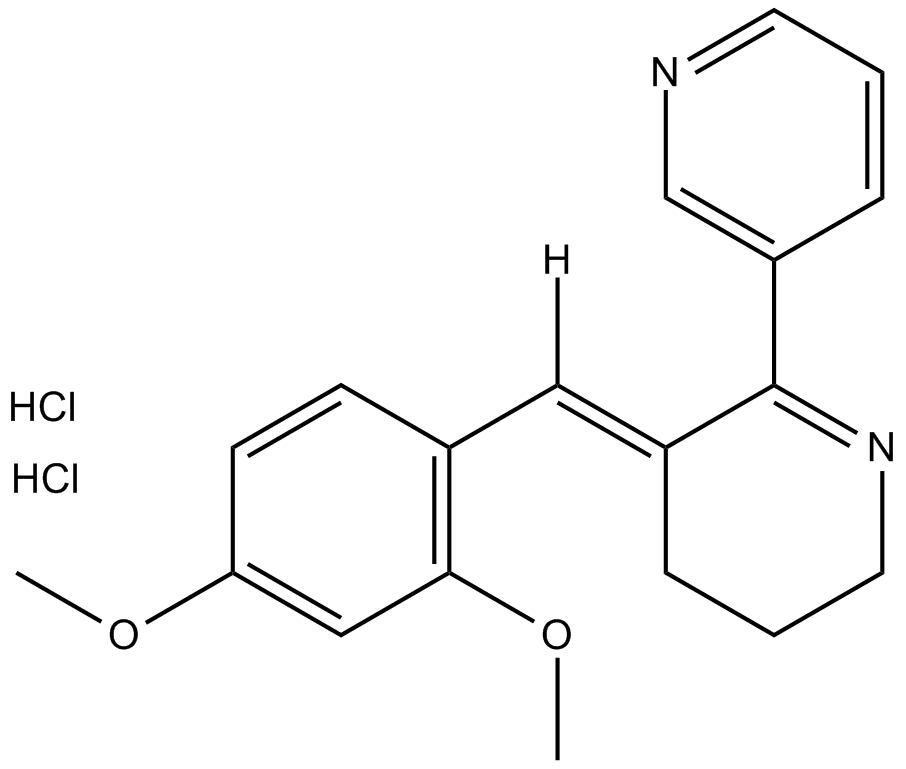
Cas No.: 156223-05-1
Sample solution is provided at 25 µL, 10mM.
_1-3.$$$39978408@51.jpg');)
_1-9.$$$38538795@65.jpg');)
_1-9.$$$39112701@51.jpg');)
_1-7.$$$37316672@70.jpg');)
_366-372.$$$36198801@70.jpg');)
.$$$38565142@65.jpg');)
_1867-1883.$$$33248023@67.jpg');)
_eads6055.$$$39977546@45.jpg');)
_eadm9805.$$$40080571@45.jpg');)
_eadj3020.$$$39666821@45.jpg');)
_1-20.$$$39757301@28.jpg');)
_1-24.$$$38898113@28.jpg');)
_273-287.$$$36806353@46.jpg');)
_1-16.$$$37156877@44.jpg');)
_1-19.$$$37460805@44.jpg');)
_1291-1307.$$$34518654@46.jpg');)
GTS 21 dihydrochloride is a selective partial agonist of the α7 nicotinic acetylcholine receptor (α7-nAChR), possessing anti-inflammatory and cognition-enhancing activities[1]. GTS 21 dihydrochloride also acts as an antagonist of the α4β2 nAChR (Ki=20nM) and the 5-HT3A receptor (IC50=3.1μM)[2]. GTS 21 dihydrochloride is utilized in research related to age-associated memory impairment (AAMI), Alzheimer's disease, schizophrenia, and acute lung injury[3-4].
In vitro, pretreatment of PC12 cells with GTS 21 dihydrochloride (3μM) for 10 minutes, followed by stimulation with ethanol (100mM) for 24 hours, significantly attenuated ethanol-induced cytotoxicity and suppressed the abnormal increase in intracellular calcium concentration[5]. In human renal tubular epithelial cells (HK-2), pretreatment with GTS 21 dihydrochloride (3–10μM) for 30 minutes prior to LPS (10μg/ml) stimulation for 24 hours significantly inhibited NF-κB nuclear translocation and the expression of the kidney injury marker NGAL, while also reducing the secretion of the chemokine CCL20, thereby mitigating macrophage migration and infiltration into renal tubular cells[6].
In vivo, in Leprdb/db mice aged 10-12 weeks, intraperitoneal administration of GTS 21 dihydrochloride (4mg/kg) twice a day for 8 weeks significantly improved renal function parameters, e.g. Blood Urea Nitrogen (BUN), creatinine, reduced levels of kidney injury markers (KIM-1, NGAL) and inflammatory cytokines (IL-6, HMGB-1), and alleviated glomerular mesangial matrix expansion and apoptosis[7]. In a septic acute kidney injury model induced by LPS (5mg/kg; i.p.) in C57BL/6J mice, a single pretreatment with GTS 21 dihydrochloride (20mg/kg; i.p.) 15 minutes prior to LPS challenge significantly lowered plasma TNF-α levels, BUN, and the expression of renal injury markers NGAL and KIM-1, while also reducing the number of apoptotic cells in kidney tissue[8].
References:
[1] Briggs CA, Anderson DJ, Brioni JD, et al. Functional characterization of the novel neuronal nicotinic acetylcholine receptor ligand GTS-21 in vitro and in vivo. Pharmacol Biochem Behav. 1997 May-Jun;57(1-2):231-41.
[2] Zhang R, White NA, Soti FS, et al. N-terminal domains in mouse and human 5-hydroxytryptamine3A receptors confer partial agonist and antagonist properties to benzylidene analogs of anabaseine. J Pharmacol Exp Ther. 2006 Jun;317(3):1276-84.
[3] Olincy A, Harris JG, Johnson LL, et al. Proof-of-concept trial of an alpha7 nicotinic agonist in schizophrenia. Arch Gen Psychiatry. 2006 Jun;63(6):630-8.
[4] Adams CE, Stevens KE, Kem WR, et al. Inhibition of nitric oxide synthase prevents alpha 7 nicotinic receptor-mediated restoration of inhibitory auditory gating in rat hippocampus. Brain Res. 2000 Sep 22;877(2):235-44.
[5] Li Y, King MA, Grimes J, et al. Alpha7 nicotinic receptor mediated protection against ethanol-induced cytotoxicity in PC12 cells. Brain Res. 1999 Jan 16;816(1):225-8.
[6] Yang A, Wu CH, Matsuo S, et al. Activation of the α7nAChR by GTS-21 mitigates septic tubular cell injury and modulates macrophage infiltration. Int Immunopharmacol. 2024 Sep 10;138:112555.
[7] Nakamura Y, Matsumoto H, Wu CH, et al. Alpha 7 nicotinic acetylcholine receptors signaling boosts cell-cell interactions in macrophages effecting anti-inflammatory and organ protection. Commun Biol. 2023 Jun 23;6(1):666.
[8] Meng Q, Tian X, Li J, et al. GTS-21, a selective alpha7 nicotinic acetylcholine receptor agonist, ameliorates diabetic nephropathy in Leprdb/db mice. Sci Rep. 2022 Dec 26;12(1):22360.
| Cell experiment [1]: | |
Cell lines | PC12 cells (rat pheochromocytoma cell line) |
Preparation Method | PC12 cells were cultured as described previously and maintained under standard conditions. Cells were treated with GTS 21 dihydrochloride (3μM) for 10min prior to ethanol (100mM) exposure for 24h. |
Reaction Conditions | 3μM; pretreatment for 10min |
Applications | GTS 21 dihydrochloride significantly attenuated ethanol-induced cytotoxicity in PC12 cells, reducing cell loss and suppressing the ethanol-triggered increase in intracellular calcium concentration. |
| Animal experiment [2]: | |
Animal models | Leprdb/db mice (model of type 2 diabetes and diabetic nephropathy) and db/+ control mice |
Preparation Method | Mice (10-12 weeks old) received GTS 21 dihydrochloride (4mg/kg) via intraperitoneal injection twice daily for 8 weeks. Control groups received vehicle. Kidney function, injury markers, and inflammatory cytokines were assessed post-treatment. |
Dosage form | 4mg/kg; i.p. |
Applications | GTS 21 dihydrochloride significantly ameliorated diabetic nephropathy by reducing plasma levels of BUN, creatinine, KIM-1, and NGAL, attenuating renal inflammation (IL-6 and HMGB-1), decreasing mitochondrial dysfunction (cytochrome C release), and suppressing apoptosis (cleaved caspase-3 and Bax). Histological analysis revealed reduced mesangial matrix expansion and glomerular injury. GTS 21 dihydrochloride also modulated signaling pathways by enhancing PI3K/AKT activity and inhibiting p38 MAPK activation. |
References: | |
| Cas No. | 156223-05-1 | SDF | |
| Überlieferungen | DMXB-A | ||
| Chemical Name | (E)-3-(2,4-dimethoxybenzylidene)-3,4,5,6-tetrahydro-2,3'-bipyridine dihydrochloride | ||
| Canonical SMILES | COC1=CC(OC)=C(/C([H])=C2CCCN=C\2C3=CN=CC=C3)C=C1.Cl.Cl | ||
| Formula | C19H20N2O2.2HCl | M.Wt | 381.3 |
| Löslichkeit | DMF: 1 mg/ml,DMSO: 2 mg/ml,Ethanol: 1 mg/ml,PBS (pH 7.2): 10 mg/ml | Storage | Store at -20°C |
| General tips | Please select the appropriate solvent to prepare the stock solution according to the
solubility of the product in different solvents; once the solution is prepared, please store it in
separate packages to avoid product failure caused by repeated freezing and thawing.Storage method
and period of the stock solution: When stored at -80°C, please use it within 6 months; when stored
at -20°C, please use it within 1 month. To increase solubility, heat the tube to 37°C and then oscillate in an ultrasonic bath for some time. |
||
| Shipping Condition | Evaluation sample solution: shipped with blue ice. All other sizes available: with RT, or with Blue Ice upon request. | ||
| Prepare stock solution | |||

|
1 mg | 5 mg | 10 mg |
| 1 mM | 2.6226 mL | 13.113 mL | 26.2261 mL |
| 5 mM | 524.5 μL | 2.6226 mL | 5.2452 mL |
| 10 mM | 262.3 μL | 1.3113 mL | 2.6226 mL |
Step 1: Enter information below (Recommended: An additional animal making an allowance for loss during the experiment)
 g
μL
g
μL
Step 2: Enter the in vivo formulation (This is only the calculator, not formulation. Please contact us first if there is no in vivo formulation at the solubility Section.)
Calculation results:
Working concentration: mg/ml;
Method for preparing DMSO master liquid: mg drug pre-dissolved in μL DMSO ( Master liquid concentration mg/mL, Please contact us first if the concentration exceeds the DMSO solubility of the batch of drug. )
Method for preparing in vivo formulation: Take μL DMSO master liquid, next addμL PEG300, mix and clarify, next addμL Tween 80, mix and clarify, next add μL saline, mix and clarify.
Method for preparing in vivo formulation: Take μL DMSO master liquid, next add μL Corn oil, mix and clarify.
Note: 1. Please make sure the liquid is clear before adding the next solvent.
2. Be sure to add the solvent(s) in order. You must ensure that the solution obtained, in the previous addition, is a clear solution before proceeding to add the next solvent. Physical methods such as vortex, ultrasound or hot water bath can be used to aid dissolving.
3. All of the above co-solvents are available for purchase on the GlpBio website.
Quality Control & SDS
- View current batch:
- Purity: >99.50% Appearance: A solid
- COA (Certificate of Analysis)
- SDS (Safety Data Sheet)
- Datasheet
Average Rating: 5 (Based on Reviews and 17 reference(s) in Google Scholar.)