

Triapine (3-AP) |
Katalog-Nr.GC17897
 One-Click Copy Product Info
|

Triapine (3-AP) is a ribonucleotide reductase (RNR) M2 subunit inhibitor.
Products are for research use only. Not for human use. We do not sell to patients.
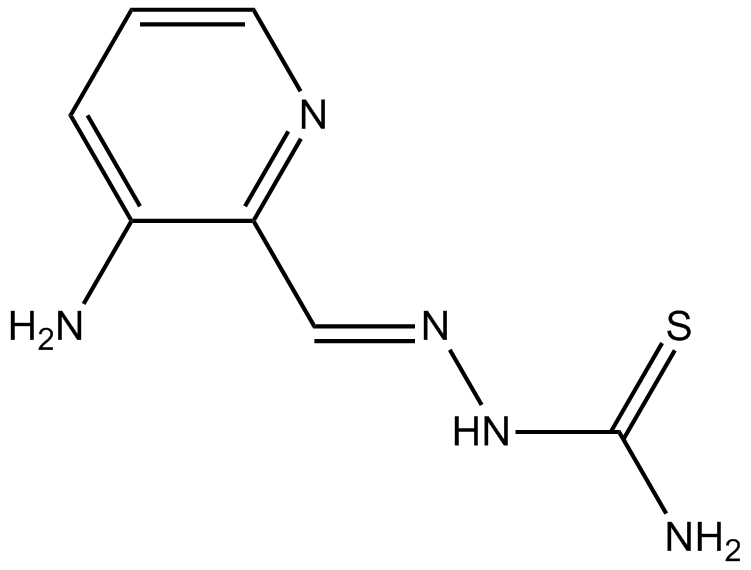
Cas No.: 143621-35-6
Sample solution is provided at 25 µL, 10mM.
Triapine (3-AP) is a ribonucleotide reductase (RNR) M2 subunit inhibitor. Triapine forms a chelator with intracellular iron ions. Triapine can be used in research related to cervical cancer, pancreatic cancer, leukemia, and glioma[1-4].
In vitro, pretreatment of Ewing sarcoma cells (WE-68, SK-ES-1, A673) with VE821 (1-5μM) for 1 hour, followed by treatment with Triapine (0.125–1μM) for 48 hours. Triapine significantly synergistically induced cell death, while promoting mitochondrial membrane potential dissipation and caspase 3/7 activity[5]. Treatment of SKOV-3-DR-GFP cells with Triapine (0.75μM) for 24-48 hours. Triapine significantly inhibited homologous recombination repair activity[6].
In vivo, Triapine (10mg/kg; administered for 5 consecutive days per week) was intraperitoneally injected into female athymic nude mice bearing SKOV-3 tumors for 4 weeks. Triapine alone had minimal effect on tumor growth delay, but significantly enhanced tumor growth delay when combined with carboplatin and liposomal doxorubicin[7]. Triapine (10mg/kg; administered for 5 consecutive days per week) combined with olaparib (50mg/kg) and cediranib (0.75mg/kg) was intraperitoneally injected into female athymic nude mice bearing SKOV3 or OVCAR3 tumors for 6 weeks. The combination of Triapine, olaparib, and cediranib significantly suppressed the growth of BRCA-wild type epithelial ovarian cancer and prolonged the survival of mice[8].
References:
[1] Martin LK, Grecula J, Jia G, et al. A dose escalation and pharmacodynamic study of triapine and radiation in patients with locally advanced pancreas cancer. Int J Radiat Oncol Biol Phys. 2012 Nov 15;84(4):e475-81.
[2] Yalowich JC, Wu X, Zhang R, et al. The anticancer thiosemicarbazones Dp44mT and triapine lack inhibitory effects as catalytic inhibitors or poisons of DNA topoisomerase IIα. Biochem Pharmacol. 2012 Jul 1;84(1):52-8.
[3] Whitnall M, Howard J, Ponka P, et al. A class of iron chelators with a wide spectrum of potent antitumor activity that overcomes resistance to chemotherapeutics. Proc Natl Acad Sci U S A. 2006 Oct 3;103(40):14901-6.
[4] Qu Q, Chen Y, Wang Y, et al. Lithocholic acid phenocopies anti-ageing effects of calorie restriction. Nature. 2025 Jul;643(8070):192-200.
[5] Sturm MJ, Henao-Restrepo JA, Becker S, et al. Synergistic anticancer activity of combined ATR and ribonucleotide reductase inhibition in Ewing's sarcoma cells. J Cancer Res Clin Oncol. 2023 Sep;149(11):8605-8617.
[6] Lin ZP, Ratner ES, Whicker ME, et al. Triapine disrupts CtIP-mediated homologous recombination repair and sensitizes ovarian cancer cells to PARP and topoisomerase inhibitors. Mol Cancer Res. 2014 Mar;12(3):381-393.
[7] Ratner ES, Zhu YL, Penketh PG, et al. Triapine potentiates platinum-based combination therapy by disruption of homologous recombination repair. Br J Cancer. 2016 Mar 29;114(7):777-86.
[8] Lin ZP, Zhu YL, Lo YC, et al. Combination of triapine, olaparib, and cediranib suppresses progression of BRCA-wild type and PARP inhibitor-resistant epithelial ovarian cancer. PLoS One. 2018 Nov 16;13(11):e0207399.
| Cell experiment [1]: | |
Cell lines | SKOV-3-DR-GFP cells (human ovarian cancer cell line) |
Preparation Method | SKOV-3-DR-GFP cells were treated with 0.75μM Triapine for 24 hours followed by an additional 24 hours of incubation treated continuously with 0.75μM Triapine for 48 hours. |
Reaction Conditions | 0.75μM; 24-48h pretreatment |
Applications | Triapine treatment for 24 hours followed by 24-hour recovery resulted in more than a 50% decrease in I-SceI-induced homologous recombination repair (HRR) activity. Continuous treatment with Triapine for 48 hours led to nearly complete abrogation of I-SceI-induced HRR activity. |
| Animal experiment [2]: | |
Animal models | Athymic nude mice and SCID-Beige mice |
Preparation Method | For subcutaneous xenograft experiments, SKOV3 or OVCAR3 cells suspended in serum-free medium mixed with Matrigel were implanted subcutaneously. For intraperitoneal xenograft experiments, PEO4ip cells suspended in serum-free medium were implanted intraperitoneally. Mice were treated intraperitoneally with vehicle or Triapine+olaparib+cediranib once daily for 5 consecutive days per week. |
Dosage form | 10mg/kg; i.p.; daily for 5 consecutive days per week for 6 weeks |
Applications | Triapine alone had no inhibitory effects on the growth of SKOV3 xenografts in mice. The combination of Triapine, olaparib, and cediranib resulted in marked suppression of BRCA-wild type epithelial ovarian cancer growth and significant prolongation of the survival time of mice in both subcutaneous and intraperitoneal xenograft models. |
References: | |
| Cas No. | 143621-35-6 | SDF | |
| Chemical Name | [(E)-(3-aminopyridin-2-yl)methylideneamino]thiourea | ||
| Canonical SMILES | C1=CC(=C(N=C1)C=NNC(=S)N)N | ||
| Formula | C7H9N5S | M.Wt | 195.24 |
| Löslichkeit | ≥ 83.3mg/mL in DMSO | Storage | Store at -20° C |
| General tips | Please select the appropriate solvent to prepare the stock solution according to the
solubility of the product in different solvents; once the solution is prepared, please store it in
separate packages to avoid product failure caused by repeated freezing and thawing.Storage method
and period of the stock solution: When stored at -80°C, please use it within 6 months; when stored
at -20°C, please use it within 1 month. To increase solubility, heat the tube to 37°C and then oscillate in an ultrasonic bath for some time. |
||
| Shipping Condition | Evaluation sample solution: shipped with blue ice. All other sizes available: with RT, or with Blue Ice upon request. | ||
| Prepare stock solution | |||

|
1 mg | 5 mg | 10 mg |
| 1 mM | 5.1219 mL | 25.6095 mL | 51.219 mL |
| 5 mM | 1.0244 mL | 5.1219 mL | 10.2438 mL |
| 10 mM | 512.2 μL | 2.561 mL | 5.1219 mL |
Step 1: Enter information below (Recommended: An additional animal making an allowance for loss during the experiment)
 g
μL
g
μL
Step 2: Enter the in vivo formulation (This is only the calculator, not formulation. Please contact us first if there is no in vivo formulation at the solubility Section.)
Calculation results:
Working concentration: mg/ml;
Method for preparing DMSO master liquid: mg drug pre-dissolved in μL DMSO ( Master liquid concentration mg/mL, Please contact us first if the concentration exceeds the DMSO solubility of the batch of drug. )
Method for preparing in vivo formulation: Take μL DMSO master liquid, next addμL PEG300, mix and clarify, next addμL Tween 80, mix and clarify, next add μL saline, mix and clarify.
Method for preparing in vivo formulation: Take μL DMSO master liquid, next add μL Corn oil, mix and clarify.
Note: 1. Please make sure the liquid is clear before adding the next solvent.
2. Be sure to add the solvent(s) in order. You must ensure that the solution obtained, in the previous addition, is a clear solution before proceeding to add the next solvent. Physical methods such as vortex, ultrasound or hot water bath can be used to aid dissolving.
3. All of the above co-solvents are available for purchase on the GlpBio website.
Quality Control & SDS
- View current batch:
- Purity: >98.00% Appearance: A solid
- COA (Certificate of Analysis)
- SDS (Safety Data Sheet)
- Datasheet
Average Rating: 5 (Based on Reviews and 40 reference(s) in Google Scholar.)