
XL-784 |
| Katalog-Nr.GC32505 |
XL-784 ist ein selektiver Matrix-Metalloproteinasen (MMP)-Inhibitor mit IC50-Werten von ~1900, 0,81, 120, 10,8, 18, 0,56 nM fÜr MMP-1, MMP-2, MMP-3, MMP-8, MMP-9 MMP-13 bzw.
Products are for research use only. Not for human use. We do not sell to patients.
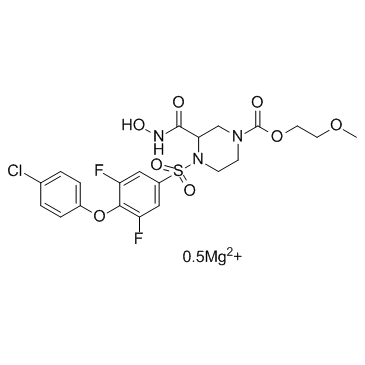
Cas No.: 1224964-36-6
Sample solution is provided at 25 µL, 10mM.
XL-784 is a selective matrix metalloproteinases (MMP) inhibitor, with IC50s of ~1900, 0.81, 120, 10.8, 18, 0.56 nM for MMP-1,MMP-2,MMP-3,MMP-8,MMP-9,MMP-13,respectively.
XL-784 is a highly potent, low-molecular-weight (1,122 g/mol) inhibitor of MMPs that has very limited aqueous solubility (20 μg/mL). XL-784 potently inhibits MMP-2, MMP-13, andADAM10 [TNF-α-converting enzyme (TACE)] activity in vitro, with IC50 values in the range of 1-2 nM. XL-784 also inhibits MMP-9 (IC50 ~20 nM) activity and ADAM17 (IC50 ~70 nM) also known as TACE. However, it exhibits low potency for inhibition of MMP-1 (IC50 ~2,000 nM)[1].
All mice tolerate the treatments similarly. Control mice all developed aneurysms with a mean %△AD of 158.5%±4.3%. Treatment with all doses of XL-784 and doxycycline are effective in inhibiting aortic dilatation. There is a clear dose-response relationship between XL-784 and reductions in aortic dilatation at harvest (50 mg/kg 140.4% ±3.2%; 125 mg/kg 129.3% ±5.1%; 250 mg/kg 119.2%±3.5%; all Ps<0.01 compared to control). This continues with the higher doses (375 mg/kg 88.6%±4.4%; 500 mg/kg 76.0%±3.5%). The highest 2 doses of XL-784 tested are more effective than doxycycline (112.2%±2.0%, P<0.05) in inhibiting maximal dilatation of the aorta after elastase perfusion[2].
[1]. Williams JM, et al. Evaluation of metalloprotease inhibitors on hypertension and diabetic nephropathy. Am J Physiol Renal Physiol. 2011 Apr;300(4):F983-98. [2]. Ennis T, et al. Effect of novel limited-spectrum MMP inhibitor XL784 in abdominal aortic aneurysms. J Cardiovasc Pharmacol Ther. 2012 Dec;17(4):417-26.

Animal experiment: | Mice[2]A total of 89 mice undergo aortic perfusion. Beginning the day of perfusion, animals are treated with the study drug (e.g., XL-784), a negative control, or doxycycline. 76 animals survive to sacrifice and are included in the analysis. Animals treated with the experimental agent, XL-784, receive gavage daily with the agent diluted in 0.1 mL of Cremophor, a nonionic castor oil-based solubilizer and emulsifying agent. Three doses of the drug are used, 50 (n=17), 125 (n=17), and 250 mg/kg per d (n=18) administered as a single daily dose. The fifth group of mice do not receive a gavage treatment but are treated with doxycycline (n=19) in their drinking water at a concentration 100 mg/kg per d of the animals. In the second treatment protocol, a total of 50 animals underwent aortic perfusion and 47 animals survive for analysis at 14 days. The 5 treatment groups are XL-784 at 250, 375, or 500 mg/kg, Cremaphor diluent alone, or doxycycline 100 mg/kg. Animals are assigned in groups of 3 to a treatment group rotating randomly through each treatment group until there are 9 animals in each group except for the 500 mg/kg per d group which totaled to 14 animals[2]. |
References: [1]. Williams JM, et al. Evaluation of metalloprotease inhibitors on hypertension and diabetic nephropathy. Am J Physiol Renal Physiol. 2011 Apr;300(4):F983-98. | |
| Cas No. | 1224964-36-6 | SDF | |
| Canonical SMILES | O=C(N1CC(C(NO)=O)N(S(=O)(C2=CC(F)=C(OC3=CC=C(Cl)C=C3)C(F)=C2)=O)CC1)OCCOC.[0.5Mg2+] | ||
| Formula | C21H22ClF2N3O8S | M.Wt | 549.93 |
| Löslichkeit | DMSO: ≥ 110 mg/mL (200.39 mM) | Storage | Store at -20°C |
| General tips | Please select the appropriate solvent to prepare the stock solution according to the
solubility of the product in different solvents; once the solution is prepared, please store it in
separate packages to avoid product failure caused by repeated freezing and thawing.Storage method
and period of the stock solution: When stored at -80°C, please use it within 6 months; when stored
at -20°C, please use it within 1 month. To increase solubility, heat the tube to 37°C and then oscillate in an ultrasonic bath for some time. |
||
| Shipping Condition | Evaluation sample solution: shipped with blue ice. All other sizes available: with RT, or with Blue Ice upon request. | ||
| Prepare stock solution | |||
|
1 mg | 5 mg | 10 mg |
| 1 mM | 1.8184 mL | 9.0921 mL | 18.1841 mL |
| 5 mM | 363.7 μL | 1.8184 mL | 3.6368 mL |
| 10 mM | 181.8 μL | 909.2 μL | 1.8184 mL |
Step 1: Enter information below (Recommended: An additional animal making an allowance for loss during the experiment)
Step 2: Enter the in vivo formulation (This is only the calculator, not formulation. Please contact us first if there is no in vivo formulation at the solubility Section.)
Calculation results:
Working concentration: mg/ml;
Method for preparing DMSO master liquid: mg drug pre-dissolved in μL DMSO ( Master liquid concentration mg/mL, Please contact us first if the concentration exceeds the DMSO solubility of the batch of drug. )
Method for preparing in vivo formulation: Take μL DMSO master liquid, next addμL PEG300, mix and clarify, next addμL Tween 80, mix and clarify, next add μL ddH2O, mix and clarify.
Method for preparing in vivo formulation: Take μL DMSO master liquid, next add μL Corn oil, mix and clarify.
Note: 1. Please make sure the liquid is clear before adding the next solvent.
2. Be sure to add the solvent(s) in order. You must ensure that the solution obtained, in the previous addition, is a clear solution before proceeding to add the next solvent. Physical methods such as vortex, ultrasound or hot water bath can be used to aid dissolving.
3. All of the above co-solvents are available for purchase on the GlpBio website.
Quality Control & SDS
- View current batch:
- Purity: >98.00%
- COA (Certificate Of Analysis)
- SDS (Safety Data Sheet)
- Datasheet
Average Rating: 5 (Based on Reviews and 8 reference(s) in Google Scholar.)
GLPBIO products are for RESEARCH USE ONLY. Please make sure your review or question is research based.
Required fields are marked with *


