

E3330 (Synonyms: APX 3330) |
Catalog No.GC10620
 One-Click Copy Product Info
|

E3330 est un inhibiteur de petite-molécule de l'endonucléase apurique-apyrimidique/facteur effecteur redox (APE1/Ref-1) pour la fonction du domaine redox (IC50, 50 µmol/L).
Products are for research use only. Not for human use. We do not sell to patients.
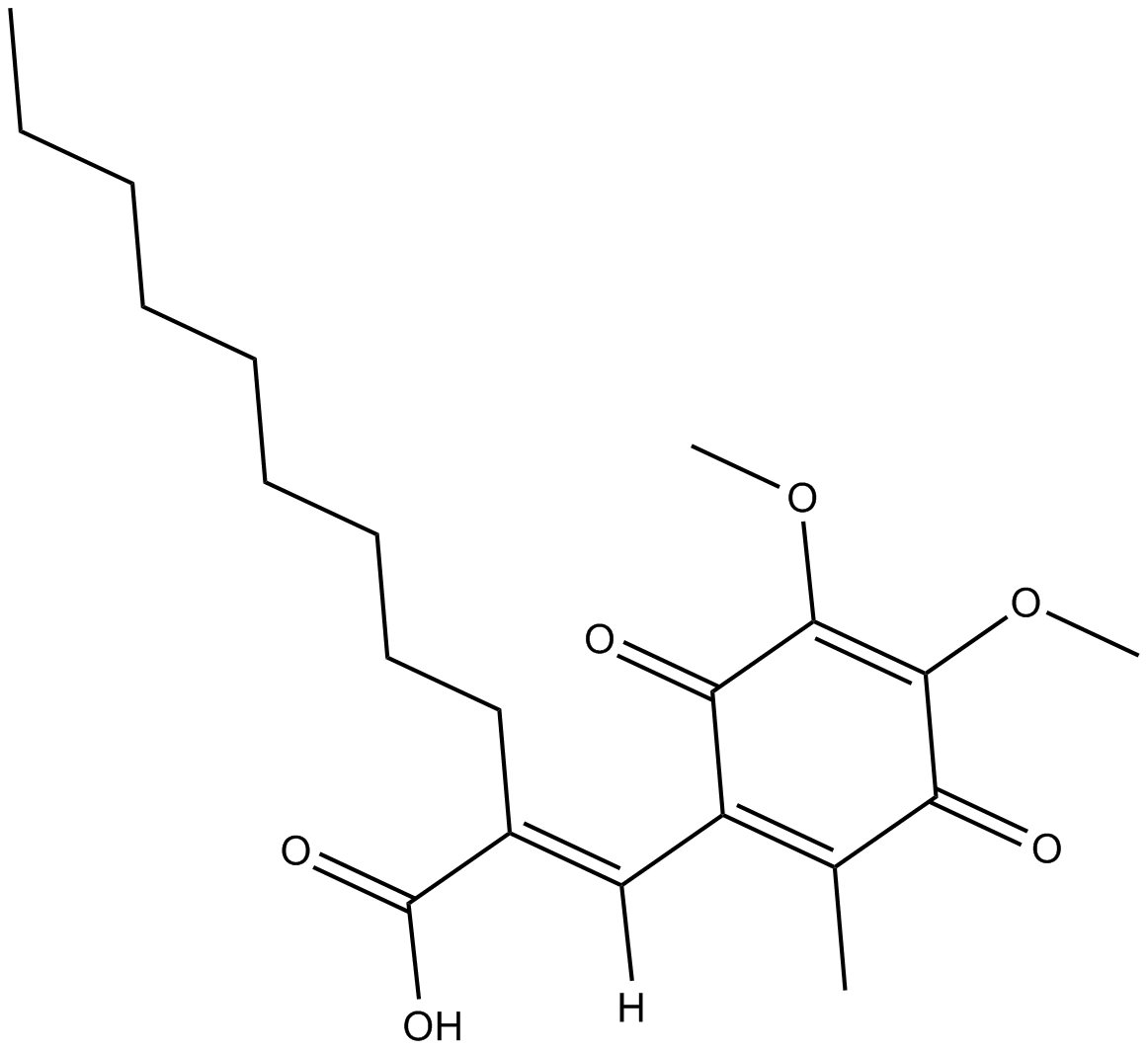
Cas No.: 136164-66-4
Sample solution is provided at 25 µL, 10mM.
E3330 est un inhibiteur de petite-molécule de l'endonucléase apurique-apyrimidique/facteur effecteur redox (APE1/Ref-1) pour la fonction du domaine redox (IC50, 50 µmol/L)[1,2].
E3330(10-30 µM, 72h) inhibe non-seulement la croissance, mais également les capacités migratoires de cellules du cancer de pancréase in vitroo [1]. La co-incubation de E3330(30 µM, 3 h ) et de cisplatine (5-20 µM, 72 h) a significativement réduit la viabilité cellulaire par rapport à la cisplatine seule dans la lignée cellulaire de NSCLC humain H1975[3]. Le traitement de E3330 a empêché l'activation fonctionnelle de NF-κB via modification de la trafik subcellulaire d'APE1 et a réduit l'expression d' IL-6 et d'IL-8 qui est induite par TNF-α [4]. E3330 a clairement supprimé la sécrétion de cytokines inflammatoires comme le facteur de nécrose tumorale-α (TNF-α), l'interleukine (IL-6) et IL-12, ainsi que les médiateurs inflammatoires comme oxyde nitrique (NO) et la prostaglandine E2 (PGE2) à partir de cellules RAW264.7 LPS-stimulées [5].
Le traitement de E3330 (10-100 mg/kg, par voie orale) a atténué les lésions hépatiques 1 heure après la stimulation par la galactosamine. E3330 est efficace lorsque ce qui est administré par voie orale 6 ou 12 heures après la stimulation par la galactosamine dans le modèle d'hépatite galactosamine-induit dans les rats F344 [6]. L'injection de TNF combinée avec la galactosamine a induit une lésion sévère hépatique. Le pré-traitement par voie orale de 100 et 300 mg/kg E3330 a considérablement atténué l'augmentation des activités de L-alanine aminotransférase et de L-aspartate aminotransférase plasmatiques 30 minutes avant l'injection de galactosamine/TNF[7]. La demi-vie estimée (t1/2) de E3330 est 3.7 heures dans les rats[2].
References:
[1]. Zou G M, Maitra A. Small-molecule inhibitor of the AP endonuclease 1/REF-1 E3330 inhibits pancreatic cancer cell growth and migration[J]. Molecular cancer therapeutics, 2008, 7(7): 2012-2021.
[2]. Fishel M L, Colvin E S, Luo M, et al. Inhibition of the redox function of APE1/Ref-1 in myeloid leukemia cell lines results in a hypersensitive response to retinoic acid-induced differentiation and apoptosis[J]. Experimental hematology, 2010, 38(12): 1178-1188.
[3]. Manguinhas R, Fernandes A S, Costa J G, et al. Impact of the APE1 redox function inhibitor E3330 in non-small cell lung cancer cells exposed to cisplatin: increased cytotoxicity and impairment of cell migration and invasion[J]. Antioxidants, 2020, 9(6): 550.
[4]. Cesaratto L, Codarin E, Vascotto C, et al. Specific inhibition of the redox activity of ape1/ref-1 by e3330 blocks tnf-α-induced activation of IL-8 production in liver cancer cell lines[J]. PLoS One, 2013, 8(8): e70909.
[5]. Jedinak A, Dudhgaonkar S, Kelley M R, et al. Apurinic/Apyrimidinic endonuclease 1 regulates inflammatory response in macrophages[J]. Anticancer research, 2011, 31(2): 379-385.
[6]. Nagakawa J, Hirota K, Hishinuma I, et al. Protective effect of E3330, a novel quinone derivative, in galactosamine-induced hepatitis in rats[J]. Journal of Pharmacology and Experimental Therapeutics, 1993, 264(1): 496-500.
[7]. Nagakawa J, Hishinuma I, Hirota K, et al. Protective effects of E3330, a novel quinone derivative, on galactosamine/tumor necrosis factor-α-induced hepatitis in mice[J]. European journal of pharmacology, 1992, 229(1): 63-67.
| Expériences cellulaires [1]: | |
Lignées cellulaires | Cellules du cancer de pancréas PaCa-2 et Panc-1 |
Méthode de préparation | Les cellules ont été maintenues à 37°C dans 5% CO2 et ont été cultivées dans le Substrat Modifié d'Eagle de Dulbecco avec 10% sérum de veau cosmique. Les cellules PaCa-2 et Panc-1 ont été traitées par E3330 pendant respectivement 72 et 48 heures. |
Conditions de réaction | 0-135 µM pendant 48, 72 h |
Domaines d'application | L'effet que E3330 peut ralentir efficaement de mainière dose-dépendante la vitesse de croissance des cellules a été constaté, ce que les valeurs d'ED50 sont 135 et 87 µmol/L pour respectivement PaCa-2 and Panc-1. |
| Expériences animales [1]: | |
Modèles animaux | Rats non-obsèse diabétiques / immunodéficientes sévèrement combiés (NOD/SCID) |
Méthode de préparation | Les cellules PaCa-2 (2.5 × 10⁶) dans 0.2 mL DMEM ont été implantées par voie sous-cutanée dans le flanc droit de rats NOD/SCID. E3330 a été dissous dans une solution de 4% CremophorEL:EtOH (1:1)/saline ou dans la méthylcellulose (0.5%). Quand les volumes tumoraux sont supérieurs à 100 mm3, E3330 a été administré par voie orale deux fois par jour, avec un intervalle de 8 heures, à 25mg/kg pendant 10 à 12 jours (régime 5 jours sur 2 jours de repos). Les tumeurs ont été mesurées tous les deux jours et ont été observées pendant approximativement 6 semaines. |
Forme de dosage | 25 mg/kg, par voie orale deux fois par jour, pendant 10 à12 days (régime 5 jours sur 2 jours de repos) |
Domaines d'application | Au contraire aux tumeurs de véhicule - témoin, les xénogreffes PaCa-2 a présenté un retard significatif de la croissance tumorale. |
References: | |
| Cas No. | 136164-66-4 | SDF | |
| Synonymes | APX 3330 | ||
| Chemical Name | (E)-2-((4,5-dimethoxy-2-methyl-3,6-dioxocyclohexa-1,4-dien-1-yl)methylene)undecanoic acid | ||
| Canonical SMILES | CCCCCCCCC/C(C(O)=O)=C([H])\C(C1=O)=C(C(C(OC)=C1OC)=O)C | ||
| Formula | C21H30O6 | M.Wt | 378.46 |
| Solubility | ≥ 75.4mg/mL in DMSO, ≥ 75.4mg/mL in EtOH | Storage | Store at -20°C |
| General tips | Please select the appropriate solvent to prepare the stock solution according to the
solubility of the product in different solvents; once the solution is prepared, please store it in
separate packages to avoid product failure caused by repeated freezing and thawing.Storage method
and period of the stock solution: When stored at -80°C, please use it within 6 months; when stored
at -20°C, please use it within 1 month. To increase solubility, heat the tube to 37°C and then oscillate in an ultrasonic bath for some time. |
||
| Shipping Condition | Evaluation sample solution: shipped with blue ice. All other sizes available: with RT, or with Blue Ice upon request. | ||
| Prepare stock solution | |||

|
1 mg | 5 mg | 10 mg |
| 1 mM | 2.6423 mL | 13.2114 mL | 26.4229 mL |
| 5 mM | 528.5 μL | 2.6423 mL | 5.2846 mL |
| 10 mM | 264.2 μL | 1.3211 mL | 2.6423 mL |
Step 1: Enter information below (Recommended: An additional animal making an allowance for loss during the experiment)
 g
μL
g
μL
Step 2: Enter the in vivo formulation (This is only the calculator, not formulation. Please contact us first if there is no in vivo formulation at the solubility Section.)
Calculation results:
Working concentration: mg/ml;
Method for preparing DMSO master liquid: mg drug pre-dissolved in μL DMSO ( Master liquid concentration mg/mL, Please contact us first if the concentration exceeds the DMSO solubility of the batch of drug. )
Method for preparing in vivo formulation: Take μL DMSO master liquid, next addμL PEG300, mix and clarify, next addμL Tween 80, mix and clarify, next add μL saline, mix and clarify.
Method for preparing in vivo formulation: Take μL DMSO master liquid, next add μL Corn oil, mix and clarify.
Note: 1. Please make sure the liquid is clear before adding the next solvent.
2. Be sure to add the solvent(s) in order. You must ensure that the solution obtained, in the previous addition, is a clear solution before proceeding to add the next solvent. Physical methods such as vortex, ultrasound or hot water bath can be used to aid dissolving.
3. All of the above co-solvents are available for purchase on the GlpBio website.
Quality Control & SDS
- View current batch:
- Purity: >98.00% Appearance: A solid
- COA (Certificate of Analysis)
- SDS (Safety Data Sheet)
- Datasheet
Average Rating: 5 (Based on Reviews and 16 reference(s) in Google Scholar.)