

E3330 (Synonyms: APX 3330) |
カタログ番号GC10620
 One-Click Copy Product Info
|

E3330は、apurinic-apyrimidinic endonuclease/redox effector factor(APE1/Ref-1)のレドックスドメイン機能の小分子阻害剤である(IC50、50 µmol/L)
Products are for research use only. Not for human use. We do not sell to patients.
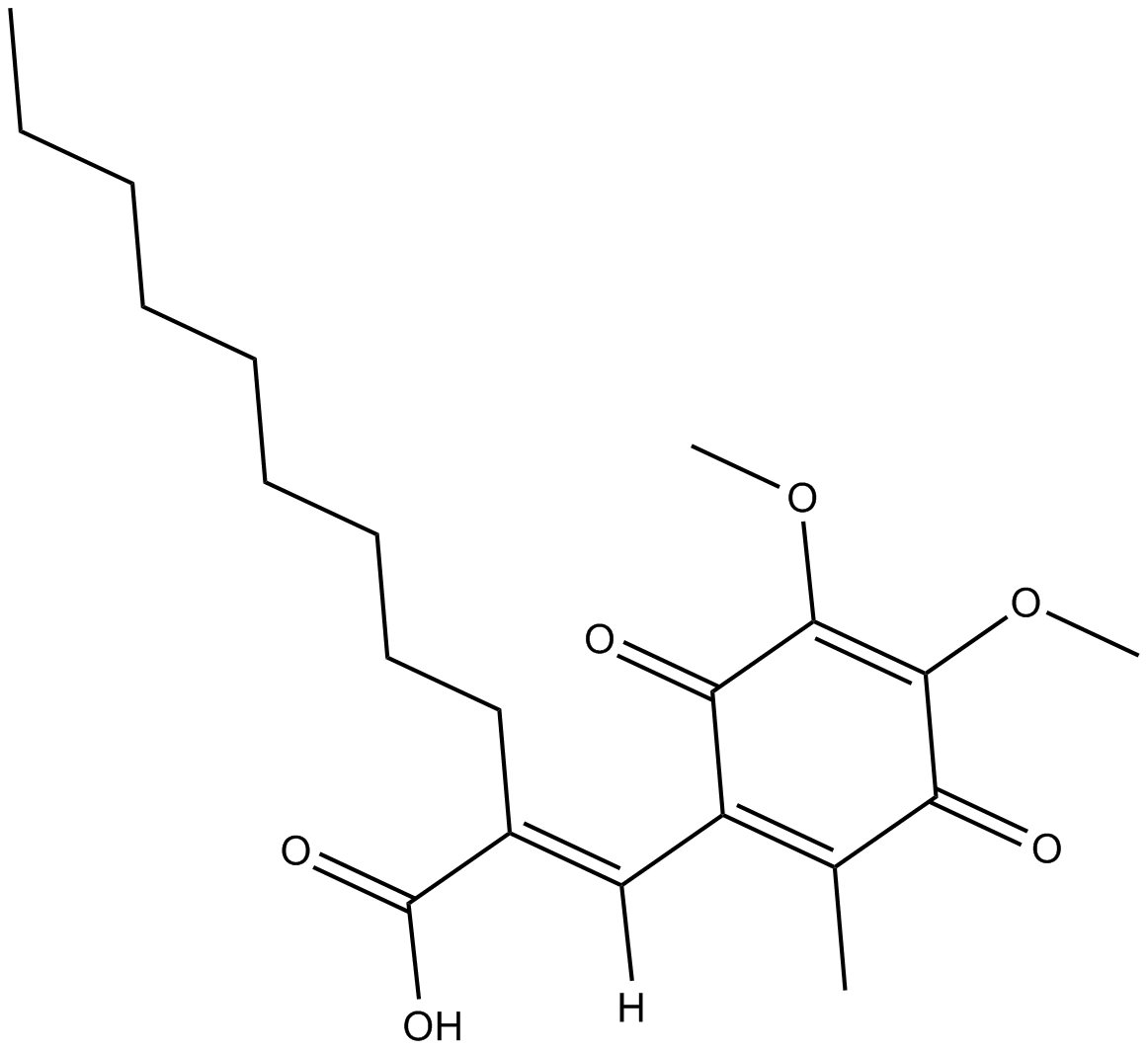
Cas No.: 136164-66-4
Sample solution is provided at 25 µL, 10mM.
E3330は、apurinic-apyrimidinic endonuclease/redox effector factor(APE1/Ref-1)のレドックスドメイン機能の小分子阻害剤である(IC50、50 µmol/L)。
E3330(10~30μM、72時間)は、in vitroにおける膵臓がん細胞の増殖だけでなく遊走能も阻害する。ヒトNSCLC細胞株H1975において、E3330(30μM、3時間)とシスプラチン(5~20μM、72時間)の共培養は、シスプラチン単独と比較して細胞生存率を有意に低下させた。E3330の投与は、APE1の細胞内輸送の変化を介したNF-κBの機能的活性化を阻止し、TNF-αによって誘導されるIL-6およびIL-8の発現を減少させた。E3330は、LPSで刺激したRAW264.7細胞からの腫瘍壊死因子α(TNF-α)、インターロイキン(IL-6)、IL-12、炎症性メディエーターである一酸化窒素(NO)、プロスタグランジンE2(PGE2)などの炎症性サイトカインの分泌を明確に抑制した。
ガラクトサミン負荷の1時間後にE3330(10~100 mg/kg、経口)を投与すると、肝障害が抑制された。E3330は、F344ラットのガラクトサミン誘発肝炎モデルにおいて、ガラクトサミン負荷6時間後または12時間後にp.o.投与すると有効であった。ガラクトサミンと組み合わせたTNFの注射は、重篤な肝障害をもたらした。ガラクトサミン/TNF注射の30分前にE3330を100mg/kgと300mg/kgを経口投与すると、血漿中のL-アラニンアミノトランスフェラーゼ活性とL-アスパラギン酸アミノトランスフェラーゼ活性の上昇が有意に抑制された。マウスにおけるE3330の推定半減期(t1/2)は3.7時間であった。
References:
[1]. Zou G M, Maitra A. Small-molecule inhibitor of the AP endonuclease 1/REF-1 E3330 inhibits pancreatic cancer cell growth and migration[J]. Molecular cancer therapeutics, 2008, 7(7): 2012-2021.
[2]. Fishel M L, Colvin E S, Luo M, et al. Inhibition of the redox function of APE1/Ref-1 in myeloid leukemia cell lines results in a hypersensitive response to retinoic acid-induced differentiation and apoptosis[J]. Experimental hematology, 2010, 38(12): 1178-1188.
[3]. Manguinhas R, Fernandes A S, Costa J G, et al. Impact of the APE1 redox function inhibitor E3330 in non-small cell lung cancer cells exposed to cisplatin: increased cytotoxicity and impairment of cell migration and invasion[J]. Antioxidants, 2020, 9(6): 550.
[4]. Cesaratto L, Codarin E, Vascotto C, et al. Specific inhibition of the redox activity of ape1/ref-1 by e3330 blocks tnf-α-induced activation of IL-8 production in liver cancer cell lines[J]. PLoS One, 2013, 8(8): e70909.
[5]. Jedinak A, Dudhgaonkar S, Kelley M R, et al. Apurinic/Apyrimidinic endonuclease 1 regulates inflammatory response in macrophages[J]. Anticancer research, 2011, 31(2): 379-385.
[6]. Nagakawa J, Hirota K, Hishinuma I, et al. Protective effect of E3330, a novel quinone derivative, in galactosamine-induced hepatitis in rats[J]. Journal of Pharmacology and Experimental Therapeutics, 1993, 264(1): 496-500.
[7]. Nagakawa J, Hishinuma I, Hirota K, et al. Protective effects of E3330, a novel quinone derivative, on galactosamine/tumor necrosis factor-α-induced hepatitis in mice[J]. European journal of pharmacology, 1992, 229(1): 63-67.
細胞実験 [1]: | |
細胞株 | 膵臓癌PaCa-2およびPanc-1細胞 |
準備方法 | 細胞は37℃、5% CO2環境下で、10%コズミックカーフ血清を含むDulbecco's Modified Eagle's Mediumで培養された。PaCa-2細胞は72時間、Panc-1細胞は48時間、E3330で処理された。 |
反応条件 | 0-135 µM; 48、72時間 |
アプリケーション | E3330は、PaCa-2およびPanc-1細胞の成長速度を用量依存的に効果的に遅らせ、PaCa-2で135 µmol/L、Panc-1で87 µmol/LのED50を示した。 |
動物実験 [1]: | |
動物モデル | 非肥満糖尿病/重度複合免疫不全(NOD/SCID)マウス |
準備方法 | PaCa-2細胞(2.5 × 10^6個)を0.2 mLのDMEM培地に懸濁し、NOD/SCIDマウスの右側腹部に皮下移植した。E3330は4% CremophorEL(1:1)/生理食塩水溶液またはメチルセルロース(0.5%)に溶解された。腫瘍体積が100 mm^3を超えた時点で、E3330は25 mg/kgで経口投与され、1日2回、8時間間隔で10〜12日間(5日投与、2日休薬のスケジュール)投与された。腫瘍は週2回測定され、約6週間追跡された。 |
投与形態 | 25 mg/kg、1日2回経口投与、10〜12日間(5日投与、2日休薬) |
アプリケーション | ビークル対照群の腫瘍と比較して、PaCa-2異種移植腫瘍は有意な腫瘍成長遅延を示した。 |
参考文献: [1] : Fishel M L, Jiang Y, Rajeshkumar N V, et al. Impact of APE1/Ref-1 Redox Inhibition on Pancreatic Tumor GrowthAPE1/Ref-1 Redox Inhibition on Pancreatic Tumor Growth[J]. Molecular cancer therapeutics, 2011, 10(9): 1698-1708. | |
| Cas No. | 136164-66-4 | SDF | |
| 同義語 | APX 3330 | ||
| Chemical Name | (E)-2-((4,5-dimethoxy-2-methyl-3,6-dioxocyclohexa-1,4-dien-1-yl)methylene)undecanoic acid | ||
| Canonical SMILES | CCCCCCCCC/C(C(O)=O)=C([H])\C(C1=O)=C(C(C(OC)=C1OC)=O)C | ||
| Formula | C21H30O6 | M.Wt | 378.46 |
| 溶解度 | ≥ 75.4mg/mL in DMSO, ≥ 75.4mg/mL in EtOH | Storage | Store at -20°C |
| General tips | Please select the appropriate solvent to prepare the stock solution according to the
solubility of the product in different solvents; once the solution is prepared, please store it in
separate packages to avoid product failure caused by repeated freezing and thawing.Storage method
and period of the stock solution: When stored at -80°C, please use it within 6 months; when stored
at -20°C, please use it within 1 month. To increase solubility, heat the tube to 37°C and then oscillate in an ultrasonic bath for some time. |
||
| Shipping Condition | Evaluation sample solution: shipped with blue ice. All other sizes available: with RT, or with Blue Ice upon request. | ||
| Prepare stock solution | |||

|
1 mg | 5 mg | 10 mg |
| 1 mM | 2.6423 mL | 13.2114 mL | 26.4229 mL |
| 5 mM | 528.5 μL | 2.6423 mL | 5.2846 mL |
| 10 mM | 264.2 μL | 1.3211 mL | 2.6423 mL |
Step 1: Enter information below (Recommended: An additional animal making an allowance for loss during the experiment)
 g
μL
g
μL
Step 2: Enter the in vivo formulation (This is only the calculator, not formulation. Please contact us first if there is no in vivo formulation at the solubility Section.)
Calculation results:
Working concentration: mg/ml;
Method for preparing DMSO master liquid: mg drug pre-dissolved in μL DMSO ( Master liquid concentration mg/mL, Please contact us first if the concentration exceeds the DMSO solubility of the batch of drug. )
Method for preparing in vivo formulation: Take μL DMSO master liquid, next addμL PEG300, mix and clarify, next addμL Tween 80, mix and clarify, next add μL saline, mix and clarify.
Method for preparing in vivo formulation: Take μL DMSO master liquid, next add μL Corn oil, mix and clarify.
Note: 1. Please make sure the liquid is clear before adding the next solvent.
2. Be sure to add the solvent(s) in order. You must ensure that the solution obtained, in the previous addition, is a clear solution before proceeding to add the next solvent. Physical methods such as vortex, ultrasound or hot water bath can be used to aid dissolving.
3. All of the above co-solvents are available for purchase on the GlpBio website.
Quality Control & SDS
- View current batch:
- Purity: >98.00% Appearance: A solid
- COA (Certificate of Analysis)
- SDS (Safety Data Sheet)
- Datasheet
Average Rating: 5 (Based on Reviews and 16 reference(s) in Google Scholar.)