

ML385 |
Catalog No.GC19254
 One-Click Copy Product Info
|

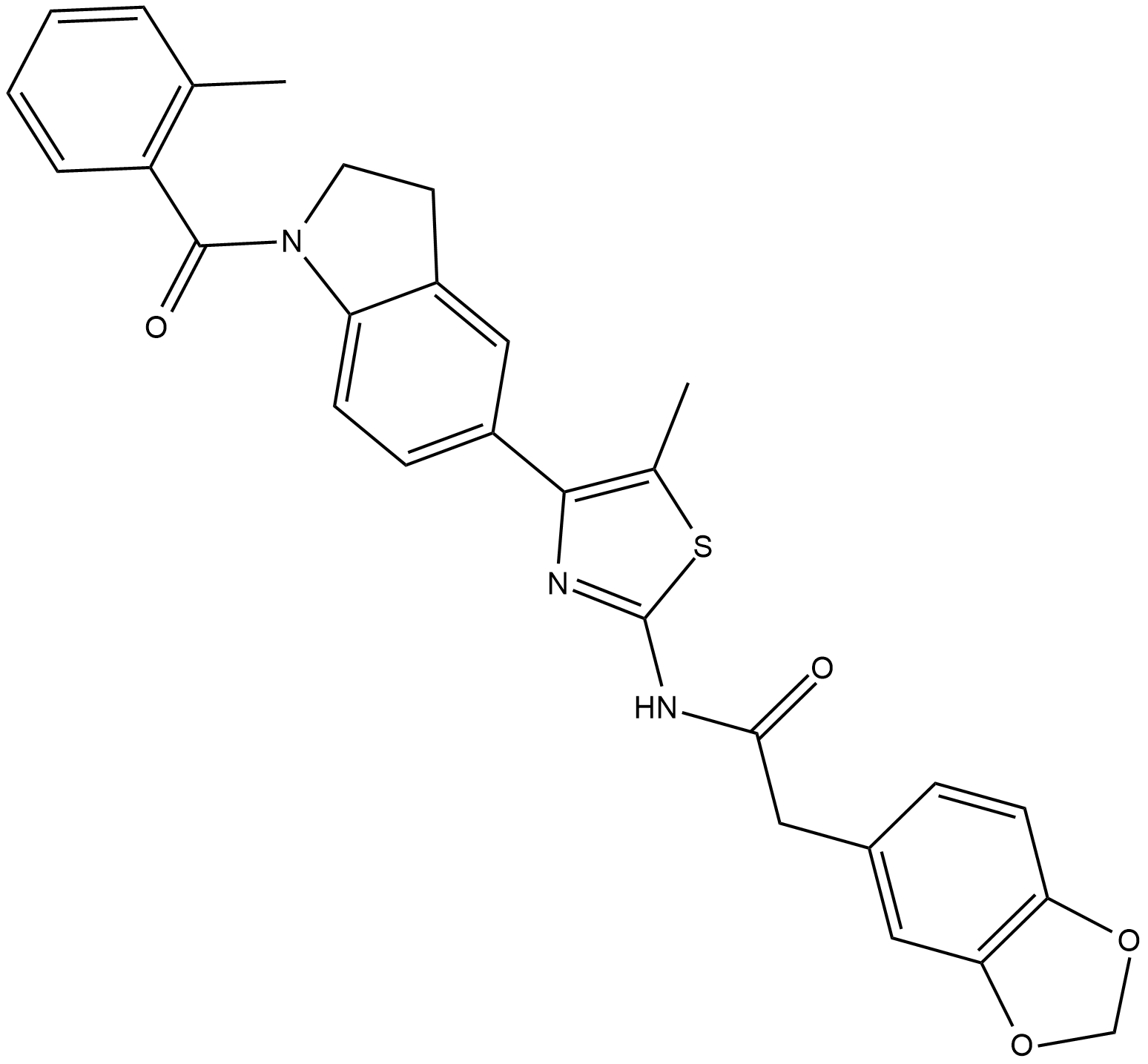
ML385 est un inhibiteur spécifique du facteur nucléaire érythroïde 2 lié au facteur 2 (NRF2).
Products are for research use only. Not for human use. We do not sell to patients.
Cas No.: 846557-71-9
Sample solution is provided at 25 µL, 10mM.
- Int J Mol Sci 23.18 (2022):10465.PMID:36142378
- Int J Mol Sci 24.12 (2023):10016.PMID:37373164
- J Agr Food Chem (2025).PMID:40493028
- Biochem Pharmacol (2025):117411.PMID:41067285
- Int J Mol Sci 27.7 (2026):3070.PMID:41977254
- Chem-Biol Interact 387 (2024):110824.PMID:38056806
- Mol Nutr Food Res (2024):2300123.PMID:38196088
- Int J Mol Sci 26.12 (2025):5490.
- Int Immunopharmacol 156 (2025):114685.PMID:40286782
- J-Ethnopharmacol-(2025):120870.PMID:41207347
- J Ethnopharmacol (2026):121383.PMID:41698557
- Int J Mol Sci 27.7 (2026):3070.
- Eur J Pharmacol (2026):178864.
- J Funct Foods 126 (2025):106695.
- Neurochem Res 50.3 (2025):149.PMID:40257585
- Vet Res 56.1 (2025):161.PMID:40764596
- Sci Rep-Uk 15.1 (2025):18697.PMID:40216975
- J Biol Chem 302.5 (2026).PMID:41881261
- Mol Immunol (2026).PMID:42600551
- Digest Dis Sci (2023):1-13.PMID:38007702
- Pathogens 14.6 (2025):590.
- Clin Exp Pharmacol P 53.2 (2026):e70110.PMID:41656496
- Mol Oral Microbiol: (2026).PMID:42713739
- Chem Biodivers 18.4 (2021):e2001007.PMID:33624427
- Chin J Integr Med (2024):1-11.PMID:39167283
- Oxid Med Cell Longev 2021 (2021).PMID:34712383
- Food Funct 13.13 (2022):6962-6974.PMID:35678194
- Phytomedicine (2024):155433.
- Diss. UTAR, (2024).
- J Funct Foods 122 (2024) 106535.
ML385 est un inhibiteur spécifique du facteur nucléaire érythroïde 2 lié au facteur 2 (NRF2). ML385 se lie à NRF2 et inhibe l'expression des gènes cibles en aval en tant que molécule sonde. Plus précisément, ML385 se lie au domaine Neh1, le domaine Cap ‘N’ Collar Basic Leucine Zipper (CNC-bZIP) de NRF2, et interfère avec la liaison du complexe protéique V-Maf Avian Musculoaponeurotic Fibrosarcoma Oncogene Homolog G (MAFG)-NRF2 aux séquences d'ADN régulatrices. ML385 montre une spécificité et une sélectivité pour les cellules NSCLC avec mutation KEAP1 menant à un gain de fonction de NRF2.[1][2]
Une étude in vitro a démontré que ML385 inhibe potentiellement NRF2 par interaction directe. La signalisation NRF2 a diminué de manière dépendante du temps, avec un déclin maximal à 72 h. Une réduction des niveaux d'ARNm de NRF2 a également été observée. De plus, ML385 a causé une inhibition globale de la signalisation NRF2 dans les cellules cancéreuses pulmonaires avec des mutations KEAP1, ainsi que d'autres gènes cibles. Le traitement par ML385 a également significativement atténué l'activité enzymatique de NQO1 et réduit les niveaux de GSH ainsi que la capacité antioxydante cellulaire.[2]
Une étude in vivo de ML385 a indiqué qu'il inhibe NRF2 et montre une activité anti-tumorale prometteuse. ML385 en combinaison avec le carboplatine a montré une réduction significative de la croissance tumorale par rapport au véhicule. Bien que le traitement avec un seul agent (soit ML385 soit carboplatine) ait conduit à une réduction de la croissance tumorale, l'ampleur de ces effets variait entre les lignées cellulaires et n'atteignait pas la signification statistique. De plus, les échantillons tumoraux traités avec ML385 ont montré une réduction significative du niveau de protéine NRF2 et de ses gènes cibles en aval. En outre, l'ajout de ML385 a diminué l'anisotropie de manière dépendante de la dose, avec une IC50 de 1,9 μM, suggérant que le complexe protéique NRF2-MAFG était dissocié de l'ADN-ARE marqué à la fluorescéine.[2]
References:
[1]. Xian P, et al. Mesenchymal stem cell-derived exosomes as a nanotherapeutic agent for amelioration of inflammation-induced astrocyte alterations in mice. Theranostics. 2019 Aug 14;9(20):5956-5975.
[2]. Singh A, et al. Small Molecule Inhibitor of NRF2 Selectively Intervenes Therapeutic Resistance in KEAP1-Deficient NSCLC Tumors. ACS Chem Biol. 2016 Nov 18;11(11):3214-3225.
| Expériences cellulaires [1]: | |
Lignées cellulaires | Cellules A549 |
Méthode de préparation | Les cellules A549 ont été transfectées avec un vecteur rapporteur luciférase luciole (Fluc) sous le contrôle d’un promoteur minimal TATA, comprenant en amont un élément de réponse antioxydant (ARE) spécifique de NRF2 provenant du promoteur humain NQO1. Les clones exprimant de manière stable ARE-FLuc7 ont été sélectionnés et validés. |
Conditions de réaction | Les cellules ont été cultivées en présence de ML385 (5 μM) pendant 48h et 72h, et les changements dans les niveaux d'expression de NRF2 et de ses gènes cibles ont été mesurés. |
Domaines d'application | Le traitement des cellules A549 avec ML385 a démontré une réduction des enzymes impliquées dans la synthèse et le recyclage du glutathion, des membres de la famille des thioredoxines, ainsi que des gènes liés au métabolisme du glucose, de manière dépendante du temps. Le traitement avec ML385 a significativement atténué l'activité de l'enzyme NQO1 et réduit les niveaux de GSH ainsi que la capacité antioxydante cellulaire. |
| Expériences animales [2]: | |
Modèles animaux | Souris mâles C57B/6 âgées de 1 à 8 semaines |
Méthode de préparation | Les souris ont reçu une injection intrapéritonéale quotidienne de ML385 (30 mg/kg) dissous dans du PBS avec 5% de diméthylsulfoxyde (DMSO) pendant 7 jours. |
Forme de dosage | 30 mg/kg |
Domaines d'application | ML385 pourrait inhiber Nrf2 et a été utilisé pour explorer le mécanisme de la voie de signalisation Nrf2-NF-κB impliquée dans l'inhibition de l'activation des astrocytes. Les souris traitées avec ML385 ont présenté une diminution significative de l'expression de Keap1, HO-1, Nrf2, et p-P65/P-65 (P < 0,05) par rapport aux groupes Sham ou Véhicule témoin. |
Références : [1]. Singh A, et al. Small Molecule Inhibitor of NRF2 Selectively Intervenes Therapeutic Resistance in KEAP1-Deficient NSCLC Tumors. ACS Chem Biol. 2016 Nov 18;11(11):3214-3225. [2]. Xian P, et al. Mesenchymal stem cell-derived exosomes as a nanotherapeutic agent for amelioration of inflammation-induced astrocyte alterations in mice. Theranostics. 2019 Aug 14;9(20):5956-5975. | |
| Cas No. | 846557-71-9 | SDF | |
| Canonical SMILES | O=C(NC1=NC(C2=CC=C(N(C(C3=C(C)C=CC=C3)=O)CC4)C4=C2)=C(C)S1)CC5=CC(OCO6)=C6C=C5 | ||
| Formula | C29H25N3O4S | M.Wt | 511.59 |
| Solubility | DMSO : ≥ 30 mg/mL (58.64 mM) | Storage | Store at -20°C |
| General tips | Please select the appropriate solvent to prepare the stock solution according to the
solubility of the product in different solvents; once the solution is prepared, please store it in
separate packages to avoid product failure caused by repeated freezing and thawing.Storage method
and period of the stock solution: When stored at -80°C, please use it within 6 months; when stored
at -20°C, please use it within 1 month. To increase solubility, heat the tube to 37°C and then oscillate in an ultrasonic bath for some time. |
||
| Shipping Condition | Evaluation sample solution: shipped with blue ice. All other sizes available: with RT, or with Blue Ice upon request. | ||
| Prepare stock solution | |||

|
1 mg | 5 mg | 10 mg |
| 1 mM | 1.9547 mL | 9.7735 mL | 19.5469 mL |
| 5 mM | 390.9 μL | 1.9547 mL | 3.9094 mL |
| 10 mM | 195.5 μL | 977.3 μL | 1.9547 mL |
Step 1: Enter information below (Recommended: An additional animal making an allowance for loss during the experiment)
 g
μL
g
μL
Step 2: Enter the in vivo formulation (This is only the calculator, not formulation. Please contact us first if there is no in vivo formulation at the solubility Section.)
Calculation results:
Working concentration: mg/ml;
Method for preparing DMSO master liquid: mg drug pre-dissolved in μL DMSO ( Master liquid concentration mg/mL, Please contact us first if the concentration exceeds the DMSO solubility of the batch of drug. )
Method for preparing in vivo formulation: Take μL DMSO master liquid, next addμL PEG300, mix and clarify, next addμL Tween 80, mix and clarify, next add μL saline, mix and clarify.
Method for preparing in vivo formulation: Take μL DMSO master liquid, next add μL Corn oil, mix and clarify.
Note: 1. Please make sure the liquid is clear before adding the next solvent.
2. Be sure to add the solvent(s) in order. You must ensure that the solution obtained, in the previous addition, is a clear solution before proceeding to add the next solvent. Physical methods such as vortex, ultrasound or hot water bath can be used to aid dissolving.
3. All of the above co-solvents are available for purchase on the GlpBio website.
Quality Control & SDS
- View current batch:
- Purity: >98.00% Appearance: A solid
- COA (Certificate of Analysis)
- SDS (Safety Data Sheet)
- Datasheet
-
Related Biological Data

Nrf2 mediates ECH activation of the BDNF/TrkB signaling axis.(A-B) Western blot detection of nuclear Nrf2 (n=6). (C-D) Depression-like behavioral assays (n=19). (E-F) Brain tissue TUNEL for apoptosis detection.
Western blot research revealed that rats in the PSD + ECH-H group had higher levels of Nucleus-Nrf2 expression than rats in the PSD group and the PSD + ML385 (GlpBio) + ECH-H group.
Phytomedicine, 2024: 155433. PMID: 38547621 IF: 7.8996 -
Related Biological Data

DCA attenuates the expressions of key occludin and ZO-1 of TJ membrane proteins in vitro to maintain BBB integrity. (a–d)Western blotting assay of occludin and ZO-1 and the band strength of the respective protein relative to Tubulin in mouse brain. The mentioned results indicate that DCA inhibits ischemia-induced BBB destruction.
We used ML385 (GlpBio), a specific inhibitor of Nrf2 in cells, and the protective effect of DCA disappeared, indicating that DCA could alleviate oxidative stress through the PDK2-PDH-Nrf2 channel.
Oxid Med Cell Longev 2021 (2021). PMID: 34712383 IF: 6.541 -
Related Biological Data

Ellagic acid alleviated diquat-induced jejunal oxidative stress through a Nrf2 mediated signaling pathway. (A) Immunohistochemistry analysis for Nrf2 in the jejunum tissue. (B-D) NQO-1, GPX1, and HO-1 mRNA expressions in jejunum tissue.
ML385(a specific Nrf2 inhibitor) (GlpBio) was prepared in suspension in PBS with 100 µL per mouse.
iScience.2021 Sep 25;24(10):103170. PMID: 35268077 IF: 5.719 -
Related Biological Data

4-ME attenuated lipid metabolism by activating Nrf2. (E) Oil red O staining. (F) Intracellular TG content. (G–K) Quantification data of Nfr2, CD36, SREBP-1c, FASN, and PPAR-γ protein expression levels in LO2 cells
ML385 (10 µM) (GlpBio), a specific Nrf2 inhibitor, was used to treat LO2 cells.
Int J Mol Sci 23.18 (2022): 10465. PMID: 36142378 IF: 5.5999 -
Related Biological Data

Nrf2 and HO-1 inhibitors counteract the effect of Empagliflozin in suppressing Pi-induced calcification. (A,B) The Nrf2 inhibitor, ML385 (5 μM), as well as HO-1 inhibitors.
The Nrf2 inhibitor, ML385 (5 μM) (GlpBio), as well as HO-1 inhibitors
Int J Mol Sci 24.12 (2023): 10016. PMID: 37373164 IF: 5.5999
Average Rating: 5 (Based on Reviews and 39 reference(s) in Google Scholar.)