

Axitinib (AG 013736) (Synonyms: AG 013736) |
カタログ番号GC12216
 One-Click Copy Product Info
|

Axitinib (AG 013736)は経口活性の特異性血管内皮成長因子受容体(VEGFR)阻害剤であり、VEGFR-1、VEGFR-2とVEGFR-3を標的とし、IC50値はそれぞれ0.1nM、0.2nMと0.1-0.3nMである。
Products are for research use only. Not for human use. We do not sell to patients.
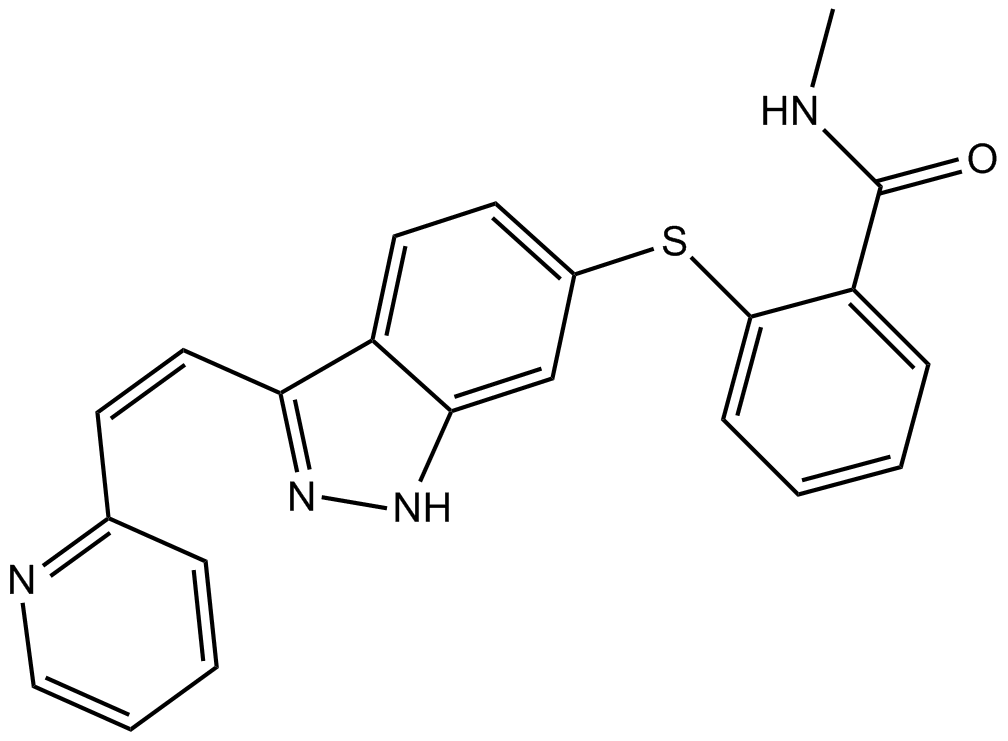
Cas No.: 319460-85-0
Sample solution is provided at 25 µL, 10mM.
Axitinib (AG 013736)は経口活性の特異性血管内皮成長因子受容体(VEGFR)阻害剤であり、VEGFR-1、VEGFR-2とVEGFR-3を標的とし、IC50値はそれぞれ0.1nM、0.2nMと0.1-0.3nMである[1]。Axitinibは血小板由来の成長因子受容体(PDGFR)とチロシンタンパク質キナーゼKIT (c-KIT)に対し阻害作用を有し、IC50値はそれぞれ1.6nMと1.7nMである[2]。AxitinibはVEGFシグナル伝達経路を阻害することで、腫瘍の血管新生を阻害でき、よって腫瘍の成長と転移を阻害する[3]。Axitinibは癌の研究に常用され、特には腎細胞癌と甲状腺癌の治療に広く使われている[4]。
体外で、Axitinib (0.1-25μM)でヒト網膜内皮細胞(HRECs)を48時間処理した結果、細胞内乳糖脱水素酵素(LDH)の放出を著しく増やした。Axitinib (0.1, 1μM)は、持続的な高グルコース濃度と変動するグルコース濃度に暴露されるHRECsにおけるVEGFR2のリン酸化を著しく減らした[5]。
体内で、Axitinib (1mg/kg/日)で間質性膀胱炎(IC)ラットに5日間経口投与した結果、非尿路収縮を減らし、排尿間隔と尿量を増やし、尿路上皮剥離、血管新生、肥満細胞浸潤と線維症を緩和させた[6]。Axitinib (25mg/kg/日)をRenca細胞異種移植マウスに経口投与した結果、腫瘍の成長と転移を著しく阻害し、マウスでCD8+ T細胞の浸潤と活性を促進した[7]。
References:
[1] Malekan M, Ebrahimzadeh M A. Vascular endothelial growth factor receptors [VEGFR] as target in breast cancer treatment: current status in preclinical and clinical studies and future directions[J]. Current Topics in Medicinal Chemistry, 2022, 22(11): 891-920.
[2] Jiang D, Xu T, Zhong L, et al. Research progress of VEGFR small molecule inhibitors in ocular neovascular diseases[J]. European Journal of Medicinal Chemistry, 2023, 257: 115535.
[3] Kelly R J, Rixe O. Axitinib—a selective inhibitor of the vascular endothelial growth factor (VEGF) receptor[J]. Targeted oncology, 2009, 4: 297-305.
[4] Keating G M. Axitinib: a review in advanced renal cell carcinoma[J]. Drugs, 2015, 75: 1903-1913.
[5] Lazzara F, Conti F, Sasmal P K, et al. Anti-angiogenic and antioxidant effects of axitinib in human retinal endothelial cells: implications in diabetic retinopathy[J]. Frontiers in Pharmacology, 2024, 15: 1415846.
[6] Shin J H, Ryu C M, Yu H Y, et al. Therapeutic effects of axitinib, an anti-angiogenic tyrosine kinase inhibitor, on interstitial cystitis[J]. Scientific Reports, 2023, 13(1): 8329.
[7] Yuan H, Cai P, Li Q, et al. Axitinib augments antitumor activity in renal cell carcinoma via STAT3-dependent reversal of myeloid-derived suppressor cell accumulation[J]. Biomedicine & Pharmacotherapy, 2014, 68(6): 751-756.
| 細胞実験[1]: | |
細胞株 | ヒト網膜内皮細胞(HRECs) |
準備方法 | 高レベルのグルコース(HG) (40mM)のある/ない状態で、Axitinib (0.1, 1, 10, 25µM)で、HRECsを新鮮な培地に48時間処理した。CyQUANTTM LDH細胞毒性アッセイを使い、乳糖脱水素酵素(LDH)細胞の放出を測定した。 |
反応条件 | 0.1, 1, 10, 25µM;48時間 |
アプリケーション | 濃度が25µMのAxitinibがHRECsに有毒で、対照細胞に比べて、著しいLDH放出に導くことが観察された。 |
| 動物実験 [2]: | |
動物モデル | Sprague Dawleyラット |
準備方法 | 10週齢の雌Sprague Dawleyラットを三つのグループ(n=10/グループ)に分けた:模擬手術、塩酸塩(HCl)とAxitinibグループである。HCl注射の一週間後(0日目)、AxitinibグループにAxitinib (1mg/kg)を5日間連続で経口投与し、痛みを毎日評価した。膀胱の機能、組織学、遺伝学の検査を7日目に評価した。 |
投与形態 | 1mg/kg/日;5日間;経口 |
アプリケーション | Axitinib投与の3日後に、疼痛閾値は著しく改善した。Axitinibは非排尿性収縮を減らし、排尿間隔と排尿量を増やし、尿路上皮剥離、血管新生、肥満細胞浸潤と線維症を軽減した。 |
References: | |
| Cas No. | 319460-85-0 | SDF | |
| 同義語 | AG 013736 | ||
| Chemical Name | N-methyl-2-[[3-[(E)-2-pyridin-2-ylethenyl]-1H-indazol-6-yl]sulfanyl]benzamide | ||
| Canonical SMILES | CNC(=O)C1=CC=CC=C1SC2=CC3=C(C=C2)C(=NN3)C=CC4=CC=CC=N4 | ||
| Formula | C22H18N4OS | M.Wt | 386.47 |
| 溶解度 | ≥ 19.3mg/mL in DMSO | Storage | Store at -20°C |
| General tips | Please select the appropriate solvent to prepare the stock solution according to the
solubility of the product in different solvents; once the solution is prepared, please store it in
separate packages to avoid product failure caused by repeated freezing and thawing.Storage method
and period of the stock solution: When stored at -80°C, please use it within 6 months; when stored
at -20°C, please use it within 1 month. To increase solubility, heat the tube to 37°C and then oscillate in an ultrasonic bath for some time. |
||
| Shipping Condition | Evaluation sample solution: shipped with blue ice. All other sizes available: with RT, or with Blue Ice upon request. | ||
| Prepare stock solution | |||

|
1 mg | 5 mg | 10 mg |
| 1 mM | 2.5875 mL | 12.9376 mL | 25.8752 mL |
| 5 mM | 517.5 μL | 2.5875 mL | 5.175 mL |
| 10 mM | 258.8 μL | 1.2938 mL | 2.5875 mL |
Step 1: Enter information below (Recommended: An additional animal making an allowance for loss during the experiment)
 g
μL
g
μL
Step 2: Enter the in vivo formulation (This is only the calculator, not formulation. Please contact us first if there is no in vivo formulation at the solubility Section.)
Calculation results:
Working concentration: mg/ml;
Method for preparing DMSO master liquid: mg drug pre-dissolved in μL DMSO ( Master liquid concentration mg/mL, Please contact us first if the concentration exceeds the DMSO solubility of the batch of drug. )
Method for preparing in vivo formulation: Take μL DMSO master liquid, next addμL PEG300, mix and clarify, next addμL Tween 80, mix and clarify, next add μL saline, mix and clarify.
Method for preparing in vivo formulation: Take μL DMSO master liquid, next add μL Corn oil, mix and clarify.
Note: 1. Please make sure the liquid is clear before adding the next solvent.
2. Be sure to add the solvent(s) in order. You must ensure that the solution obtained, in the previous addition, is a clear solution before proceeding to add the next solvent. Physical methods such as vortex, ultrasound or hot water bath can be used to aid dissolving.
3. All of the above co-solvents are available for purchase on the GlpBio website.
Quality Control & SDS
- View current batch:
- Purity: >98.00% Appearance: A solid
- COA (Certificate of Analysis)
- SDS (Safety Data Sheet)
- Datasheet
Average Rating: 5 (Based on Reviews and 2 reference(s) in Google Scholar.)