

Axitinib (AG 013736) (Synonyms: AG 013736) |
Catalog No.GC12216
 One-Click Copy Product Info
|

Axitinib (AG 013736) is an orally active specific vascular endothelial growth factor receptor (VEGFR) inhibitor that targets VEGFR-1, VEGFR-2, and VEGFR-3 with IC50 values of 0.1nM, 0.2nM, and 0.1-0.3nM, respectively.
Products are for research use only. Not for human use. We do not sell to patients.
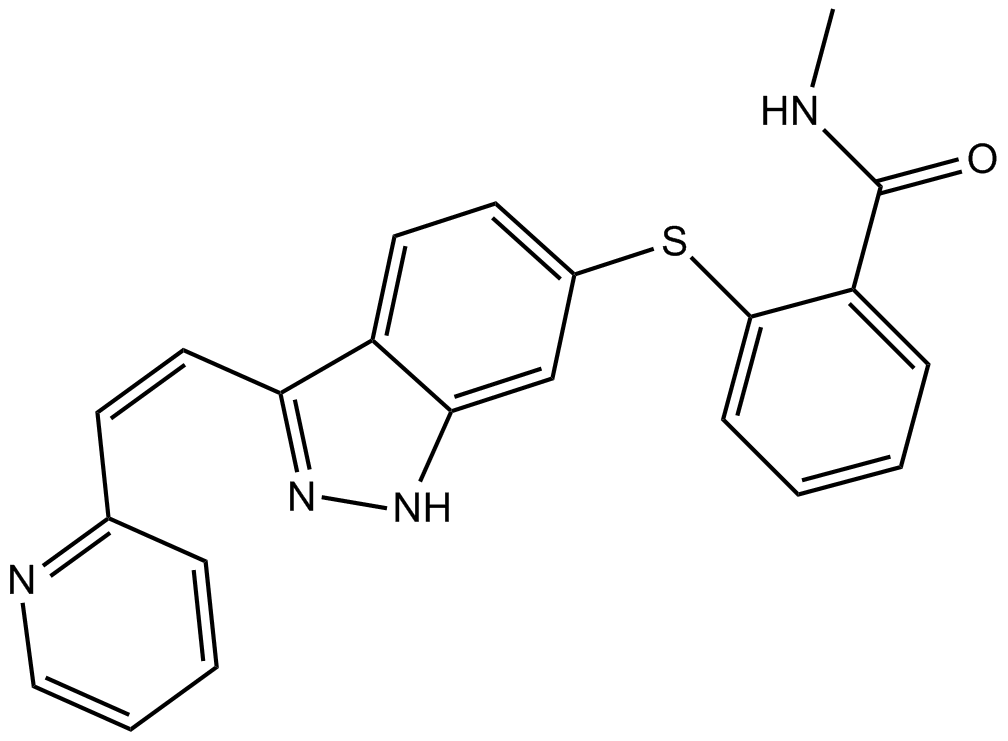
Cas No.: 319460-85-0
Sample solution is provided at 25 µL, 10mM.
Axitinib (AG 013736) is an orally active specific vascular endothelial growth factor receptor (VEGFR) inhibitor that targets VEGFR-1, VEGFR-2, and VEGFR-3 with IC50 values of 0.1nM, 0.2nM, and 0.1-0.3nM, respectively[1]. Axitinib has inhibitory effects on platelet-derived growth factor receptor (PDGFR) and tyrosine protein kinase KIT (c-KIT), with IC50 values of 1.6nM and 1.7nM, respectively[2]. Axitinib can inhibit tumor angiogenesis by inhibiting the VEGF signaling pathway, thereby inhibiting tumor growth and metastasis[3]. Axitinib is commonly used in cancer research, especially in the treatment of renal cell carcinoma and thyroid cancer[4].
In vitro, Axitinib (0.1-25μM) treatment of human retinal endothelial cells (HRECs) for 48h significantly increased the release of intracellular lactate dehydrogenase (LDH). Axitinib (0.1, 1μM) significantly reduced the phosphorylation of VEGFR2 in HRECs exposed to sustained high glucose concentrations and fluctuating glucose concentrations[5].
In vivo, oral treatment of interstitial cystitis (IC) rats with Axitinib (1mg/kg/day) for 5 days reduced non-urinary contractions, increased urination interval and urine output, and alleviated urothelial exfoliation, angiogenesis, mast cell infiltration and fibrosis[6]. Oral treatment of Renca cell xenograft mice with Axitinib (25mg/kg/day) significantly inhibited tumor growth and metastasis and promoted the infiltration and activity of CD8+ T cells in mice[7].
References:
[1] Malekan M, Ebrahimzadeh M A. Vascular endothelial growth factor receptors [VEGFR] as target in breast cancer treatment: current status in preclinical and clinical studies and future directions[J]. Current Topics in Medicinal Chemistry, 2022, 22(11): 891-920.
[2] Jiang D, Xu T, Zhong L, et al. Research progress of VEGFR small molecule inhibitors in ocular neovascular diseases[J]. European Journal of Medicinal Chemistry, 2023, 257: 115535.
[3] Kelly R J, Rixe O. Axitinib—a selective inhibitor of the vascular endothelial growth factor (VEGF) receptor[J]. Targeted oncology, 2009, 4: 297-305.
[4] Keating G M. Axitinib: a review in advanced renal cell carcinoma[J]. Drugs, 2015, 75: 1903-1913.
[5] Lazzara F, Conti F, Sasmal P K, et al. Anti-angiogenic and antioxidant effects of axitinib in human retinal endothelial cells: implications in diabetic retinopathy[J]. Frontiers in Pharmacology, 2024, 15: 1415846.
[6] Shin J H, Ryu C M, Yu H Y, et al. Therapeutic effects of axitinib, an anti-angiogenic tyrosine kinase inhibitor, on interstitial cystitis[J]. Scientific Reports, 2023, 13(1): 8329.
[7] Yuan H, Cai P, Li Q, et al. Axitinib augments antitumor activity in renal cell carcinoma via STAT3-dependent reversal of myeloid-derived suppressor cell accumulation[J]. Biomedicine & Pharmacotherapy, 2014, 68(6): 751-756.
| Cell experiment [1]: | |
|
Cell lines |
Human retinal endothelial cells (HRECs) |
|
Preparation Method |
HRECs were subjected to treatment in a fresh medium for 48h with Axitinib (0.1, 1, 10, 25µM) with or without high levels of glucose (HG) (40mM). Lactate dehydrogenase (LDH) cell release was measured using the CyQUANTTM LDH Cytotoxicity assay. |
|
Reaction Conditions |
0.1, 1, 10, 25µM; 48h |
|
Applications |
The 25µM Axitinib concentration has been found to be toxic to HRECs, leading to significant LDH release compared to control cells. |
| Animal experiment [2]: | |
|
Animal models |
Sprague Dawley rats |
|
Preparation Method |
Ten‑week‑old female Sprague Dawley rats were divided into three groups (n=10/group): sham, hydrochloride (HCl), and Axitinib groups. One week after HCl instillation (day 0), the Axitinib group received oral Axitinib (1mg/kg) for five consecutive days and pain was evaluated daily. Bladder function, histology and genetics were evaluated on day 7. |
|
Dosage form |
1mg/kg/day; 5 days; p.o. |
|
Applications |
The pain threshold significantly improved 3 days after Axitinib administration. Axitinib decreased non-voiding contraction and increased the micturition interval and micturition volume and alleviated urothelial denudation, angiogenesis, mast cell infiltration, and fibrosis. |
|
References: |
|
| Cas No. | 319460-85-0 | SDF | |
| Synonyms | AG 013736 | ||
| Chemical Name | N-methyl-2-[[3-[(E)-2-pyridin-2-ylethenyl]-1H-indazol-6-yl]sulfanyl]benzamide | ||
| Canonical SMILES | CNC(=O)C1=CC=CC=C1SC2=CC3=C(C=C2)C(=NN3)C=CC4=CC=CC=N4 | ||
| Formula | C22H18N4OS | M.Wt | 386.47 |
| Solubility | ≥ 19.3mg/mL in DMSO | Storage | Store at -20°C |
| General tips | Please select the appropriate solvent to prepare the stock solution according to the
solubility of the product in different solvents; once the solution is prepared, please store it in
separate packages to avoid product failure caused by repeated freezing and thawing.Storage method
and period of the stock solution: When stored at -80°C, please use it within 6 months; when stored
at -20°C, please use it within 1 month. To increase solubility, heat the tube to 37°C and then oscillate in an ultrasonic bath for some time. |
||
| Shipping Condition | Evaluation sample solution: shipped with blue ice. All other sizes available: with RT, or with Blue Ice upon request. | ||
| Prepare stock solution | |||

|
1 mg | 5 mg | 10 mg |
| 1 mM | 2.5875 mL | 12.9376 mL | 25.8752 mL |
| 5 mM | 517.5 μL | 2.5875 mL | 5.175 mL |
| 10 mM | 258.8 μL | 1.2938 mL | 2.5875 mL |
Step 1: Enter information below (Recommended: An additional animal making an allowance for loss during the experiment)
 g
μL
g
μL
Step 2: Enter the in vivo formulation (This is only the calculator, not formulation. Please contact us first if there is no in vivo formulation at the solubility Section.)
Calculation results:
Working concentration: mg/ml;
Method for preparing DMSO master liquid: mg drug pre-dissolved in μL DMSO ( Master liquid concentration mg/mL, Please contact us first if the concentration exceeds the DMSO solubility of the batch of drug. )
Method for preparing in vivo formulation: Take μL DMSO master liquid, next addμL PEG300, mix and clarify, next addμL Tween 80, mix and clarify, next add μL saline, mix and clarify.
Method for preparing in vivo formulation: Take μL DMSO master liquid, next add μL Corn oil, mix and clarify.
Note: 1. Please make sure the liquid is clear before adding the next solvent.
2. Be sure to add the solvent(s) in order. You must ensure that the solution obtained, in the previous addition, is a clear solution before proceeding to add the next solvent. Physical methods such as vortex, ultrasound or hot water bath can be used to aid dissolving.
3. All of the above co-solvents are available for purchase on the GlpBio website.
Quality Control & SDS
- View current batch:
- Purity: >98.00% Appearance: A solid
- COA (Certificate of Analysis)
- SDS (Safety Data Sheet)
- Datasheet
Average Rating: 5 (Based on Reviews and 2 reference(s) in Google Scholar.)