

Busulfan (Synonyms: Busulphan, Mielosan, Milecitan, Myeloleukon, Mylecytan, Myleran, NCI C01592, NSC 750) |
カタログ番号GC13671
 One-Click Copy Product Info
|

Busulfanはアルキル化薬であり、DNAをアルキル化し、ヒト血清Paraoxonase 1に対するIC50値は77μMである。
Products are for research use only. Not for human use. We do not sell to patients.
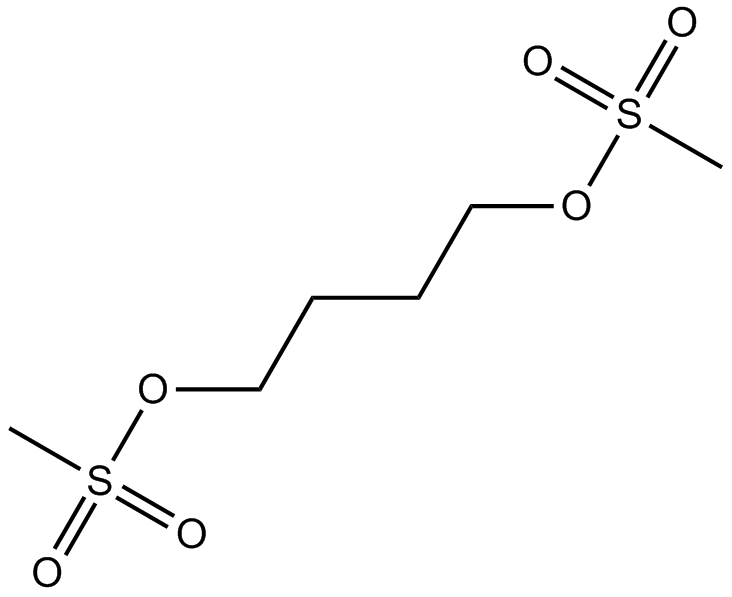
Cas No.: 55-98-1
Sample solution is provided at 25 µL, 10mM.
_1-3.$$$39978408@51.jpg');)
_1-9.$$$38538795@65.jpg');)
_1-9.$$$39112701@51.jpg');)
_1-7.$$$37316672@70.jpg');)
_366-372.$$$36198801@70.jpg');)
.$$$38565142@65.jpg');)
_1867-1883.$$$33248023@67.jpg');)
_eads6055.$$$39977546@45.jpg');)
_eadm9805.$$$40080571@45.jpg');)
_eadj3020.$$$39666821@45.jpg');)
_1-20.$$$39757301@28.jpg');)
_1-24.$$$38898113@28.jpg');)
_273-287.$$$36806353@46.jpg');)
_1-16.$$$37156877@44.jpg');)
_1-19.$$$37460805@44.jpg');)
_1291-1307.$$$34518654@46.jpg');)
Busulfanはアルキル化薬であり、DNAをアルキル化し、ヒト血清Paraoxonase 1に対するIC50値は77μMである[1]。Busulfanは細胞と動物モデルに広く使われ、速やかに分裂する細胞の死亡を誘発する[2]。
体外で、100μg/mlのBusulfanでPC39細胞を8時間処理した結果、アポトーシスを誘発し、同時にカスパーゼの活性、Bcl-2とPARPタンパク質の切断が起きた[3]。1000μM BusulfanでHepaRG細胞を4日間処理した結果、細胞ミトコンドリア機能障害、中性脂質のレベルの上昇、脂肪酸摂取の増加、超低密度のリポタンパク質の分泌の減少を起こした[4]。150μMのBusulfanでU2OSとMG-63細胞を48時間処理した結果、細胞の生存率を著しく阻害し、miR-200ファミリーを上方制御し、関連の標的遺伝子を制御した[5]。100μM Busulfanで48時間処理した結果、マウスの精原前駆細胞でオートファジーを阻害し、Ser2448でmTORのリン酸化を著しく上方制御した[6]。
体内で、40mg/kgのBusulfanを56日間単回腹腔内注射した結果、雄のC3H/Kamマウスを永久に不妊にし、残った幹細胞精原細胞で生成された精子の形態学的損傷を起こした[7]。NOD/ LtSz-scid /IL2Rγノックマウスで、ヒト細胞の潅流の48と24時間前に、25mg/kgのBusulfanを二回腹腔内注射した結果、ヒト造血幹細胞(HSC)の生着を促進し、生存率を著しく改善した[8]。
References:
[1] Söyüt H. Investigation of inhibition of busulfan (Chemotherapeutic Drug) on human serum paraoxonase-1 (PON1)[J]. Int. J. Pharmacol. 2021, 17(8), 572–576.
[2] Berger D P, Winterhalter B R, Dengler W A, et al. Preclinical activity off hepsulfam and busulfan in solid human tumor xenografts and human bone marrow[J]. Anti-Cancer Drugs, 1992, 3(5): 531-540.
[3] Hassan Z, Hassan M, Hellström-Lindberg E. The pharmacodynamic effect of busulfan in the P39 myeloid cell line in vitro[J]. Leukemia, 2001, 15(8): 1240-1247.
[4] Allard J, Bucher S, Ferron P J, et al. Busulfan induces steatosis in HepaRG cells but not in primary human hepatocytes: Possible explanations and implication for the prediction of drug‐induced liver injury[J]. Fundamental & Clinical Pharmacology, 2024, 38(1): 152-167.
[5] Mei Q, Li F, Quan H, et al. Busulfan inhibits growth of human osteosarcoma through miR‐200 family micro RNA s in vitro and in vivo[J]. Cancer science, 2014, 105(7): 755-762.
[6] Wei R, Zhang X, Cai Y, et al. Busulfan suppresses autophagy in mouse spermatogonial progenitor cells via mTOR of AKT and p53 signaling pathways[J]. Stem Cell Reviews and Reports, 2020, 16(6): 1242-1255.
[7] Bucci L R, Meistrich M L. Effects of busulfan on murine spermatogenesis: cytotoxicity, sterility, sperm abnormalities, and dominant lethal mutations[J]. Mutation Research/Fundamental and Molecular Mechanisms of Mutagenesis, 1987, 176(2): 259-268.
[8] Hayakawa J, Hsieh M M, Uchida N, et al. Busulfan produces efficient human cell engraftment in NOD/LtSz-Scid IL2Rγ null mice[J]. Stem cells, 2009, 27(1): 175-182.
| 細胞実験[1]: | |
細胞株 | P39細胞 |
準備方法 | 37°C、5% CO2の湿度で、10%の熱不活性化のウシ胎児血清(FBS)、ペニシリン(25IU/ml)とストレプトマイシン(25μg/ml)を添加したRPMI 1640培地でP39細胞を培養した。細胞播種濃度は0.20 × 10⁶個の細胞/mlであった。すべての実験を、指数関数的に増殖する細胞で行った。10、20、40、60、80と100μg/mlの最終濃度のBusulfanで細胞を2、4と8時間培養した。細胞を洗浄し、Busulfanのない培地で72時間再培養した。全ての実験で、10% FBS、または10% FBSと0.5%のDMSOを添加した培地で培養した細胞を対照物とした。6μg/mlの最終濃度のエトポシドで処理した細胞を、アポトーシスに対する陽性対照物として使用した。細胞数と生存率をトリパンブルー排除法で測定した。 |
反応条件 | 10、20、40、60、80と100μg/ml;2、4と8時間 |
アプリケーション | P39細胞で、Busulfanは濃度と時間依存的に、細胞の生存率を阻害し、細胞数を減らした。 |
| 動物実験 [2]: | |
動物モデル | Wistarラット |
準備方法 | 32匹の雄のWistarラット(6-8週齢、平均体重は150g)を、標準な条件(22 ± 3℃、湿度は45-60%)下で飼育し、水と咀嚼可能な食物を自由に摂取させた。ラットをランダムに2つのグループ(8匹/グループ)に分けた;(I):ラットの対照群には注射をしなかった;(II):二番目のグループのラットには、40mg/kg Busulfanを単回腹腔内注射した。注射の56日後から、ラットからサンプルを採り、組織病理学的な変化を分析した。 |
投与形態 | 40mg/kg、単回;腹腔内注射 |
アプリケーション | Busulfanの処理は、ラットで精子の形成の枯渇と破壊を起こし、腎臓組織の鬱血、広範囲の壊死、変性、腎尿細管での硝子円柱の形成を起こした。 |
References: | |
| Cas No. | 55-98-1 | SDF | |
| 同義語 | Busulphan, Mielosan, Milecitan, Myeloleukon, Mylecytan, Myleran, NCI C01592, NSC 750 | ||
| Chemical Name | 4-methylsulfonyloxybutyl methanesulfonate | ||
| Canonical SMILES | CS(=O)(=O)OCCCCOS(=O)(=O)C | ||
| Formula | C6H14O6S2 | M.Wt | 246.3 |
| 溶解度 | ≥ 12.3mg/mL in DMSO | Storage | Store at -20°C |
| General tips | Please select the appropriate solvent to prepare the stock solution according to the
solubility of the product in different solvents; once the solution is prepared, please store it in
separate packages to avoid product failure caused by repeated freezing and thawing.Storage method
and period of the stock solution: When stored at -80°C, please use it within 6 months; when stored
at -20°C, please use it within 1 month. To increase solubility, heat the tube to 37°C and then oscillate in an ultrasonic bath for some time. |
||
| Shipping Condition | Evaluation sample solution: shipped with blue ice. All other sizes available: with RT, or with Blue Ice upon request. | ||
| Prepare stock solution | |||

|
1 mg | 5 mg | 10 mg |
| 1 mM | 4.0601 mL | 20.3004 mL | 40.6009 mL |
| 5 mM | 812 μL | 4.0601 mL | 8.1202 mL |
| 10 mM | 406 μL | 2.03 mL | 4.0601 mL |
Step 1: Enter information below (Recommended: An additional animal making an allowance for loss during the experiment)
 g
μL
g
μL
Step 2: Enter the in vivo formulation (This is only the calculator, not formulation. Please contact us first if there is no in vivo formulation at the solubility Section.)
Calculation results:
Working concentration: mg/ml;
Method for preparing DMSO master liquid: mg drug pre-dissolved in μL DMSO ( Master liquid concentration mg/mL, Please contact us first if the concentration exceeds the DMSO solubility of the batch of drug. )
Method for preparing in vivo formulation: Take μL DMSO master liquid, next addμL PEG300, mix and clarify, next addμL Tween 80, mix and clarify, next add μL saline, mix and clarify.
Method for preparing in vivo formulation: Take μL DMSO master liquid, next add μL Corn oil, mix and clarify.
Note: 1. Please make sure the liquid is clear before adding the next solvent.
2. Be sure to add the solvent(s) in order. You must ensure that the solution obtained, in the previous addition, is a clear solution before proceeding to add the next solvent. Physical methods such as vortex, ultrasound or hot water bath can be used to aid dissolving.
3. All of the above co-solvents are available for purchase on the GlpBio website.
Quality Control & SDS
- View current batch:
- Purity: >97.00% Appearance: A solid
- COA (Certificate of Analysis)
- SDS (Safety Data Sheet)
- Datasheet
Average Rating: 5 (Based on Reviews and 31 reference(s) in Google Scholar.)