

DAMGO |
カタログ番号GC10803
 One-Click Copy Product Info
|

DAMGOはμ-オピオイド受容体(MOR)の高選択性のペプチドアゴニストであり、Kd値は3.46nMである。
Products are for research use only. Not for human use. We do not sell to patients.
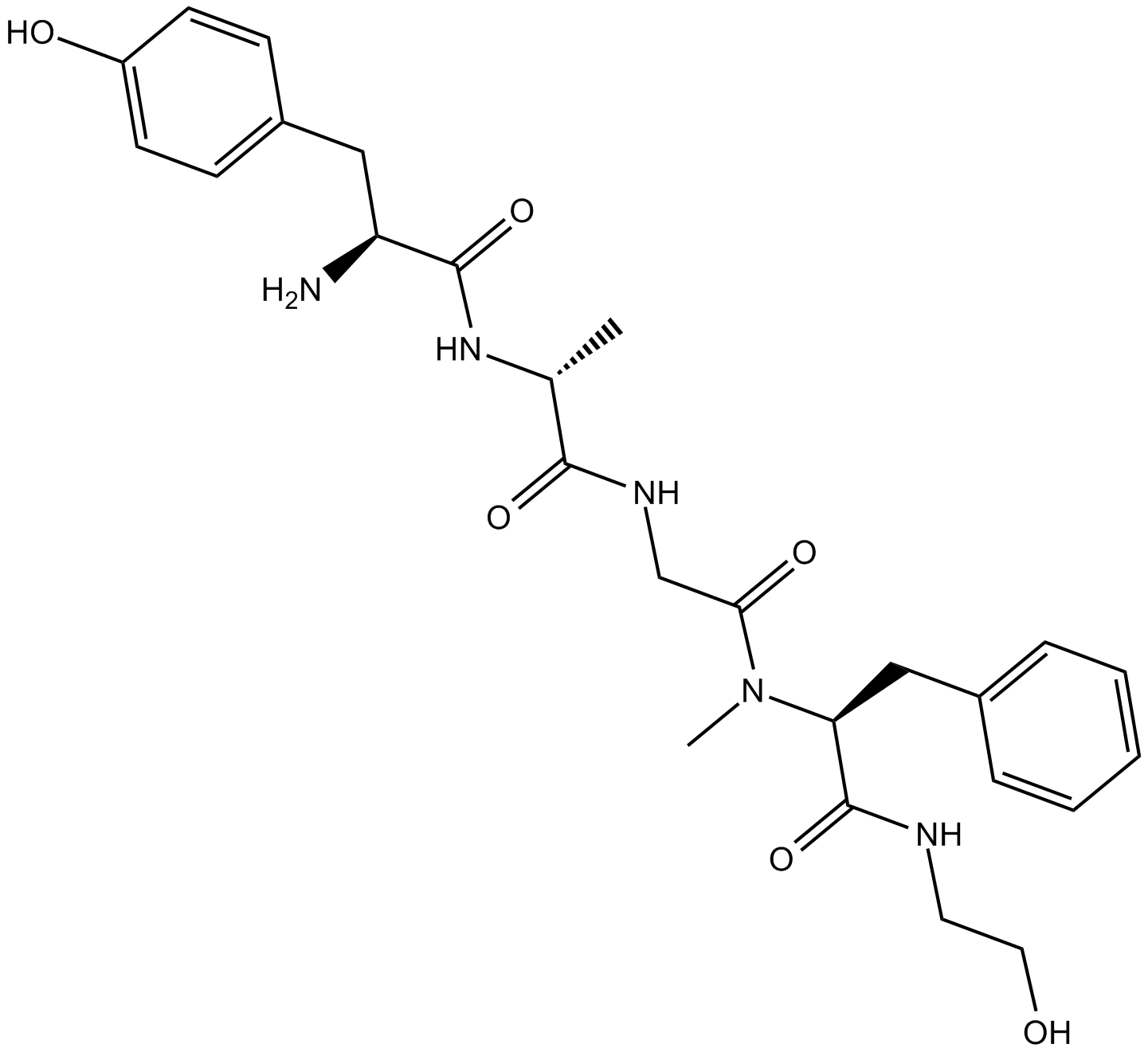
Cas No.: 78123-71-4
Sample solution is provided at 25 µL, 10mM.
_1-3.$$$39978408@51.jpg');)
_1-9.$$$38538795@65.jpg');)
_1-9.$$$39112701@51.jpg');)
_1-7.$$$37316672@70.jpg');)
_366-372.$$$36198801@70.jpg');)
.$$$38565142@65.jpg');)
_1867-1883.$$$33248023@67.jpg');)
_eads6055.$$$39977546@45.jpg');)
_eadm9805.$$$40080571@45.jpg');)
_eadj3020.$$$39666821@45.jpg');)
_1-20.$$$39757301@28.jpg');)
_1-24.$$$38898113@28.jpg');)
_273-287.$$$36806353@46.jpg');)
_1-16.$$$37156877@44.jpg');)
_1-19.$$$37460805@44.jpg');)
_1291-1307.$$$34518654@46.jpg');)
DAMGOはμ-オピオイド受容体(MOR)の高選択性のペプチドアゴニストであり、Kd値は3.46nMである[1-2]。DAMGOはGタンパク質共役の受容体を活性化し、アデニル酸シクラーゼを阻害し、よって細胞内cAMPのレベルを低下させ、イオンチャネルの活性を調節することで、神経興奮性と神経伝達物質の放出を抑制する。DAMGOは、疼痛メカニズムの研究、神経シグナル伝達経路の分析、そしてオピオイド受容体機能の研究に使われることが可能である[3-4]。
In vitro(体外)実験で、ラットの背根神経節感覚ニューロンをDAMGO(1μM)で2-3分で前処理し、その後はプロスタグランジンE₂(PGE₂;1μM)で120秒間刺激した。DAMGOは、テトロドトキシン耐性ナトリウム電流(TTX-R Iₙₐ)のPGE₂による増強を著しく阻害した[5]。TF-1ヒト骨髄前駆体細胞をDAMGO(1μMと10μM)で24時間前処理した。DAMGOは、細胞の表面でCXCR4受容体の発現レベルを低下させ、細胞でX4指向性HIV-1株IIIBの複製を著しく阻害した[6]。
In vivo(体内)実験で、若年の雄のマウスの前帯状皮質に、DAMGO(10ng)を定位的に注入した(生後の6、8と10日目に投与)。DAMGOはマウスで自閉症様の行動を誘発し(社会相互作用の欠陥、不安様の行動と常同行動)、前帯状皮質でGrin2bの発現とGluN2Bタンパク質のレベルを下方制御した[7]。成体した(3-6か月齢)と高齢(24か月齢)のマウスに、DAMGO(5-15μg)を局所(手術部位)または腰椎(L3~L5)髄腔内注射で投与した(術後の1日目、または1-3日目に投与)。切開モデルで、DAMGOは熱と機械的刺激に誘発される術後痛覚過敏を用量依存的に軽減した。髄腔内DAMGO(5μg)または全身腹腔内注射(1mg/kg)による切開誘発の自発的な疼痛に対する阻害作用は、成体したマウスではより著しかった[8]。
References:
[1] Onogi T, Minami M, Katao Y, et al. DAMGO, a mu-opioid receptor selective agonist, distinguishes between mu- and delta-opioid receptors around their first extracellular loops. FEBS Lett. 1995 Jan 2;357(1):93-7.
[2] Eisenberg RM. DAMGO stimulates the hypothalamo-pituitary-adrenal axis through a mu-2 opioid receptor. J Pharmacol Exp Ther. 1993 Aug;266(2):985-91.
[3] Minami M, Onogi T, Nakagawa T, et al. DAMGO, a mu-opioid receptor selective ligand, distinguishes between mu-and kappa-opioid receptors at a different region from that for the distinction between mu- and delta-opioid receptors. FEBS Lett. 1995 May 1;364(1):23-7.
[4] Koganezawa T, Okada Y, Terui N, et al. A μ-opioid receptor agonist DAMGO induces rapid breathing in the arterially perfused in situ preparation of rat. Respir Physiol Neurobiol. 2011 Jul 31;177(2):207-11.
[5] Gold MS, Levine JD. DAMGO inhibits prostaglandin E2-induced potentiation of a TTX-resistant Na+ current in rat sensory neurons in vitro. Neurosci Lett. 1996 Jul 12;212(2):83-6.
[6] Strazza M, Banerjee A, Alexaki A, et al. Effect of μ-opioid agonist DAMGO on surface CXCR4 and HIV-1 replication in TF-1 human bone marrow progenitor cells. BMC Res Notes. 2014 Oct 23;7:752.
[7] Sheng Z, Liu Q, Cheng C, et al. Fentanyl induces autism-like behaviours in mice by hypermethylation of the glutamate receptor gene Grin2b. Br J Anaesth. 2022 Oct;129(4):544-554.
[8] Mecklenburg J, Patil MJ, Koek W, et al. Effects of local and spinal administrations of mu-opioids on postoperative pain in aged versus adult mice. Pain Rep. 2017 Jan;2(1):e584.
| 細胞実験[1]: | |
細胞株 | TF-1ヒト骨髄前駆体細胞(CD34+CD38+造血前駆細胞株) |
準備方法 | 37°C、5% CO₂で、10%の熱失活ウシ胎児血清(FBS)、ペニシリン(100U/ml)、ストレプトマイシン(100μg/ml)と組換えヒト顆粒球/マクロファージコロニー刺激因子(2ng/ml)を添加したRPMI-1640培地でTF-1細胞を培養した。TF-1細胞をDAMGO(1μMと10μM)で24時間処理した。 |
反応条件 | 1μMと10μM;24時間 |
アプリケーション | DAMGOの処理により、TF-1細胞で、CXCR4の表面発現プロファイルが著しく変化し、CXCR4陽性細胞の相対的な割合が低発現表現型へとシフトした。この作用は、X4 HIV-1株IIIBの複製の3倍以上の減少と関連していた。 |
| 動物実験 [2]: | |
動物モデル | C57BL/6Jマウス(生後6、8、10日目の若年の雄と雌のマウス) |
準備方法 | 生後6、8、10日目に、マウスの前帯状皮質(ACC)にDAMGO(10ng)を定位的に微量注射した。行動テスト(3チャンバー式社会的選好性試験、高架式十字迷路試験、グルーミング行動試験とオープンフィールド試験)を生後30-32日目の間に行った。 |
投与形態 | 10ng;定位脳内注射;生後6、8、10日目に三回投与 |
アプリケーション | DAMGOをACCに注射したところ、若年のマウスで、自閉症様の行動を誘発(社会相互作用の欠陥、不安様の行動、定型的な行動の増加)した。DAMGOの処理は、Grin2b遺伝子プロモーター領域の過剰メチル化を通じて、ACCにおけるGrin2bの発現とGluN2Bタンパク質の量を著しく下方制御した。 |
References: | |
| Cas No. | 78123-71-4 | SDF | |
| Chemical Name | (S)-2-amino-N-((R)-1-((2-(((S)-1-((2-hydroxyethyl)amino)-1-oxo-3-phenylpropan-2-yl)(methyl)amino)-2-oxoethyl)amino)-1-oxopropan-2-yl)-3-(4-hydroxyphenyl)propanamide | ||
| Canonical SMILES | O=C([C@H](CC1=CC=CC=C1)N(C)C(CNC([C@@H](C)NC([C@H](CC(C=C2)=CC=C2O)N)=O)=O)=O)NCCO | ||
| Formula | C26H35N5O6 | M.Wt | 513.7 |
| 溶解度 | H2O: >50mg/mL; DMSO: 20mg/mL | Storage | -20°C, protect from light |
| General tips | Please select the appropriate solvent to prepare the stock solution according to the
solubility of the product in different solvents; once the solution is prepared, please store it in
separate packages to avoid product failure caused by repeated freezing and thawing.Storage method
and period of the stock solution: When stored at -80°C, please use it within 6 months; when stored
at -20°C, please use it within 1 month. To increase solubility, heat the tube to 37°C and then oscillate in an ultrasonic bath for some time. |
||
| Shipping Condition | Evaluation sample solution: shipped with blue ice. All other sizes available: with RT, or with Blue Ice upon request. | ||
| Prepare stock solution | |||

|
1 mg | 5 mg | 10 mg |
| 1 mM | 1.9467 mL | 9.7333 mL | 19.4666 mL |
| 5 mM | 389.3 μL | 1.9467 mL | 3.8933 mL |
| 10 mM | 194.7 μL | 973.3 μL | 1.9467 mL |
Step 1: Enter information below (Recommended: An additional animal making an allowance for loss during the experiment)
 g
μL
g
μL
Step 2: Enter the in vivo formulation (This is only the calculator, not formulation. Please contact us first if there is no in vivo formulation at the solubility Section.)
Calculation results:
Working concentration: mg/ml;
Method for preparing DMSO master liquid: mg drug pre-dissolved in μL DMSO ( Master liquid concentration mg/mL, Please contact us first if the concentration exceeds the DMSO solubility of the batch of drug. )
Method for preparing in vivo formulation: Take μL DMSO master liquid, next addμL PEG300, mix and clarify, next addμL Tween 80, mix and clarify, next add μL saline, mix and clarify.
Method for preparing in vivo formulation: Take μL DMSO master liquid, next add μL Corn oil, mix and clarify.
Note: 1. Please make sure the liquid is clear before adding the next solvent.
2. Be sure to add the solvent(s) in order. You must ensure that the solution obtained, in the previous addition, is a clear solution before proceeding to add the next solvent. Physical methods such as vortex, ultrasound or hot water bath can be used to aid dissolving.
3. All of the above co-solvents are available for purchase on the GlpBio website.
Quality Control & SDS
- View current batch:
- Purity: >99.50% Appearance: A solid
- COA (Certificate of Analysis)
- SDS (Safety Data Sheet)
- Datasheet
Average Rating: 5 (Based on Reviews and 34 reference(s) in Google Scholar.)