

DAMGO |
Catalog No.GC10803
 One-Click Copy Product Info
|

DAMGO is a highly selective peptide agonist for the μ-opioid receptor (MOR) with a Kd of 3.46nM.
Products are for research use only. Not for human use. We do not sell to patients.
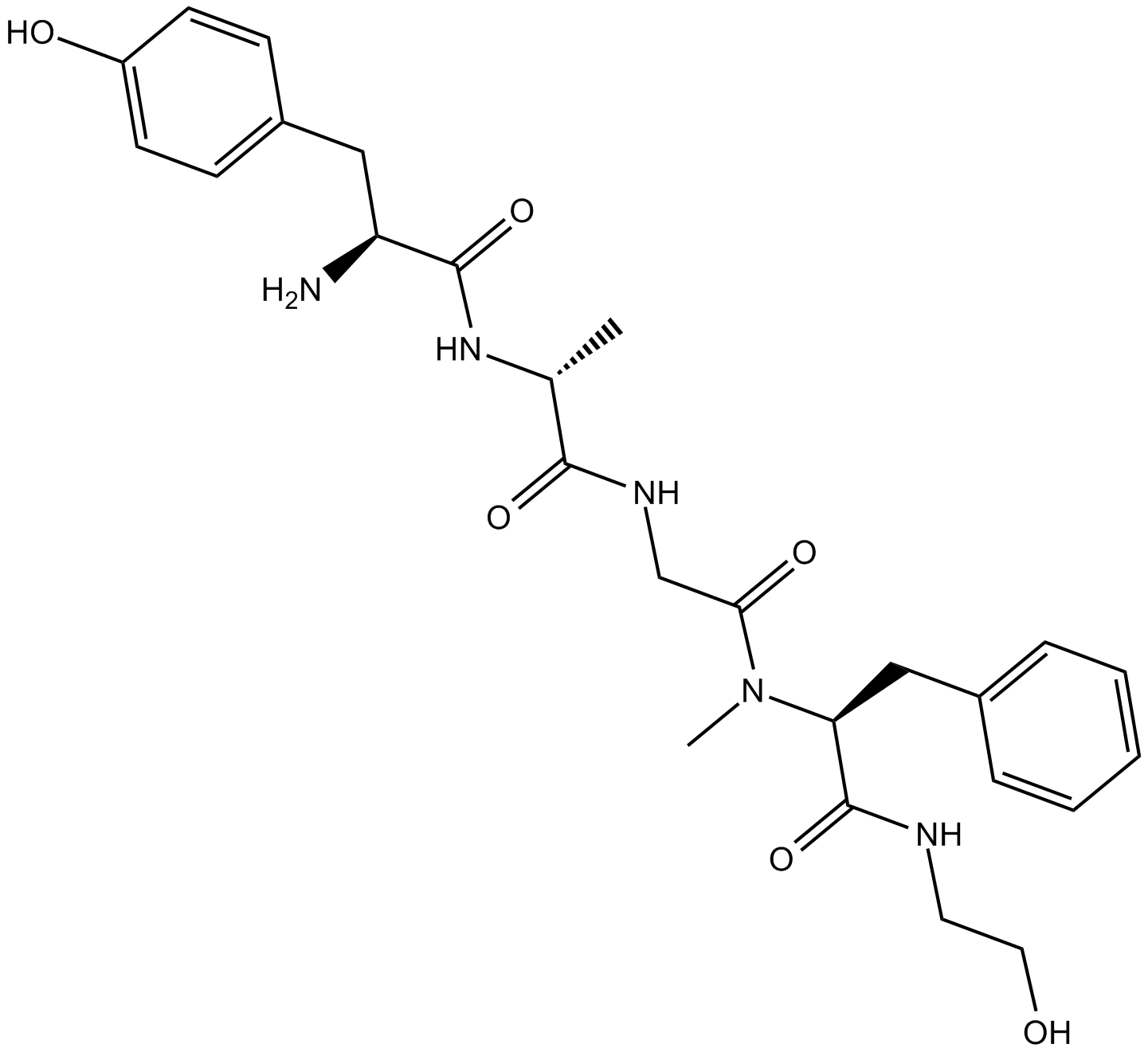
Cas No.: 78123-71-4
Sample solution is provided at 25 µL, 10mM.
_1-3.$$$39978408@51.jpg');)
_1-9.$$$38538795@65.jpg');)
_1-9.$$$39112701@51.jpg');)
_1-7.$$$37316672@70.jpg');)
_366-372.$$$36198801@70.jpg');)
.$$$38565142@65.jpg');)
_1867-1883.$$$33248023@67.jpg');)
_eads6055.$$$39977546@45.jpg');)
_eadm9805.$$$40080571@45.jpg');)
_eadj3020.$$$39666821@45.jpg');)
_1-20.$$$39757301@28.jpg');)
_1-24.$$$38898113@28.jpg');)
_273-287.$$$36806353@46.jpg');)
_1-16.$$$37156877@44.jpg');)
_1-19.$$$37460805@44.jpg');)
_1291-1307.$$$34518654@46.jpg');)
DAMGO is a highly selective peptide agonist for the μ-opioid receptor (MOR) with a Kd of 3.46nM[1-2]. DAMGO activates G protein-coupled receptors, inhibits adenylate cyclase to reduce intracellular cAMP levels, and modulates ion channel activity, thereby suppressing neuronal excitability and neurotransmitter release. DAMGO can be used for pain mechanism research, neural signaling pathway analysis, and opioid receptor function studies[3-4].
In vitro, rat dorsal root ganglion sensory neurons were pretreated with DAMGO (1μM) for 2-3min, followed by stimulation with prostaglandin E₂ (PGE₂; 1μM) for 120s. DAMGO significantly inhibited PGE₂-induced enhancement of tetrodotoxin-resistant sodium currents (TTX-R Iₙₐ)[5]. TF-1 human bone marrow progenitor cells were pretreated with DAMGO (1μM and 10μM) for 24 hours. DAMGO reduced the expression level of the CXCR4 receptor on the cell surface and significantly inhibited the replication of the X4-tropic HIV-1 strain IIIB in cells[6].
In vivo, DAMGO (10ng) was stereotactically injected into the anterior cingulate cortex of young male mice (administered on postnatal days 6, 8, and 10). DAMGO induced autism-like behaviors in mice, including social interaction deficits, anxiety-like behaviors, and stereotyped behaviors, while downregulating Grin2b expression and GluN2B protein levels in the anterior cingulate cortex[7]. DAMGO (5–15μg) was administered via local (surgical site) or lumbar (L3–L5) intrathecal injection to adult (3–6 months old) and aged (24 months old) mice (administered on day 1 or days 1–3 postoperatively). DAMGO dose-dependently attenuated heat- and mechanical-induced postoperative hyperalgesia in an incision model. The inhibitory effect on incision-induced spontaneous pain by intrathecal DAMGO (5μg) or systemic intraperitoneal injection (1mg/kg) was more pronounced in adult mice[8].
References:
[1] Onogi T, Minami M, Katao Y, et al. DAMGO, a mu-opioid receptor selective agonist, distinguishes between mu- and delta-opioid receptors around their first extracellular loops. FEBS Lett. 1995 Jan 2;357(1):93-7.
[2] Eisenberg RM. DAMGO stimulates the hypothalamo-pituitary-adrenal axis through a mu-2 opioid receptor. J Pharmacol Exp Ther. 1993 Aug;266(2):985-91.
[3] Minami M, Onogi T, Nakagawa T, et al. DAMGO, a mu-opioid receptor selective ligand, distinguishes between mu-and kappa-opioid receptors at a different region from that for the distinction between mu- and delta-opioid receptors. FEBS Lett. 1995 May 1;364(1):23-7.
[4] Koganezawa T, Okada Y, Terui N, et al. A μ-opioid receptor agonist DAMGO induces rapid breathing in the arterially perfused in situ preparation of rat. Respir Physiol Neurobiol. 2011 Jul 31;177(2):207-11.
[5] Gold MS, Levine JD. DAMGO inhibits prostaglandin E2-induced potentiation of a TTX-resistant Na+ current in rat sensory neurons in vitro. Neurosci Lett. 1996 Jul 12;212(2):83-6.
[6] Strazza M, Banerjee A, Alexaki A, et al. Effect of μ-opioid agonist DAMGO on surface CXCR4 and HIV-1 replication in TF-1 human bone marrow progenitor cells. BMC Res Notes. 2014 Oct 23;7:752.
[7] Sheng Z, Liu Q, Cheng C, et al. Fentanyl induces autism-like behaviours in mice by hypermethylation of the glutamate receptor gene Grin2b. Br J Anaesth. 2022 Oct;129(4):544-554.
[8] Mecklenburg J, Patil MJ, Koek W, et al. Effects of local and spinal administrations of mu-opioids on postoperative pain in aged versus adult mice. Pain Rep. 2017 Jan;2(1):e584.
| Cell experiment [1]: | |
Cell lines | TF-1 human bone marrow progenitor cells (CD34+CD38+ hematopoietic progenitor cell line) |
Preparation Method | TF-1 cells were cultured in RPMI-1640 medium supplemented with 10% heat-inactivated fetal bovine serum (FBS), penicillin (100U/ml), streptomycin (100μg/ml), and recombinant human granulocyte/macrophage colony-stimulating factor (2ng/ml) at 37°C in 5% CO₂. TF-1 cells were treated with DAMGO (1μM and 10μM) for 24 hours. |
Reaction Conditions | 1μM and 10μM; 24h. |
Applications | DAMGO treatment significantly altered the surface expression profile of CXCR4 on TF-1 cells, shifting the relative proportion of CXCR4+ cells toward a low-expressing phenotype. This effect correlated with a >3-fold reduction in replication of the X4 HIV-1 strain IIIB. |
| Animal experiment [2]: | |
Animal models | C57BL/6J mice (young male and female mice at postnatal days 6, 8, and 10) |
Preparation Method | Mice received stereotaxic microinjections of DAMGO (10ng) into the anterior cingulate cortex (ACC) at postnatal days 6, 8, and 10. Behavioral tests including three-chamber social preference, elevated plus maze, grooming behavior, and open-field test were performed from postnatal days 30-32. |
Dosage form | 10ng; stereotaxic intracerebral injection; administered three times at P6, P8, and P10. |
Applications | DAMGO injection into the ACC induced autism-like behaviors in young mice, including social interaction deficits, anxiety-like behaviors, and increased stereotyped behaviors. DAMGO treatment significantly downregulated Grin2b expression and GluN2B protein amounts in the ACC through hypermethylation of the Grin2b gene promoter region. |
References: | |
| Cas No. | 78123-71-4 | SDF | |
| Chemical Name | (S)-2-amino-N-((R)-1-((2-(((S)-1-((2-hydroxyethyl)amino)-1-oxo-3-phenylpropan-2-yl)(methyl)amino)-2-oxoethyl)amino)-1-oxopropan-2-yl)-3-(4-hydroxyphenyl)propanamide | ||
| Canonical SMILES | O=C([C@H](CC1=CC=CC=C1)N(C)C(CNC([C@@H](C)NC([C@H](CC(C=C2)=CC=C2O)N)=O)=O)=O)NCCO | ||
| Formula | C26H35N5O6 | M.Wt | 513.7 |
| Solubility | H2O: >50mg/mL; DMSO: 20mg/mL | Storage | -20°C, protect from light |
| General tips | Please select the appropriate solvent to prepare the stock solution according to the
solubility of the product in different solvents; once the solution is prepared, please store it in
separate packages to avoid product failure caused by repeated freezing and thawing.Storage method
and period of the stock solution: When stored at -80°C, please use it within 6 months; when stored
at -20°C, please use it within 1 month. To increase solubility, heat the tube to 37°C and then oscillate in an ultrasonic bath for some time. |
||
| Shipping Condition | Evaluation sample solution: shipped with blue ice. All other sizes available: with RT, or with Blue Ice upon request. | ||
| Prepare stock solution | |||

|
1 mg | 5 mg | 10 mg |
| 1 mM | 1.9467 mL | 9.7333 mL | 19.4666 mL |
| 5 mM | 389.3 μL | 1.9467 mL | 3.8933 mL |
| 10 mM | 194.7 μL | 973.3 μL | 1.9467 mL |
Step 1: Enter information below (Recommended: An additional animal making an allowance for loss during the experiment)
 g
μL
g
μL
Step 2: Enter the in vivo formulation (This is only the calculator, not formulation. Please contact us first if there is no in vivo formulation at the solubility Section.)
Calculation results:
Working concentration: mg/ml;
Method for preparing DMSO master liquid: mg drug pre-dissolved in μL DMSO ( Master liquid concentration mg/mL, Please contact us first if the concentration exceeds the DMSO solubility of the batch of drug. )
Method for preparing in vivo formulation: Take μL DMSO master liquid, next addμL PEG300, mix and clarify, next addμL Tween 80, mix and clarify, next add μL saline, mix and clarify.
Method for preparing in vivo formulation: Take μL DMSO master liquid, next add μL Corn oil, mix and clarify.
Note: 1. Please make sure the liquid is clear before adding the next solvent.
2. Be sure to add the solvent(s) in order. You must ensure that the solution obtained, in the previous addition, is a clear solution before proceeding to add the next solvent. Physical methods such as vortex, ultrasound or hot water bath can be used to aid dissolving.
3. All of the above co-solvents are available for purchase on the GlpBio website.
Quality Control & SDS
- View current batch:
- Purity: >99.50% Appearance: A solid
- COA (Certificate of Analysis)
- SDS (Safety Data Sheet)
- Datasheet
Average Rating: 5 (Based on Reviews and 34 reference(s) in Google Scholar.)