

Liarozole dihydrochloride (Synonyms: R75251 dihydrochloride) |
カタログ番号GC38554
 One-Click Copy Product Info
|

Liarozole dihydrochlorideはイミダゾール環を含有する化合物であり、オールトランスレチノイン酸(RA)のシトクロムP-450依存性の代謝を阻害し、IC50値は2.2µMである。
Products are for research use only. Not for human use. We do not sell to patients.
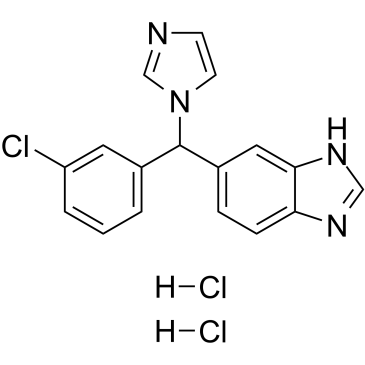
Cas No.: 1883548-96-6
Sample solution is provided at 25 µL, 10mM.
_1-3.$$$39978408@51.jpg');)
_1-9.$$$38538795@65.jpg');)
_1-9.$$$39112701@51.jpg');)
_1-7.$$$37316672@70.jpg');)
_366-372.$$$36198801@70.jpg');)
.$$$38565142@65.jpg');)
_1867-1883.$$$33248023@67.jpg');)
_eads6055.$$$39977546@45.jpg');)
_eadm9805.$$$40080571@45.jpg');)
_eadj3020.$$$39666821@45.jpg');)
_1-20.$$$39757301@28.jpg');)
_1-24.$$$38898113@28.jpg');)
_273-287.$$$36806353@46.jpg');)
_1-16.$$$37156877@44.jpg');)
_1-19.$$$37460805@44.jpg');)
_1291-1307.$$$34518654@46.jpg');)
Liarozole dihydrochlorideはイミダゾール環を含有する化合物であり、オールトランスレチノイン酸(RA)のシトクロムP-450依存性の代謝を阻害し、IC50値は2.2µMである[1]。Liarozole dihydrochlorideは、TGF-β3遺伝子とタンパク質の発現、バーシカン、COL1A1とフィブロネクチンの発現を下方制御することで、細胞内マトリックス(ECM)の形成を抑制する[2]。Liarozole dihydrochlorideは、数多くの癌細胞と移植腫瘍の増殖の阻害に広く使われている[3]。
In vitro(体外)実験で、Liarozole dihydrochloride(25µM)で5日間処理したところ、Huh-7細胞の増殖と遊走が著しく阻害された[4]。10nM Liarozole dihydrochlorideで24時間処理したところ、平滑筋腫細胞の増殖が著しく阻害され、ECM遺伝子とCYP26A1の発現レベルが低下した[5]。
In vivo(体内)実験で、80mg/kgのLiarozole dihydrochlorideを9週間、毎日二回経口投与したところ、N-Butyl-N-(4-hydroxybutyl) nitrosamine(BBN)に誘発された膀胱癌の発生率が著しく阻害された[6]。
| 細胞実験 [1]: | |
|
細胞株 |
Huh-7細胞 |
|
調製方法 |
37℃、5% CO2の環境下で、10%のウシ胎児血清(FBS)と1.5g/lのNaHCO3を添加したDMEMでHuh-7細胞を24時間培養した。3×104個の細胞を12ウェルのプレートの各ウェルに三連で置いた。Huh-7細胞を様々な濃度のLiarozole dihydrochloride(0、1、5、10と25µM)で72時間処理し、その後は、細胞ライセートを使い、Pin1抗体による免疫ブロッティングを行った。 |
|
反応条件 |
0、1、5、10と25µM;72時間 |
|
応用 |
Liarozole dihydrochlorideの処理により、Huh-7細胞におけるPin1のレベルが用量依存的に著しく低下した。 |
| 動物実験 [2]: | |
|
動物モデル |
雄のWistarラット |
|
調製方法 |
22±1°C、60%の相対湿度、12時間の明暗周期というコントロールされた環境で雄のWistarラット(7週齢)を培養し、飼料と水を自由に摂取させた。ラットに、0.05% BBNを含有する飲用水を自由に摂取させ、Liarozole dihydrochloride(80mg/kg)を9週間、毎日二回経口投与した。全てのラットをエーテル麻酔で殺処分し、評価のために膀胱を摘出した。 |
|
剤形 |
80mg/kg;毎日二回;9週間;経口投与 |
|
応用 |
Liarozole dihydrochlorideの処理により、ラットで、BBN誘発性膀胱癌の発生が阻害された。 |
| Cas No. | 1883548-96-6 | SDF | |
| 同義語 | R75251 dihydrochloride | ||
| Canonical SMILES | ClC1=CC(C(C2=CC=C3N=CNC3=C2)N4C=CN=C4)=CC=C1.[H]Cl.[H]Cl | ||
| Formula | C17H15Cl3N4 | M.Wt | 381.69 |
| 溶解度 | Water: ≥ 50 mg/mL (131.00 mM); DMSO: 50 mg/mL (131.00 mM) | Storage | Store at -20°C |
| Shipping Condition | Evaluation sample solution: shipped with blue ice. All other sizes available: with RT, or with Blue Ice upon request. | ||
| Prepare stock solution | |||

|
1 mg | 5 mg | 10 mg |
| 1 mM | 2.6199 mL | 13.0996 mL | 26.1993 mL |
| 5 mM | 524 μL | 2.6199 mL | 5.2399 mL |
| 10 mM | 262 μL | 1.31 mL | 2.6199 mL |
Step 1: Enter information below (Recommended: An additional animal making an allowance for loss during the experiment)
 g
μL
g
μL
Step 2: Enter the in vivo formulation (This is only the calculator, not formulation. Please contact us first if there is no in vivo formulation at the solubility Section.)
Calculation results:
Working concentration: mg/ml;
Method for preparing DMSO master liquid: mg drug pre-dissolved in μL DMSO ( Master liquid concentration mg/mL, Please contact us first if the concentration exceeds the DMSO solubility of the batch of drug. )
Method for preparing in vivo formulation: Take μL DMSO master liquid, next addμL PEG300, mix and clarify, next addμL Tween 80, mix and clarify, next add μL saline, mix and clarify.
Method for preparing in vivo formulation: Take μL DMSO master liquid, next add μL Corn oil, mix and clarify.
Note: 1. Please make sure the liquid is clear before adding the next solvent.
2. Be sure to add the solvent(s) in order. You must ensure that the solution obtained, in the previous addition, is a clear solution before proceeding to add the next solvent. Physical methods such as vortex, ultrasound or hot water bath can be used to aid dissolving.
3. All of the above co-solvents are available for purchase on the GlpBio website.
Quality Control & SDS
- View current batch:
- Purity: >99.00% Appearance: A solid
- COA (Certificate of Analysis)
- SDS (Safety Data Sheet)
- Datasheet
Average Rating: 5 (Based on Reviews and 28 reference(s) in Google Scholar.)