

Liarozole dihydrochloride (Synonyms: R75251 dihydrochloride) |
Catalog No.GC38554
 One-Click Copy Product Info
|

Liarozole dihydrochloride is an imidazole-containing compound that inhibits the cytochrome P-450-dependent metabolism of all-trans-retinoic acid (RA), with an IC50 value of 2.2µM.
Products are for research use only. Not for human use. We do not sell to patients.
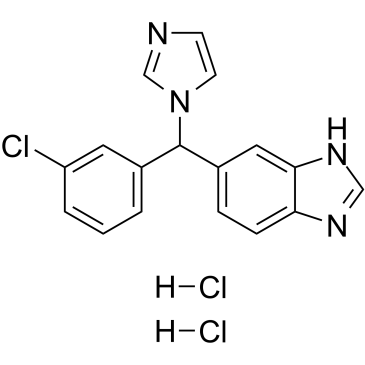
Cas No.: 1883548-96-6
Sample solution is provided at 25 µL, 10mM.
_1-3.$$$39978408@51.jpg');)
_1-9.$$$38538795@65.jpg');)
_1-9.$$$39112701@51.jpg');)
_1-7.$$$37316672@70.jpg');)
_366-372.$$$36198801@70.jpg');)
.$$$38565142@65.jpg');)
_1867-1883.$$$33248023@67.jpg');)
_eads6055.$$$39977546@45.jpg');)
_eadm9805.$$$40080571@45.jpg');)
_eadj3020.$$$39666821@45.jpg');)
_1-20.$$$39757301@28.jpg');)
_1-24.$$$38898113@28.jpg');)
_273-287.$$$36806353@46.jpg');)
_1-16.$$$37156877@44.jpg');)
_1-19.$$$37460805@44.jpg');)
_1291-1307.$$$34518654@46.jpg');)
Liarozole dihydrochloride is an imidazole-containing compound that inhibits the cytochrome P-450-dependent metabolism of all-trans-retinoic acid (RA), with an IC50 value of 2.2µM[1]. Liarozole dihydrochloride suppresses extracellular matrix (ECM) formation by downregulating the expression of TGF-β3 gene and protein, as well as the expression of versican, COL1A1 and fibronectin[2]. Liarozole dihydrochloride has been widely used to inhibit the growth of various cancer cells and transplanted tumors[3].
In vitro, Liarozole dihydrochloride (25µM) treatment for 5 days significantly inhibited the proliferation and migration of Huh-7 cells[4]. Treatment with 10nM Liarozole dihydrochloride for 24 hours significantly inhibited the growth of leiomyoma cells and reduced the expression levels of ECM genes and CYP26A1[5].
In vivo, Liarozole dihydrochloride treatment via oral administration at a dose of 80mg/kg twice daily for 9 weeks significantly inhibited the occurrence of bladder cancer in rats induced by N-Butyl-N-(4-hydroxybutyl) nitrosamine (BBN)[6].
References:
[1] Van Wauwe J, Van Nyen G, Coene M C, et al. Liarozole, an inhibitor of retinoic acid metabolism, exerts retinoid-mimetic effects in vivo[J]. The Journal of pharmacology and experimental therapeutics, 1992, 261(2): 773-779.
[2] Levy G, Malik M, Britten J, et al. Liarozole inhibits transforming growth factor-β3–mediated extracellular matrix formation in human three-dimensional leiomyoma cultures[J]. Fertility and sterility, 2014, 102(1): 272-281. e2.
[3] De Coster R, Wouters W, Van Ginckel R, et al. Experimental studies with liarozole (R 75 251): an antitumoral agent which inhibits retinoic acid breakdown[J]. The Journal of steroid biochemistry and molecular biology, 1992, 43(1-3): 197-201.
[4] Liao X H, Zhang A L, Zheng M, et al. Chemical or genetic Pin1 inhibition exerts potent anticancer activity against hepatocellular carcinoma by blocking multiple cancer-driving pathways[J]. Scientific reports, 2017, 7(1): 43639.
[5] Gilden M, Malik M, Britten J, et al. Leiomyoma fibrosis inhibited by liarozole, a retinoic acid metabolic blocking agent[J]. Fertility and sterility, 2012, 98(6): 1557-1562.
[6] Nagae H, Otawara Y, Suzuki K, et al. Effect of liarozole on the cell proliferation activity in the rat urinary bladder epithelium induced by N-butyl-N-(4-hydroxybutyl) nitrosamine[J]. Nihon Hinyokika Gakkai zasshi. The Japanese Journal of Urology, 1999, 90(10): 838-842.
| Cell experiment [1]: | |
|
Cell lines |
Huh-7 cells |
|
Preparation Method |
Huh-7 cells were cultured for 24 hours in DMEM supplemented with 10% fetal bovine serum (FBS) and 1.5g/l of NaHCO3 at 37°C in an atmosphere of air with 5% CO2. 3×10⁴ cells were placed in each well of a 12-well plate, in triplicate. Huh-7 cells were treated with different concentrations of Liarozole dihydrochloride (0, 1, 5, 10, and 25µM) for 72 hours, followed by subjecting cell lysates to immunoblotting with Pin1 antibody. |
|
Reaction Conditions |
0, 1, 5, 10, and 25µM; 72h |
|
Applications |
Liarozole dihydrochloride treatment significantly increased the Pin1 levels in Huh-7 cells in a dose-dependent manner. |
| Animal experiment [2]: | |
|
Animal models |
Male Wistar rats |
|
Preparation Method |
Male Wistar rats (seven-week-old) were maintained in a controlled environment at 22±1°C and 60% relative humidity under a 12h light/dark cycle, and were given food and water ad libitum. Rats were allowed free access to the drinking water containing 0.05% BBN, and were administered the Liarozole dihydrochloride twice daily by oral gavage (80mg/kg) for 9 weeks. All rats were killed by ether anesthesia, and the urinary bladders were taken for evaluation. |
|
Dosage form |
80mg/kg; twice daily; 9 weeks; p.o. |
|
Applications |
Liarozole dihydrochloride treatment inhibited BBN-induced urinary bladder carcinogenesis in rats. |
References: [1] Liao X H, Zhang A L, Zheng M, et al. Chemical or genetic Pin1 inhibition exerts potent anticancer activity against hepatocellular carcinoma by blocking multiple cancer-driving pathways[J]. Scientific reports, 2017, 7(1): 43639. [2] Nagae H, Otawara Y, Suzuki K, et al. Effect of liarozole on the cell proliferation activity in the rat urinary bladder epithelium induced by N-butyl-N-(4-hydroxybutyl) nitrosamine[J]. Nihon Hinyokika Gakkai zasshi. The Japanese Journal of Urology, 1999, 90(10): 838-842. | |
| Cas No. | 1883548-96-6 | SDF | |
| Synonyms | R75251 dihydrochloride | ||
| Canonical SMILES | ClC1=CC(C(C2=CC=C3N=CNC3=C2)N4C=CN=C4)=CC=C1.[H]Cl.[H]Cl | ||
| Formula | C17H15Cl3N4 | M.Wt | 381.69 |
| Solubility | Water: ≥ 50 mg/mL (131.00 mM); DMSO: 50 mg/mL (131.00 mM) | Storage | Store at -20°C |
| Shipping Condition | Evaluation sample solution: shipped with blue ice. All other sizes available: with RT, or with Blue Ice upon request. | ||
| Prepare stock solution | |||

|
1 mg | 5 mg | 10 mg |
| 1 mM | 2.6199 mL | 13.0996 mL | 26.1993 mL |
| 5 mM | 524 μL | 2.6199 mL | 5.2399 mL |
| 10 mM | 262 μL | 1.31 mL | 2.6199 mL |
Step 1: Enter information below (Recommended: An additional animal making an allowance for loss during the experiment)
 g
μL
g
μL
Step 2: Enter the in vivo formulation (This is only the calculator, not formulation. Please contact us first if there is no in vivo formulation at the solubility Section.)
Calculation results:
Working concentration: mg/ml;
Method for preparing DMSO master liquid: mg drug pre-dissolved in μL DMSO ( Master liquid concentration mg/mL, Please contact us first if the concentration exceeds the DMSO solubility of the batch of drug. )
Method for preparing in vivo formulation: Take μL DMSO master liquid, next addμL PEG300, mix and clarify, next addμL Tween 80, mix and clarify, next add μL saline, mix and clarify.
Method for preparing in vivo formulation: Take μL DMSO master liquid, next add μL Corn oil, mix and clarify.
Note: 1. Please make sure the liquid is clear before adding the next solvent.
2. Be sure to add the solvent(s) in order. You must ensure that the solution obtained, in the previous addition, is a clear solution before proceeding to add the next solvent. Physical methods such as vortex, ultrasound or hot water bath can be used to aid dissolving.
3. All of the above co-solvents are available for purchase on the GlpBio website.
Quality Control & SDS
- View current batch:
- Purity: >99.00% Appearance: A solid
- COA (Certificate of Analysis)
- SDS (Safety Data Sheet)
- Datasheet
Average Rating: 5 (Based on Reviews and 28 reference(s) in Google Scholar.)