

NAD+ (Synonyms: Nicotinamide adenine dinucleotide) |
カタログ番号GC17216
 One-Click Copy Product Info
|

NAD+は、水素イオンを転移し、多くの酵素反応に関与する補酵素である。ピロリン酸結合を介して 5'-アデノシンリン酸に結合したリボシルニコチンアミド 5'-二リン酸で構成されている。
Products are for research use only. Not for human use. We do not sell to patients.
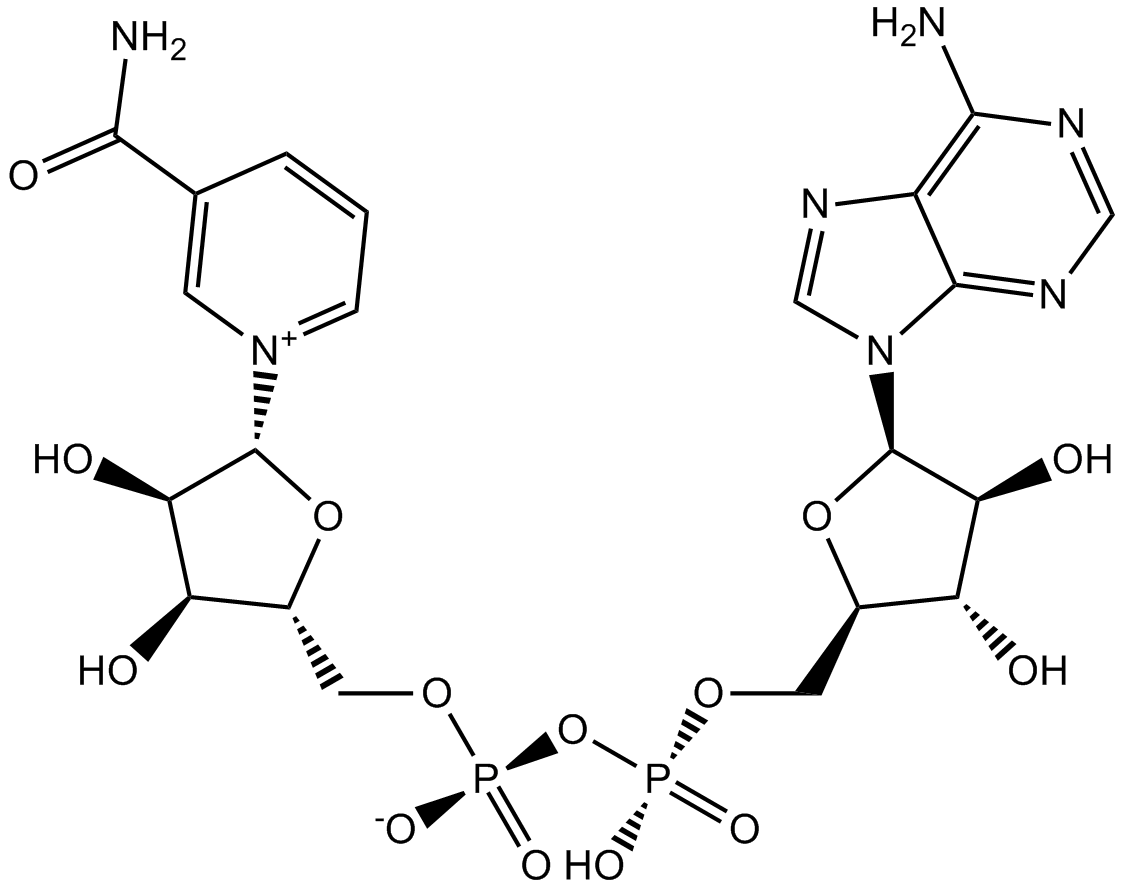
Cas No.: 53-84-9
Sample solution is provided at 25 µL, 10mM.
NAD+は、水素イオンを転移し、多くの酵素反応に関与する補酵素である。ピロリン酸結合を介して 5'-アデノシンリン酸に結合したリボシルニコチンアミド 5'-二リン酸で構成されている[1]。NAD+はニコチンアミドアデニンジヌクレオチド(NAD)の酸化形式であり、NADの還元型はNADHである。細胞内NAD+/NADHは細胞の代謝活動と健康を示す[2]。NAD+は肝心なレドックスキャリアーであり、解糖系、糖新生系、トリカルボン酸回路、呼吸鎖では掛け替えのない役割を果たしている[3]。NAD+は、核酵素ポリ(ADP-リボーゼ)ポリメラーゼ-1(PARP-1)の基質でもある[4]。
試験管内では、未熟なCD4+ T細胞をNAD+ (100µM)で72時間処理した結果、未熟なCD4+ T細胞は大量のサイトカインを生産し、ヘルパーT細胞(Th1、Th2とTh17細胞)への細胞の分化を促進したが、分化細胞をサイトカインの生産を阻止した[5]。
生体内では、NAD+ (10, 60 mg/kg)をART2−/−と野生型(WT)マウスに静脈内注射した結果、WTマウスにおけるCD4+ CD25+ FoxP3+調節T細胞(T reg細胞)の阻害作用を用量依存的に減らし、ART2−/−マウスではT reg細胞の機能には影響がなかった。生体内では、T reg細胞のサイズと表現型をも調節した[6]。虚血再潅流(I/R)のマウスにNAD+ (10-20 mg/kg)を静脈内投与した結果、I/R誘発性の心筋梗塞を用量依存的に減らし、TUNNELシグナル、Boxと切断型カスパーゼ-3のレベルを減らし、Bcl-XLレベルを増やした[7]。
References:
[1] Pietrowska-Borek M, Dobrogojski J, Sobieszczuk-Nowicka E, et al. New insight into plant signaling: extracellular ATP and uncommon nucleotides[J]. Cells, 2020, 9(2): 345.
[2] Belenky P, Bogan K L, Brenner C. NAD+ metabolism in health and disease[J]. Trends in biochemical sciences, 2007, 32(1): 12-19.
[3] Guo C, Huang Q, Wang Y, et al. Therapeutic application of natural products: NAD+ metabolism as potential target[J]. Phytomedicine, 2023, 114: 154768.
[4] Alano C C, Tran A, Tao R, et al. Differences among cell types in NAD+ compartmentalization: a comparison of neurons, astrocytes, and cardiac myocytes[J]. Journal of neuroscience research, 2007, 85(15): 3378-3385.
[5] Tullius S G, Biefer H R C, Li S, et al. NAD+ protects against EAE by regulating CD4+ T-cell differentiation[J]. Nature communications, 2014, 5(1): 5101.
[6] Hubert S, Rissiek B, Klages K, et al. Extracellular NAD+ shapes the Foxp3+ regulatory T cell compartment through the ART2–P2X7 pathway[J]. Journal of Experimental Medicine, 2010, 207(12): 2561-2568.
[7] Zhang Y, Wang B, Fu X, et al. Exogenous NAD+ administration significantly protects against myocardial ischemia/reperfusion injury in rat model[J]. American journal of translational research, 2016, 8(8): 3342.
| 細胞実験[1]: | |
細胞株 | CD4+ T細胞 |
準備方法 | CD4+ T細胞をマウス脾臓から単離し、100μMのNAD+を処理細胞の培地に添加し、処理の72時間後に細胞機能と分化分析を行った。 |
反応条件 | 100μM; 72時間 |
アプリケーション | NAD+は未熟なCD4+ T細胞をTh1、Th2とTh17細胞に転換させる。NAD+は未熟なCD4+ T細胞で強力なサイトカイン酸性を誘発するが、分化細胞でサイトカインの生産を遮断する。 |
| 動物実験 [2]: | |
動物モデル | ART2−/−、 WTマウス |
準備方法 | 100–200µlのPBS(pHは7.4に調整)の10また60 mgのNAD+をマウスに静脈内処理した。24時間後、LN、脾臓と血液から調製された単細胞懸濁液をフローサイトメトリーで分析した。 |
投与形態 | 10また60mg/kg;i.v.(静脈内) |
アプリケーション | 外因NAD+はWTマウスCD4+ CD25+ FoxP3+調節T細胞(T reg細胞)を用量依存的に減らし、ART2−/−マウスからT reg細胞の機能には影響がなかった。外因NAD+は生体内で、T reg細胞のサイズと表現型を調節できる。 |
References: | |
| Cas No. | 53-84-9 | SDF | |
| 同義語 | Nicotinamide adenine dinucleotide | ||
| Chemical Name | [[(2R,3S,4R,5R)-5-(6-aminopurin-9-yl)-3,4-dihydroxyoxolan-2-yl]methoxy-hydroxyphosphoryl] [(2R,3S,4R,5R)-5-(3-carbamoylpyridin-1-ium-1-yl)-3,4-dihydroxyoxolan-2-yl]methyl phosphate | ||
| Canonical SMILES | C1=CC(=C[N+](=C1)C2C(C(C(O2)COP(=O)([O-])OP(=O)(O)OCC3C(C(C(O3)N4C=NC5=C4N=CN=C5N)O)O)O)O)C(=O)N | ||
| Formula | C21H27N7O14P2 | M.Wt | 663.43 |
| 溶解度 | ≥ 28.55mg/mL in Water | Storage | Store at -20°C |
| General tips | Please select the appropriate solvent to prepare the stock solution according to the
solubility of the product in different solvents; once the solution is prepared, please store it in
separate packages to avoid product failure caused by repeated freezing and thawing.Storage method
and period of the stock solution: When stored at -80°C, please use it within 6 months; when stored
at -20°C, please use it within 1 month. To increase solubility, heat the tube to 37°C and then oscillate in an ultrasonic bath for some time. |
||
| Shipping Condition | Evaluation sample solution: shipped with blue ice. All other sizes available: with RT, or with Blue Ice upon request. | ||
| Prepare stock solution | |||

|
1 mg | 5 mg | 10 mg |
| 1 mM | 1.5073 mL | 7.5366 mL | 15.0732 mL |
| 5 mM | 301.5 μL | 1.5073 mL | 3.0146 mL |
| 10 mM | 150.7 μL | 753.7 μL | 1.5073 mL |
Step 1: Enter information below (Recommended: An additional animal making an allowance for loss during the experiment)
 g
μL
g
μL
Step 2: Enter the in vivo formulation (This is only the calculator, not formulation. Please contact us first if there is no in vivo formulation at the solubility Section.)
Calculation results:
Working concentration: mg/ml;
Method for preparing DMSO master liquid: mg drug pre-dissolved in μL DMSO ( Master liquid concentration mg/mL, Please contact us first if the concentration exceeds the DMSO solubility of the batch of drug. )
Method for preparing in vivo formulation: Take μL DMSO master liquid, next addμL PEG300, mix and clarify, next addμL Tween 80, mix and clarify, next add μL saline, mix and clarify.
Method for preparing in vivo formulation: Take μL DMSO master liquid, next add μL Corn oil, mix and clarify.
Note: 1. Please make sure the liquid is clear before adding the next solvent.
2. Be sure to add the solvent(s) in order. You must ensure that the solution obtained, in the previous addition, is a clear solution before proceeding to add the next solvent. Physical methods such as vortex, ultrasound or hot water bath can be used to aid dissolving.
3. All of the above co-solvents are available for purchase on the GlpBio website.
Quality Control & SDS
- View current batch:
- Purity: >98.00% Appearance: A solid
- COA (Certificate of Analysis)
- SDS (Safety Data Sheet)
- Datasheet
Average Rating: 5 (Based on Reviews and 24 reference(s) in Google Scholar.)