

ARV-771 |
Katalog-Nr.GC32685
 One-Click Copy Product Info
|

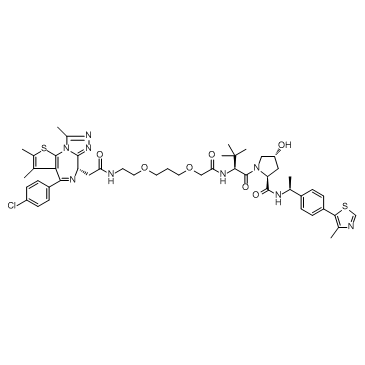
ARV-771 ist ein potenter BET-PROTAC basierend auf E3-Ligase von Hippel-Lindau mit Kds von 34 nM, 4,7 nM, 8,3 nM, 7,6 nM, 9,6 nM und 7,6 nM fÜr BRD2(1), BRD2(2), BRD3( 1), BRD3(2), BRD4(1) bzw. BRD4(2).
Products are for research use only. Not for human use. We do not sell to patients.
Cas No.: 1949837-12-0
Sample solution is provided at 25 µL, 10mM.
_1-3.$$$39978408@51.jpg');)
_1-9.$$$38538795@65.jpg');)
_1-9.$$$39112701@51.jpg');)
_1-7.$$$37316672@70.jpg');)
_366-372.$$$36198801@70.jpg');)
.$$$38565142@65.jpg');)
_1867-1883.$$$33248023@67.jpg');)
_eads6055.$$$39977546@45.jpg');)
_eadm9805.$$$40080571@45.jpg');)
_eadj3020.$$$39666821@45.jpg');)
_1-20.$$$39757301@28.jpg');)
_1-24.$$$38898113@28.jpg');)
_273-287.$$$36806353@46.jpg');)
_1-16.$$$37156877@44.jpg');)
_1-19.$$$37460805@44.jpg');)
_1291-1307.$$$34518654@46.jpg');)
ARV-771, a pan-BET-PROTAC, potently degrades BRD2/3/4 with a DC50<5nM[1]. ARV-771, which consists of a BRD4 inhibitor (JQ1) and a ligand for Von Hippel-Lindau (VHL) E3 ligase, kills cancer cells by degrading bromodomain and BET proteins overexpressed in cancer cells [2]. ARV-771 has been widely used to inhibit tumor growth in MYC/ BCL2-associated lymphoma models[3].
In vitro, ARV-771 treatment for 96 hours significantly inhibited the viability of MDA-MB-231 and MDA-MB-436 cells with IC50 values of 0.12±0.04µM and 0.45±0.02µM, respectively[4]. Treatment of HepG2 and HCCLM3 cells with 2µM ARV-771 for 24 hours significantly inhibited cell growth, blocked cell cycle progression, and reduced the expression of multiple deubiquitinating enzymes[5]. ARV-771 treatment for 48h significantly induced apoptosis in Mino cells with an IC50 value of 17±7nM[6].
In vivo, ARV-771 treatment via subcutaneous administration daily at a dose of 30mg/kg for 21 days induced tumor regression in noncastrated male Nu/Nu mice bearing 22Rv1 tumors[7]. Treatment with ARV-771 (30mg/kg subcutaneously once daily for 5 days per week) combined with BC2059 (30mg/kg intraperitoneally twice weekly) for 3 weeks significantly reduced secondary acute myelocytic leukemia (AML) tumor burden and improved survival in NSG mice bearing HEL-P/R cells[8].
References:
[1] Yedla P, Babalghith A O, Andra V V, et al. PROTACs in the management of prostate cancer[J]. Molecules, 2023, 28(9): 3698.
[2] Cho H, Jeon S I, Shim M K, et al. In situ albumin-binding and esterase-specifically cleaved BRD4-degrading PROTAC for targeted cancer therapy[J]. Biomaterials, 2023, 295: 122038.
[3] Furukawa K, Shimada K, Esaki M, et al. Development and efficacy of a Novel Bromodomain and Extraterminal Domain Degrader K-256 in MYC/BCL2-Related lymphoma[J]. Blood, 2023, 142: 5008.
[4] Teufelsbauer M, Stickler S, Eggerstorfer M T, et al. BET-directed PROTACs in triple negative breast cancer cell lines MDA-MB-231 and MDA-MB-436[J]. Breast Cancer Research and Treatment, 2024, 208(1): 89-101.
[5] Deng Y, Yu C, Chen L, et al. ARV-771 acts as an inducer of cell cycle arrest and apoptosis to suppress hepatocellular carcinoma progression[J]. Frontiers in Pharmacology, 2022, 13: 858901.
[6] Sun B, Fiskus W, Qian Y, et al. BET protein proteolysis targeting chimera (PROTAC) exerts potent lethal activity against mantle cell lymphoma cells[J]. Leukemia, 2018, 32(2): 343-352.
[7] Raina K, Lu J, Qian Y, et al. PROTAC-induced BET protein degradation as a therapy for castration-resistant prostate cancer[J]. Proceedings of the National Academy of Sciences, 2016, 113(26): 7124-7129.
[8] Saenz D T, Fiskus W C, Manshouri T, et al. BRD4 degrader and inhibitor of beta catenin-TCF7L2 are synergistically active against human AML cells resistant to BET inhibitor[J]. Cancer Research, 2019, 79(13_Supplement): 3036-3036.
| Cell experiment [1]: | |
|
Cell lines |
MDA-MB-231 cells |
|
Preparation Method |
MDA-MB-231 cells were cultured in RPMI-1640 medium supplemented with 10% FBS and 1% antibiotics. Culture conditions were 37°C with 5% CO2. 1×10⁴ cells in 100μl of medium were aliquoted into wells of a 96-well flat-bottom microtiter plate, and ARV-771 (0.2, 0.039, 0.078, 0.156, 0.313, 0.625, 1.25, 2.5, and 5µM) was added. The plates were incubated for 96h under tissue culture conditions and supplemented with MTT reagent. Viable cells were detected at 450nm. |
|
Reaction Conditions |
0.2, 0.039, 0.078, 0.156, 0.313, 0.625, 1.25, 2.5, and 5µM; 96h |
|
Applications |
ARV-771 significantly inhibited the viability of MDA-MB-231 cells in a dose-dependent manner. |
| Animal experiment [2]: | |
|
Animal models |
Nude mice |
|
Preparation Method |
Five to six weeks old nude mice were maintained in a standard sterile environment. First, HepG2 cells were digested, washed, and collected in cold PBS. Then 2×10⁶ cells in 100μl PBS were inoculated subcutaneously into each nude mouse within 30min. Nude mice with successfully transplanted tumors were randomly divided into two groups (8 mice/group) and treated with ARV-771 (20mg/kg/day; s.c.) or control vehicle every other day. After 25 days of ARV-771 treatment, mice were sacrificed by human vertebral dislocation, and CO2 was inhaled. Tumor volume and body weight of mice were measured every 5 days. Immediately after removal of the xenograft tumors from the mice, the tumors were weighed using an electronic balance. |
|
Dosage form |
20mg/kg/day for 25 days; s.c. |
|
Applications |
ARV-771 treatment remarkably reduced tumor volume and tumor weight in HepG2 xenograft model of mice. |
|
References: |
|
| Cas No. | 1949837-12-0 | SDF | |
| Canonical SMILES | CC(C(C(C1=CC=C(Cl)C=C1)=N[C@@H](CC(NCCOCCCOCC(N[C@@H](C(C)(C)C)C(N(C[C@H](O)C2)[C@@H]2C(N[C@H](C3=CC=C(C(SC=N4)=C4C)C=C3)C)=O)=O)=O)=O)C5=NN=C(C)N65)=C6S7)=C7C | ||
| Formula | C49H60ClN9O7S2 | M.Wt | 986.64 |
| Löslichkeit | DMSO : ≥ 50 mg/mL (50.68 mM) | Storage | Store at -20°C |
| General tips | Please select the appropriate solvent to prepare the stock solution according to the
solubility of the product in different solvents; once the solution is prepared, please store it in
separate packages to avoid product failure caused by repeated freezing and thawing.Storage method
and period of the stock solution: When stored at -80°C, please use it within 6 months; when stored
at -20°C, please use it within 1 month. To increase solubility, heat the tube to 37°C and then oscillate in an ultrasonic bath for some time. |
||
| Shipping Condition | Evaluation sample solution: shipped with blue ice. All other sizes available: with RT, or with Blue Ice upon request. | ||
| Prepare stock solution | |||

|
1 mg | 5 mg | 10 mg |
| 1 mM | 1.0135 mL | 5.0677 mL | 10.1354 mL |
| 5 mM | 202.7 μL | 1.0135 mL | 2.0271 mL |
| 10 mM | 101.4 μL | 506.8 μL | 1.0135 mL |
Step 1: Enter information below (Recommended: An additional animal making an allowance for loss during the experiment)
 g
μL
g
μL
Step 2: Enter the in vivo formulation (This is only the calculator, not formulation. Please contact us first if there is no in vivo formulation at the solubility Section.)
Calculation results:
Working concentration: mg/ml;
Method for preparing DMSO master liquid: mg drug pre-dissolved in μL DMSO ( Master liquid concentration mg/mL, Please contact us first if the concentration exceeds the DMSO solubility of the batch of drug. )
Method for preparing in vivo formulation: Take μL DMSO master liquid, next addμL PEG300, mix and clarify, next addμL Tween 80, mix and clarify, next add μL saline, mix and clarify.
Method for preparing in vivo formulation: Take μL DMSO master liquid, next add μL Corn oil, mix and clarify.
Note: 1. Please make sure the liquid is clear before adding the next solvent.
2. Be sure to add the solvent(s) in order. You must ensure that the solution obtained, in the previous addition, is a clear solution before proceeding to add the next solvent. Physical methods such as vortex, ultrasound or hot water bath can be used to aid dissolving.
3. All of the above co-solvents are available for purchase on the GlpBio website.
Quality Control & SDS
- View current batch:
- Purity: >98.00% Appearance: A solid
- COA (Certificate of Analysis)
- SDS (Safety Data Sheet)
- Datasheet
Average Rating: 5 (Based on Reviews and 26 reference(s) in Google Scholar.)