

D-AP5 (Synonyms: D-2-Amino-5-Phosphonovaleric acid; D-APV) |
Katalog-Nr.GC16315
 One-Click Copy Product Info
|

D-AP5 ist ein selektiver N-Methyl-D-Aspartat(NMDA)-Rezeptorantagonist mit einem Kd-Wert von 1.4 μM.
Products are for research use only. Not for human use. We do not sell to patients.
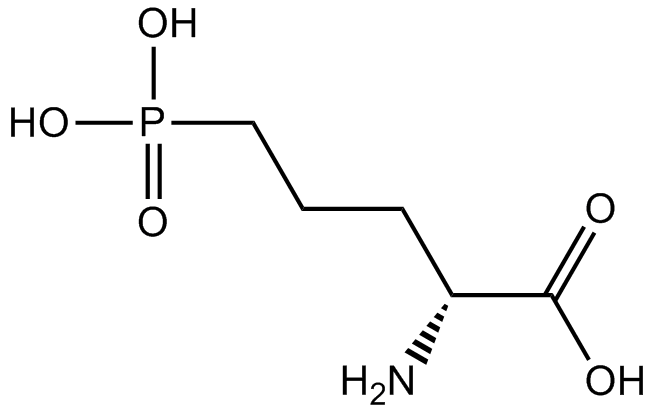
Cas No.: 79055-68-8
Sample solution is provided at 25 µL, 10mM.
_1-3.$$$39978408@51.jpg');)
_1-9.$$$38538795@65.jpg');)
_1-9.$$$39112701@51.jpg');)
_1-7.$$$37316672@70.jpg');)
_366-372.$$$36198801@70.jpg');)
.$$$38565142@65.jpg');)
_1867-1883.$$$33248023@67.jpg');)
_eads6055.$$$39977546@45.jpg');)
_eadm9805.$$$40080571@45.jpg');)
_eadj3020.$$$39666821@45.jpg');)
_1-20.$$$39757301@28.jpg');)
_1-24.$$$38898113@28.jpg');)
_273-287.$$$36806353@46.jpg');)
_1-16.$$$37156877@44.jpg');)
_1-19.$$$37460805@44.jpg');)
_1291-1307.$$$34518654@46.jpg');)
D-AP5 ist ein selektiver N-Methyl-D-Aspartat(NMDA)-Rezeptorantagonist mit einem Kd-Wert von 1.4 μM[1]. D-AP5 hemmt die Glutamatbindungsstelle des NMDA-Rezeptors[2]. Es kann verwendet werden, um die Rolle von NMDA-Rezeptoren in der Neuropathologie zu untersuchen, besonders beim Neuroschutz[3].
In vitro reduziert erheblich die Behandlung kortikaler Astrozyten mit D-AP5 (30 μM) den Anstieg der intrazellulären Ca2+-Konzentration, der durch synaptisch freigesetztes Glutamat verursacht wird, durch Hemmung der NMDA-Rezeptoren[4]. Die Behandlung hippocampaler Neuronen von Mäusen mit D-AP5 (20 μM) reduziert signifikant den NMDA-induzierten Kalziumeinstrom und hemmt die neuronale elektrische Aktivität, wodurch die Neuronen vor excitotoxischen Schäden geschützt werden[5].
In vivo beeinträchtigte signifikant die Verabreichung von D-AP5 (0.5µg/µL;1µL/Stunde) über 14 Tage mittels intracerebroventrikulärer Infusion an Lister-Ratten mit Kapuze das räumliche Lernen und die Gedächtnisleistung, vor allem durch die Hemmung der NMDA-Rezeptor-vermittelten synaptischen Plastizitätsmechanismen und der Bildung einer Langzeitpotenzierung(LTP)[6]. Die Verabreichung von D-AP5 (5-10 nmol/µL; 0.5µL/Stunde) mittels intracerebroventrikulärer Infusion an Ratten hemmte erheblich die LTP-Bildung in der hippocampalen CA1-Region, was zu Gedächtnisstörungen führte[7].
References:
[1] Evans R H, Francis A A, Jones A W, et al. The effects of a series of ω‐phosphonic α‐carboxylic amino acids on electrically evoked and excitant amino acid‐induced responses in isolated spinal cord preparations[J]. British journal of pharmacology, 1982, 75(1): 65-75.
[2] Choi D W, Koh J, Peters S. Pharmacology of glutamate neurotoxicity in cortical cell culture: attenuation by NMDA antagonists[J]. Journal of Neuroscience, 1988, 8(1): 185-196.
[3] Hwang J Y, Kim Y H, Ahn Y H, et al. N-Methyl-D-aspartate receptor blockade induces neuronal apoptosis in cortical culture[J]. Experimental neurology, 1999, 159(1): 124-130.
[4] Palygin O, Lalo U, Verkhratsky A, et al. Ionotropic NMDA and P2X1/5 receptors mediate synaptically induced Ca2+ signalling in cortical astrocytes[J]. Cell calcium, 2010, 48(4): 225-231.
[5] Benveniste M, Mienville J M, Sernagor E, et al. Concentration-jump experiments with NMDA antagonists in mouse cultured hippocampal neurons[J]. Journal of Neurophysiology, 1990, 63(6): 1373-1384.
[6] Morris R G M, Steele R J, Bell J E, et al. N‐methyl‐d‐aspartate receptors, learning and memory: chronic intraventricular infusion of the NMDA receptor antagonist d‐AP 5 interacts directly with the neural mechanisms of spatial learning[J]. European Journal of Neuroscience, 2013, 37(5): 700-717.
[7] Davis S, Butcher S P, Morris R G. The NMDA receptor antagonist D-2-amino-5-phosphonopentanoate (D-AP5) impairs spatial learning and LTP in vivo at intracerebral concentrations comparable to those that block LTP in vitro[J]. Journal of Neuroscience, 1992, 12(1): 21-34.
| Zellexperiment [1]: | |
Zelllinien | kortikale Astrozyten |
Vorbereitungsmethode | D-AP5(30 μM) wurde den Zellen 2 Minuten vor der Agonistenanwendung hinzugefügt, gevolgt von elektrophysiologischen Aufzeichnungen. |
Reaktionsbedingungen | 30 μM; 2 Minuten |
Anwendungen | D-AP5 reduziert signifikant den Anstieg der intrazellulären Ca2+-Konzentration durch synaptisch freigesetztes Glutamat. |
| Tierversuch [2]: | |
Tiermodelle | Männliche Lister-Ratten mit Kapuze |
Vorbereitungsmethode | D-AP5 wurde 14 Tage lang über eine chronische intracerebroventrikuläre Spritzenpumpe in einer Dosis von 0.5 µg/µL und einer kontinuierlichen Infusionsrate von 1 µL/h infundiert. Die chronische Infusion hält eine konstante Wirkstoffkonzentration über einen längeren Zeitraum aufrecht. |
Dosierungsform | 0.5µg/µL bei einer Rate von 1µL/h; i.c.v. |
Anwendungen | Die chronische Infusion von D-AP5 beeinträchtigte signifikant das räumliche Lern- und Gedächtnisvermögen von Ratten. |
References: | |
| Cas No. | 79055-68-8 | SDF | |
| Überlieferungen | D-2-Amino-5-Phosphonovaleric acid; D-APV | ||
| Chemical Name | (R)-2-amino-5-phosphonopentanoic acid | ||
| Canonical SMILES | OP(O)(CCC[C@H](C(O)=O)N)=O | ||
| Formula | C5H12NO5P | M.Wt | 197.13 |
| Löslichkeit | PBS (pH 7.2): 10 mg/ml | Storage | Store at -20°C |
| General tips | Please select the appropriate solvent to prepare the stock solution according to the
solubility of the product in different solvents; once the solution is prepared, please store it in
separate packages to avoid product failure caused by repeated freezing and thawing.Storage method
and period of the stock solution: When stored at -80°C, please use it within 6 months; when stored
at -20°C, please use it within 1 month. To increase solubility, heat the tube to 37°C and then oscillate in an ultrasonic bath for some time. |
||
| Shipping Condition | Evaluation sample solution: shipped with blue ice. All other sizes available: with RT, or with Blue Ice upon request. | ||
| Prepare stock solution | |||

|
1 mg | 5 mg | 10 mg |
| 1 mM | 5.0728 mL | 25.364 mL | 50.7279 mL |
| 5 mM | 1.0146 mL | 5.0728 mL | 10.1456 mL |
| 10 mM | 507.3 μL | 2.5364 mL | 5.0728 mL |
Step 1: Enter information below (Recommended: An additional animal making an allowance for loss during the experiment)
 g
μL
g
μL
Step 2: Enter the in vivo formulation (This is only the calculator, not formulation. Please contact us first if there is no in vivo formulation at the solubility Section.)
Calculation results:
Working concentration: mg/ml;
Method for preparing DMSO master liquid: mg drug pre-dissolved in μL DMSO ( Master liquid concentration mg/mL, Please contact us first if the concentration exceeds the DMSO solubility of the batch of drug. )
Method for preparing in vivo formulation: Take μL DMSO master liquid, next addμL PEG300, mix and clarify, next addμL Tween 80, mix and clarify, next add μL saline, mix and clarify.
Method for preparing in vivo formulation: Take μL DMSO master liquid, next add μL Corn oil, mix and clarify.
Note: 1. Please make sure the liquid is clear before adding the next solvent.
2. Be sure to add the solvent(s) in order. You must ensure that the solution obtained, in the previous addition, is a clear solution before proceeding to add the next solvent. Physical methods such as vortex, ultrasound or hot water bath can be used to aid dissolving.
3. All of the above co-solvents are available for purchase on the GlpBio website.
Quality Control & SDS
- View current batch:
- Purity: >98.00% Appearance: A solid
- COA (Certificate of Analysis)
- SDS (Safety Data Sheet)
- Datasheet
Average Rating: 5 (Based on Reviews and 16 reference(s) in Google Scholar.)