

Doxycycline |
Katalog-Nr.GC63621
 One-Click Copy Product Info
|

Doxycycline ist ein Breitbandantibiotikum aus der Gruppe der Tetracycline, das die Proteinsysnthese hemmt, indem es die Bindung von aktivierten Aminoacyl-tRNA an die A-Stelle der 30S-Untereinheit bakterieller Ribosomen stört. Es wird zur Behandlung einer Vielzahl von Infektionen eingesetzt, die durch Bakterien und Protozoen verursacht werden.
Products are for research use only. Not for human use. We do not sell to patients.
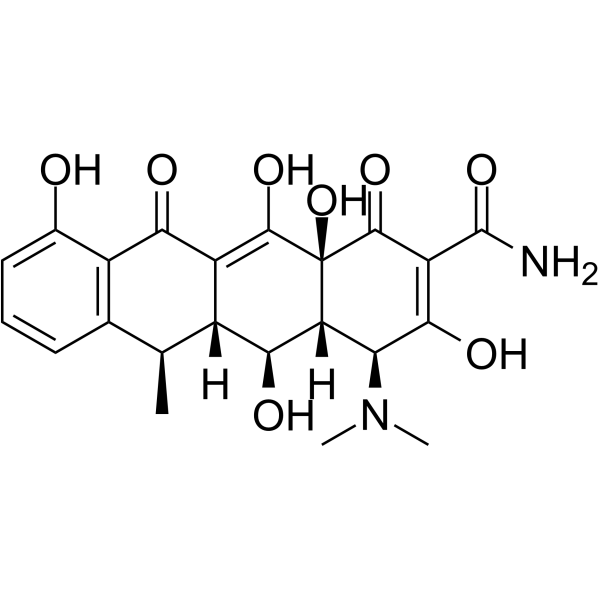
Cas No.: 564-25-0
Sample solution is provided at 25 µL, 10mM.
Doxycycline ist ein Breitbandantibiotikum aus der Gruppe der Tetracycline, das die Proteinsysnthese hemmt, indem es die Bindung von aktivierten Aminoacyl-tRNA an die A-Stelle der 30S-Untereinheit bakterieller Ribosomen stört. Es wird zur Behandlung einer Vielzahl von Infektionen eingesetzt, die durch Bakterien und Protozoen verursacht werden. Doxycycline ist auch ein unspezifischer Matrix-Metalloproteinase (MMP)-Hemmer. Doxycycline zeigt eine antitumorale und proapoptotische Wirkung[1-4].
Doxycycline(0-250 µM; 72h) hemmt die Lebensfähigkeit von Brustkrebszellen und Mammosphären[5]. Doxycycline (100 ng/mL, 1 µg/mL; 24 h) reduziert die Proliferation menschlicher Zelllinien[6].
Doxycycline(20mg /kg; p.o.;zweimal) verabreicht nac TBI bei Mäusen verbesserte das Verhalten und die motorischen Funktionen, was auf die Rolle von Doxycycline bei der Erhaltung der Integrität der Blut-Hirn-Schranke bei Mäusen hindeutet[7]. Doxycycline(DOX im Trinkwasser (6 mg/ml, 5 ml/Tag/Maus) ; 36 Tage) minimierte signifikant den dystrophischen Phänotyp der Skelett- und Herzmuskulatur und verbesserte die Muskelkraft der Vorderbeine[8]. Die FM(Fäkalmikrobiota) weiblicher C57BL/6NCrl-Mäuse wird durch die Verabreichung von Doxycycline (Doxycycline im Trinkwasser in einer Konzentration von 2 mg/ml während der Wochen 1, 2 und 4) in einer Konzentration von 2 mg/ml im Trinkwasser signifikant verändert[9].
References:
[1]. Cunha BA, Sibley CM, et,al. Doxycycline. Ther Drug Monit. 1982;4(2):115-35. doi: 10.1097/00007691-198206000-00001. PMID: 7048645.
[2].Manchado E, Weissmueller S, et,al. A combinatorial strategy for treating KRAS-mutant lung cancer. Nature. 2016 Jun 30;534(7609):647-51. doi: 10.1038/nature18600. Epub 2016 Jun 22. PMID: 27338794; PMCID: PMC4939262.
[3].Luger AL, Sauer B, et,al. Doxycycline Impairs Mitochondrial Function and Protects Human Glioma Cells from Hypoxia-Induced Cell Death: Implications of Using Tet-Inducible Systems. Int J Mol Sci. 2018 May 17;19(5):1504. doi: 10.3390/ijms19051504. PMID: 29772845; PMCID: PMC5983704.
[4]. Duivenvoorden WC, Popović SV, et,al. Doxycycline decreases tumor burden in a bone metastasis model of human breast cancer. Cancer Res. 2002 Mar 15;62(6):1588-91. PMID: 11912125.
[5]. Zhang L, Xu L, et,al. Doxycycline inhibits the cancer stem cell phenotype and epithelial-to-mesenchymal transition in breast cancer. Cell Cycle. 2017 Apr 18;16(8):737-745. doi: 10.1080/15384101.2016.1241929. Epub 2016 Oct 18. PMID: 27753527; PMCID: PMC5405729.
[6]. Ahler E, Sullivan WJ, et,al. Doxycycline alters metabolism and proliferation of human cell lines. PLoS One. 2013 May 31;8(5):e64561. doi: 10.1371/journal.pone.0064561. PMID: 23741339; PMCID: PMC3669316.
[7]. Malek AJ, Robinson BD, et,al. Doxycycline improves traumatic brain injury outcomes in a murine survival model. J Trauma Acute Care Surg. 2020 Sep;89(3):435-440. doi: 10.1097/TA.0000000000002801. PMID: 32467458.
[8]. Pereira JA, Taniguti AP, et,al. Doxycycline ameliorates the dystrophic phenotype of skeletal and cardiac muscles in mdx mice. Muscle Nerve. 2012 Sep;46(3):400-6. doi: 10.1002/mus.23331. PMID: 22907231.
[9]. Boynton FDD, Ericsson AC, et,al. Doxycycline induces dysbiosis in female C57BL/6NCrl mice. BMC Res Notes. 2017 Nov 29;10(1):644. doi: 10.1186/s13104-017-2960-7. PMID: 29187243; PMCID: PMC5708113.
| Zellexperiment [1]: | |
Zelllinien | MCF-7- und MDA-MB-468-Zellen |
Vorbereitungsmethode | Die Zellen wurden in 96-Well-Platten mit einer Dichte von 5000 Zellen/Well ausgesät. Die Zellen wurden mit Doxycycline in Konzentrationen von 0-250 µM für 72 Stunden inkubiert. |
Reaktionsbedingungen | 0-250 µM; 72h |
Anwendungen | Doxycycline hemmt die Zelllebensfähigkeit von Brustkrebszellen und Mammosphären. |
| Tierversuch [2]: | |
Tiermodelle | C57BL/6J-Mäuse |
Vorbereitungsmethode | Die Mäuse wurden einer Scheinbehandlung, einer traumatischen Hirnverletzung (TBI) oder einer TBI mit Doxycycline unterzogen. Mithilfe eines kontrollierten kortikalen Impaktors wurde eine moderate TBI ausgelöst. Die TBI mit Doxycycline-Kohorte erhielt eine Dosis Doxycycline (20 mg/kg) 2 Stunden nach der Verletzung und alle 12 Stunden bis zum 6. postoperativen Tag (POD). |
Dosierungsform | 20 mg/kg; p.o ; 2 Mal |
Anwendungen | Die Behandlung mit Doxycycline nach einer TBI bei Mäusen verbesserte das Verhalten und die motorischen Funktionen. |
References: | |
| Cas No. | 564-25-0 | SDF | |
| Formula | C22H24N2O8 | M.Wt | 444.43 |
| Löslichkeit | DMSO : 125 mg/mL (281.26 mM; Need ultrasonic) | Storage | Store at 4°C, protect from light, stored under argon |
| General tips | Please select the appropriate solvent to prepare the stock solution according to the
solubility of the product in different solvents; once the solution is prepared, please store it in
separate packages to avoid product failure caused by repeated freezing and thawing.Storage method
and period of the stock solution: When stored at -80°C, please use it within 6 months; when stored
at -20°C, please use it within 1 month. To increase solubility, heat the tube to 37°C and then oscillate in an ultrasonic bath for some time. |
||
| Shipping Condition | Evaluation sample solution: shipped with blue ice. All other sizes available: with RT, or with Blue Ice upon request. | ||
| Prepare stock solution | |||

|
1 mg | 5 mg | 10 mg |
| 1 mM | 2.2501 mL | 11.2504 mL | 22.5007 mL |
| 5 mM | 450 μL | 2.2501 mL | 4.5001 mL |
| 10 mM | 225 μL | 1.125 mL | 2.2501 mL |
Step 1: Enter information below (Recommended: An additional animal making an allowance for loss during the experiment)
 g
μL
g
μL
Step 2: Enter the in vivo formulation (This is only the calculator, not formulation. Please contact us first if there is no in vivo formulation at the solubility Section.)
Calculation results:
Working concentration: mg/ml;
Method for preparing DMSO master liquid: mg drug pre-dissolved in μL DMSO ( Master liquid concentration mg/mL, Please contact us first if the concentration exceeds the DMSO solubility of the batch of drug. )
Method for preparing in vivo formulation: Take μL DMSO master liquid, next addμL PEG300, mix and clarify, next addμL Tween 80, mix and clarify, next add μL saline, mix and clarify.
Method for preparing in vivo formulation: Take μL DMSO master liquid, next add μL Corn oil, mix and clarify.
Note: 1. Please make sure the liquid is clear before adding the next solvent.
2. Be sure to add the solvent(s) in order. You must ensure that the solution obtained, in the previous addition, is a clear solution before proceeding to add the next solvent. Physical methods such as vortex, ultrasound or hot water bath can be used to aid dissolving.
3. All of the above co-solvents are available for purchase on the GlpBio website.
Quality Control & SDS
- View current batch:
- Purity: >98.00% Appearance: A solid
- COA (Certificate of Analysis)
- SDS (Safety Data Sheet)
- Datasheet
Average Rating: 5 (Based on Reviews and 28 reference(s) in Google Scholar.)