

Eleutheroside E (Synonyms: Syringin E) |
Katalog-Nr.GN10300
 One-Click Copy Product Info
|

Eleutheroside E (EE) is a principal active component of Acanthopanax senticosus that possesses anti-fatigue, neuroprotective and immunomodulatory activities.
Products are for research use only. Not for human use. We do not sell to patients.
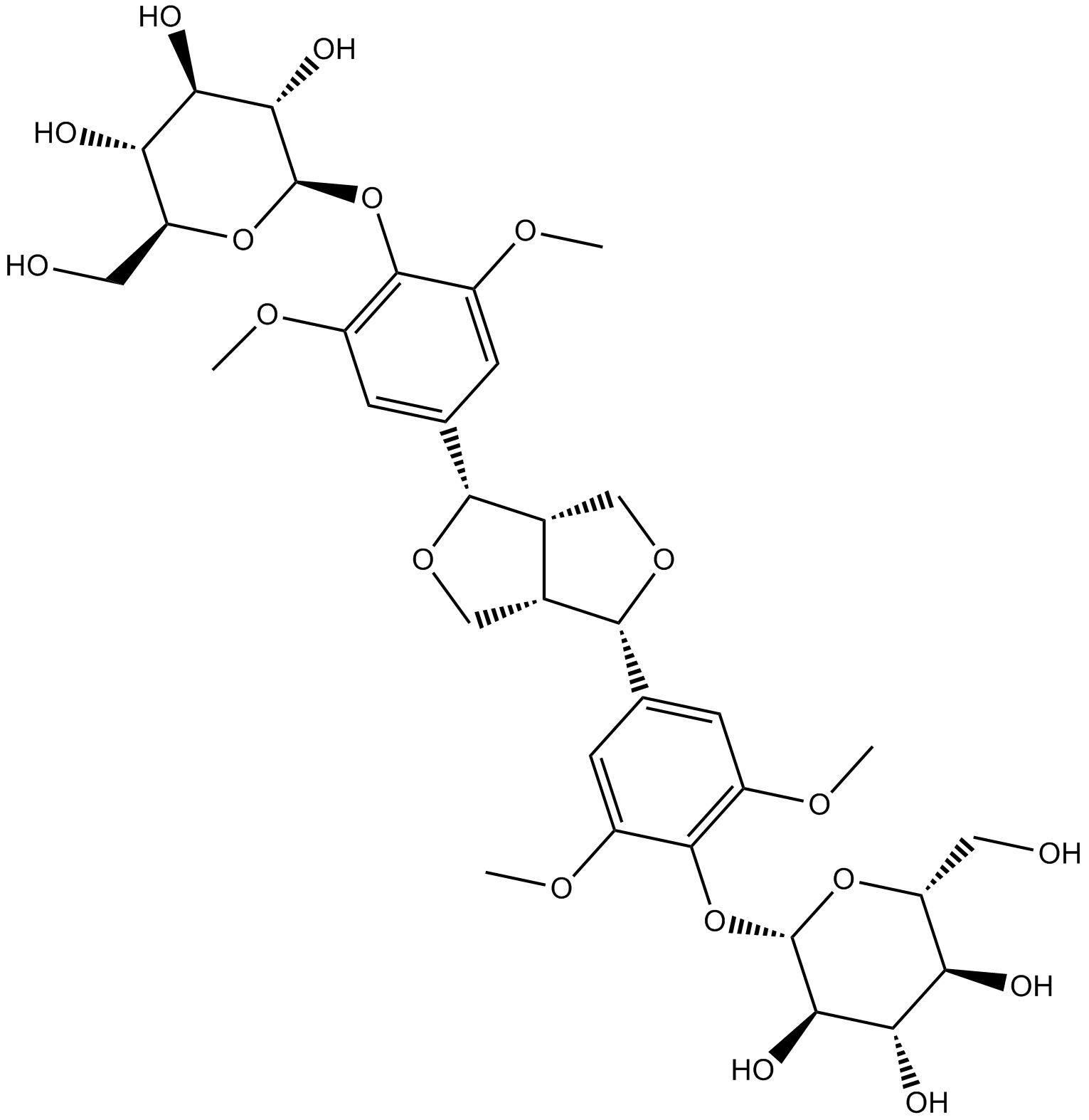
Cas No.: 39432-56-9
Sample solution is provided at 25 µL, 10mM.
Eleutheroside E (EE) is a principal active component of Acanthopanax senticosus that possesses anti-fatigue, neuroprotective and immunomodulatory activities[1].
In vitro, Eleutheroside E (100, 300 and 500μM; 48h) can improve the 1-methyl-4-phenyl-1,2,3,6-tetrahydropyridine (MPTP) -induced apoptosis of PC-12 cells by increasing the mitochondrial membrane potential and reducing the level of intracellular reactive oxygen species (ROS)[2]. Eleutheroside E (25μM; 72h) inhibited the cell viability with promoted apoptosis in Cervical cancer (CC) cells[3]. Eleutheroside E (30, 60 and 100mM; 12h) administration attenuated the cardiomyocyte apoptosis induced by hypoxia-reoxygenation (H/R) injury[4].
In vivo, Pre-treatment with Eleutheroside E (50 and 100 mg/kg; 3 days; i.p.) can improve the pathological manifestations of high-altitude pulmonary edema (HAPE), such as alveolar hemorrhage, thickening of the alveolar walls, inflammatory cell infiltration, and alveolar and interstitial edema, with the effects being positively related to the dose[1]. Supplementation with Eleutheroside E (50 mg/kg/d; 4 weeks) can prevent radiation-induced cognitive impairment and damage of neuron morphology and ultrastructures in the hippocampus of mice[5]. Eleutheroside E (10mg/kg; 20 days; gavage) alleviates cerebral ischemia-reperfusion injury in a 5-hydroxytryptamine receptor 2C (Htr2c)-dependent manner in rats[6].
References:
[1] Shen Z, Huang D, Jia N, Zhao S, Pei C, Wang Y, Wu Y, Wang X, Shi S, Wang F, He Y, Wang Z. Protective effects of Eleutheroside E against high-altitude pulmonary edema by inhibiting NLRP3 inflammasome-mediated pyroptosis. Biomed Pharmacother. 2023 Nov;167:115607.
[2] Yao Y, Liao C, Qiu H, Liang L, Zheng W, Wu L, Meng F. Effect of Eleutheroside E on an MPTP-Induced Parkinson's Disease Cell Model and Its Mechanism. Molecules. 2023 Apr 29;28(9):3820.
[3] Cai Y, Zhang J, Xin T, Xu S, Liu X, Gao Y, Huang H. Eleutheroside E functions as anti-cervical cancer drug by inhibiting the phosphatidylinositol 3-kinase pathway and reprogramming the metabolic responses. J Pharm Pharmacol. 2022 Sep 1;74(9):1251-1260.
[4] Wang S, Yang X. Eleutheroside E decreases oxidative stress and NF-κB activation and reprograms the metabolic response against hypoxia-reoxygenation injury in H9c2 cells. Int Immunopharmacol. 2020 Jul;84:106513.
[5] Song C, Duan F, Ju T, Qin Y, Zeng D, Shan S, Shi Y, Zhang Y, Lu W. Eleutheroside E supplementation prevents radiation-induced cognitive impairment and activates PKA signaling via gut microbiota. Commun Biol. 2022 Jul 8;5(1):680.
[6] Liu Z, Gao W, Xu Y. Eleutheroside E alleviates cerebral ischemia-reperfusion injury in a 5-hydroxytryptamine receptor 2C (Htr2c)-dependent manner in rats. Bioengineered. 2022 May;13(5):11718-11731.
| Cell experiment [1]: | |
|
Cell lines |
Hela and SiHa |
|
Preparation Method |
After being administered with 0 and 25µM Eleutheroside E, Hela and SiHa cells were collected, washed with phosphate-buffered saline (PBS), resuspended by 0.5ml of bind buffer, and stained with 5µl propidium iodide (PI) and 5µl Annexin V/FITC at room temperature for 15min. The cell apoptosis was analysed on a FACScan flow cytometry using CellQuest software. |
|
Reaction Conditions |
25μM; 72h |
|
Applications |
Eleutheroside E inhibited the cell viability with promoted apoptosis in Cervical cancer (CC) cells. |
| Animal experiment [2]: | |
|
Animal models |
male Sprague-Dawley rats; 100–110g; 4–5 weeks |
|
Preparation Method |
The all 42 rats were divided into the following six groups (n = 7) in a manner of random number table: (1) Sham, (2) Eleutheroside E, (3) HAPE, (4) Eleutheroside E 50mg/kg + HAPE, (5) Eleutheroside E 100mg/kg + HAPE and (6) Eleutheroside E 100mg/kg + Nig 4mg/kg + HAPE groups. Rats in the Sham and HAPE groups were treated with normal saline intraperitoneal injections, whereas those in the other four groups were injected intraperitoneally with corresponding doses of Eleutheroside E for 3 days. Nig, an activator of NLRP3, was used to explore the efficacy of Eleutheroside E on NLRP3-mediated pyroptosis in HAPE. Rats in the (6) group were injected intraperitoneally with Nig 30min before the last dose of Eleutheroside E. |
|
Dosage form |
50 and 100mg/mice; 3 days; i.p. |
|
Applications |
Pre-treatment with Eleutheroside E (50 and 100 mg/kg; 3 days; i.p.) can improve the pathological manifestations of high-altitude pulmonary edema (HAPE), such as alveolar hemorrhage, thickening of the alveolar walls, inflammatory cell infiltration, and alveolar and interstitial edema, with the effects being positively related to the dose. |
|
References: |
|
| Cas No. | 39432-56-9 | SDF | |
| Überlieferungen | Syringin E | ||
| Chemical Name | (2R,3S,4R,5R,6S)-2-[4-[6-[3,5-dimethoxy-4-[(2S,3R,4S,5S,6R)-3,4,5-trihydroxy-6-(hydroxymethyl)oxan-2-yl]oxyphenyl]-1,3,3a,4,6,6a-hexahydrofuro[3,4-c]furan-3-yl]-2,6-dimethoxyphenoxy]-6-(hydroxymethyl)oxane-3,4,5-triol | ||
| Canonical SMILES | COC1=CC(=CC(=C1OC2C(C(C(C(O2)CO)O)O)O)OC)C3C4COC(C4CO3)C5=CC(=C(C(=C5)OC)OC6C(C(C(C(O6)CO)O)O)O)OC | ||
| Formula | C34H46O18 | M.Wt | 742.72 |
| Löslichkeit | ≥ 26.2mg/mL in DMSO | Storage | Store at 2-8°C |
| General tips | Please select the appropriate solvent to prepare the stock solution according to the
solubility of the product in different solvents; once the solution is prepared, please store it in
separate packages to avoid product failure caused by repeated freezing and thawing.Storage method
and period of the stock solution: When stored at -80°C, please use it within 6 months; when stored
at -20°C, please use it within 1 month. To increase solubility, heat the tube to 37°C and then oscillate in an ultrasonic bath for some time. |
||
| Shipping Condition | Evaluation sample solution: shipped with blue ice. All other sizes available: with RT, or with Blue Ice upon request. | ||
| Prepare stock solution | |||

|
1 mg | 5 mg | 10 mg |
| 1 mM | 1.3464 mL | 6.732 mL | 13.464 mL |
| 5 mM | 269.3 μL | 1.3464 mL | 2.6928 mL |
| 10 mM | 134.6 μL | 673.2 μL | 1.3464 mL |
Step 1: Enter information below (Recommended: An additional animal making an allowance for loss during the experiment)
 g
μL
g
μL
Step 2: Enter the in vivo formulation (This is only the calculator, not formulation. Please contact us first if there is no in vivo formulation at the solubility Section.)
Calculation results:
Working concentration: mg/ml;
Method for preparing DMSO master liquid: mg drug pre-dissolved in μL DMSO ( Master liquid concentration mg/mL, Please contact us first if the concentration exceeds the DMSO solubility of the batch of drug. )
Method for preparing in vivo formulation: Take μL DMSO master liquid, next addμL PEG300, mix and clarify, next addμL Tween 80, mix and clarify, next add μL saline, mix and clarify.
Method for preparing in vivo formulation: Take μL DMSO master liquid, next add μL Corn oil, mix and clarify.
Note: 1. Please make sure the liquid is clear before adding the next solvent.
2. Be sure to add the solvent(s) in order. You must ensure that the solution obtained, in the previous addition, is a clear solution before proceeding to add the next solvent. Physical methods such as vortex, ultrasound or hot water bath can be used to aid dissolving.
3. All of the above co-solvents are available for purchase on the GlpBio website.
Quality Control & SDS
- View current batch:
- Purity: >98.00% Appearance: A solid
- COA (Certificate of Analysis)
- SDS (Safety Data Sheet)
- Datasheet
Average Rating: 5 (Based on Reviews and 30 reference(s) in Google Scholar.)