

Bacopaside II |
Katalog-Nr.GC35458
 One-Click Copy Product Info
|

Bacopaside II, ein Extrakt aus der Heilpflanze Bacopa monnieri, blockiert den Wasserkanal Aquaporin-1 (AQP1) und beeintrÄchtigt die Migration von Zellen, die AQP1 exprimieren. Bacopasid II induziert Zellzyklusarrest und Apoptose.
Products are for research use only. Not for human use. We do not sell to patients.
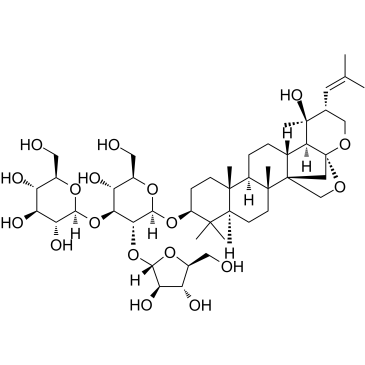
Cas No.: 382146-66-9
Sample solution is provided at 25 µL, 10mM.
_1-3.$$$39978408@51.jpg');)
_1-9.$$$38538795@65.jpg');)
_1-9.$$$39112701@51.jpg');)
_1-7.$$$37316672@70.jpg');)
_366-372.$$$36198801@70.jpg');)
.$$$38565142@65.jpg');)
_1867-1883.$$$33248023@67.jpg');)
_eads6055.$$$39977546@45.jpg');)
_eadm9805.$$$40080571@45.jpg');)
_eadj3020.$$$39666821@45.jpg');)
_1-20.$$$39757301@28.jpg');)
_1-24.$$$38898113@28.jpg');)
_273-287.$$$36806353@46.jpg');)
_1-16.$$$37156877@44.jpg');)
_1-19.$$$37460805@44.jpg');)
_1291-1307.$$$34518654@46.jpg');)
Bacopaside II is a steroidal saponin extracted from the medicinal plant Bacopa monnieriwith multiple biological activities[1]. Bacopaside II can induce cell cycle arrest and apoptosis in cancer cells[2]. Bacopaside II reduces hydrogen peroxide-induced intracellular reactive oxygen species (ROS) production and inhibits endothelial cell migration and tube formation[3]. Bacopaside II also exhibits potential for the treatment of Alzheimer's disease[4].
In vitro, treatment of triple-negative breast cancer cell lines HCC1143 and MDA-MB-231 with Bacopaside II (15–30μM) significantly induced apoptosis and necroptosis-like cell death. Combined treatment of MDA-MB-231 cells with Bacopaside II (10μM) and doxorubicin (100nM) for 72 hours demonstrated a synergistic growth inhibitory effect[5]. Treatment of colon cancer cell lines HT-29, SW480, SW620, and HCT116 with Bacopaside II (15–30μM) for 24–72 hours significantly inhibited cell growth, induced cell cycle arrest and apoptosis, and caused prominent intracellular vacuolization and autophagy-like morphological changes[6].
In vivo, oral administration of Bacopaside II (50mg/kg) for five consecutive days to ICR mice exhibited antidepressant effects, significantly reducing immobility time by 55% in the forced swimming test and by 38% in the tail suspension test[7]. Oral pre-treatment of ICR mice with Bacopaside II (50mg/kg) one hour before intraperitoneal injection of scopolamine (1mg/kg) to induce memory impairment showed that Bacopaside II ameliorated scopolamine-induced memory impairment[8].
References:
[1] Chakravarty AK, Sarkar T, Masuda K, et al. Bacopaside I and II: two pseudojujubogenin glycosides from Bacopa monniera. Phytochemistry. 2001 Oct;58(4):553-6.
[2] De Ieso ML, Pei JV, Nourmohammadi S, et al. Combined pharmacological administration of AQP1 ion channel blocker AqB011 and water channel blocker Bacopaside II amplifies inhibition of colon cancer cell migration. Sci Rep. 2019 Sep 2;9(1):12635.
[3] Palethorpe HM, Tomita Y, Smith E, et al. The Aquaporin 1 Inhibitor Bacopaside II Reduces Endothelial Cell Migration and Tubulogenesis and Induces Apoptosis. Int J Mol Sci. 2018 Feb 26;19(3):653.
[4] Anwar S, Mohammad T, Azhar MK, et al. Investigating MARK4 inhibitory potential of Bacopaside II: Targeting Alzheimer's disease. Int J Biol Macromol. 2023 Aug 1;245:125364.
[5] Rad SK, Yeo KKL, Li R, et al. Enhancement of Doxorubicin Efficacy by Bacopaside II in Triple-Negative Breast Cancer Cells. Biomolecules. 2025 Jan 3;15(1):55.
[6] Smith E, Palethorpe HM, Tomita Y, et al. The Purified Extract from the Medicinal Plant Bacopa monnieri, Bacopaside II, Inhibits Growth of Colon Cancer Cells In Vitro by Inducing Cell Cycle Arrest and Apoptosis. Cells. 2018 Jul 21;7(7):81.
[7] Zhou Y, Shen YH, Zhang C, et al. Triterpene saponins from Bacopa monnieri and their antidepressant effects in two mice models. J Nat Prod. 2007 Apr;70(4):652-5.
[8] Zhou Y, Peng L, Zhang WD, et al. Effect of triterpenoid saponins from Bacopa monniera on scopolamine-induced memory impairment in mice. Planta Med. 2009 May;75(6):568-74.
| Cell experiment [1]: | |
Cell lines | HT-29, SW480, SW620, and HCT116 (human colon cancer cell lines) |
Preparation Method | Cells were maintained in DMEM supplemented with 10% heat-inactivated fetal bovine serum (FBS), 200U/mL penicillin, 200µg/mL streptomycin at 37°C, 5% CO₂. Cells were treated with Bacopaside II dissolved in a 2% methanol vehicle at concentrations of 15-30µM for 24-72 hours. |
Reaction Conditions | 15-30μM; 24-72 hours |
Applications | Bacopaside II significantly inhibited adherent colon cancer cell growth, with IC₅₀ values ranging from 14.5µM (HCT116) to 18.4µM (HT-29). Treatment induced G0/G1 cell cycle arrest in HT-29 cells (20µM) and G2/M arrest in SW480, SW620, and HCT116 cells. Bacopaside II significantly induced apoptosis. |
| Animal experiment [2]: | |
Animal models | ICR mice |
Preparation Method | Mice were orally administered Bacopaside II (50mg/kg) suspended in 0.3% carboxymethylcellulose sodium (CMCNa) once daily for five consecutive days. Memory impairment was induced by intraperitoneal injection of Scopolamine (1mg/kg) 30 minutes before behavioral tests. The forced swimming test and tail suspension test were conducted 1 hour after the final administration on the fifth day. |
Dosage form | 50mg/kg; p.o. |
Applications | Bacopaside II administration significantly reduced immobility time by 55% in the forced swimming test and by 38% in the tail suspension test. |
References: | |
| Cas No. | 382146-66-9 | SDF | |
| Formula | C47H76O18 | M.Wt | 929.1 |
| Löslichkeit | Soluble in Methanol ; DMSO:30mg/ml | Storage | Store at -20°C,protect from light |
| General tips | Please select the appropriate solvent to prepare the stock solution according to the
solubility of the product in different solvents; once the solution is prepared, please store it in
separate packages to avoid product failure caused by repeated freezing and thawing.Storage method
and period of the stock solution: When stored at -80°C, please use it within 6 months; when stored
at -20°C, please use it within 1 month. To increase solubility, heat the tube to 37°C and then oscillate in an ultrasonic bath for some time. |
||
| Shipping Condition | Evaluation sample solution: shipped with blue ice. All other sizes available: with RT, or with Blue Ice upon request. | ||
| Prepare stock solution | |||

|
1 mg | 5 mg | 10 mg |
| 1 mM | 1.0763 mL | 5.3816 mL | 10.7631 mL |
| 5 mM | 215.3 μL | 1.0763 mL | 2.1526 mL |
| 10 mM | 107.6 μL | 538.2 μL | 1.0763 mL |
Step 1: Enter information below (Recommended: An additional animal making an allowance for loss during the experiment)
 g
μL
g
μL
Step 2: Enter the in vivo formulation (This is only the calculator, not formulation. Please contact us first if there is no in vivo formulation at the solubility Section.)
Calculation results:
Working concentration: mg/ml;
Method for preparing DMSO master liquid: mg drug pre-dissolved in μL DMSO ( Master liquid concentration mg/mL, Please contact us first if the concentration exceeds the DMSO solubility of the batch of drug. )
Method for preparing in vivo formulation: Take μL DMSO master liquid, next addμL PEG300, mix and clarify, next addμL Tween 80, mix and clarify, next add μL saline, mix and clarify.
Method for preparing in vivo formulation: Take μL DMSO master liquid, next add μL Corn oil, mix and clarify.
Note: 1. Please make sure the liquid is clear before adding the next solvent.
2. Be sure to add the solvent(s) in order. You must ensure that the solution obtained, in the previous addition, is a clear solution before proceeding to add the next solvent. Physical methods such as vortex, ultrasound or hot water bath can be used to aid dissolving.
3. All of the above co-solvents are available for purchase on the GlpBio website.
Quality Control & SDS
- View current batch:
- Purity: >98.00% Appearance: A solid
- COA (Certificate of Analysis)
- SDS (Safety Data Sheet)
- Datasheet
Average Rating: 5 (Based on Reviews and 39 reference(s) in Google Scholar.)