

Honokiol (Synonyms: NSC 293100) |
Katalog-Nr.GN10664
 One-Click Copy Product Info
|

Honokiol is a natural bisphenol chemical with multiple biological activities. It targets multiple signaling molecules and has effective antioxidant, anti-inflammatory, anti-angiogenic and anti-cancer activities. It also has broad-spectrum antibacterial and anti-human immunodeficiency virus (HIV) activities.
Products are for research use only. Not for human use. We do not sell to patients.
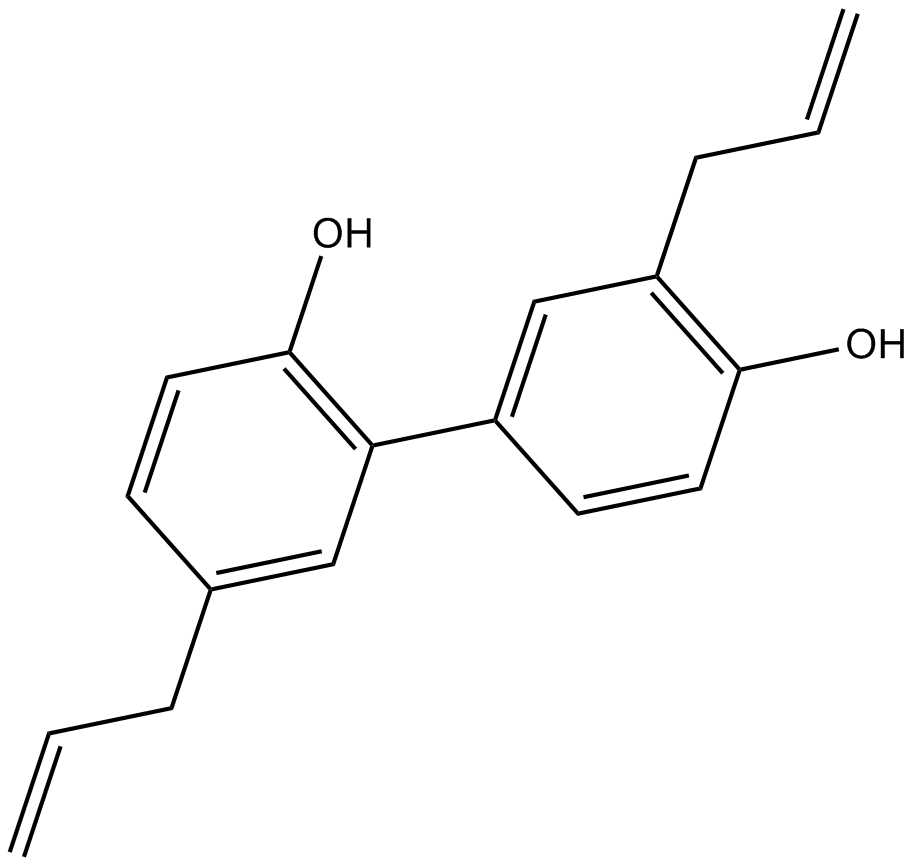
Cas No.: 35354-74-6
Sample solution is provided at 25 µL, 10mM.
Honokiol is a natural bisphenol chemical with multiple biological activities. It targets multiple signaling molecules and has effective antioxidant, anti-inflammatory, anti-angiogenic and anti-cancer activities. It also has broad-spectrum antibacterial and anti-human immunodeficiency virus (HIV) activities[1, 2]. Honokiol can inhibit the activation of serine/threonine kinase (Akt) and can pass through the blood-brain barrier[3].
In vitro, Honokiol (5, 10μM) treated platelet cells for 0.5-5min, 1 minute after convulsant stimulation, significantly inhibited the phosphorylation of Lyn and PLCγ2, and the amount of p47 protein was significantly reduced after 3min[4]. Honokiol (20-100μM) treated melanoma cell lines (SK-MEL2 and MeWo cells) for 24-72h, reduced the cell viability of both cell lines in a dose- and time-dependent manner, increased the cytosolic cytochrome c content, elevated caspase activity, and increased mitochondrial depolarization[5].
In vivo, Honokiol (5mg/kg) treated rats undergoing cecal ligation and puncture (CLP) surgery by a single intraperitoneal injection restored the morphological changes in rat kidney tissue, reduced the production of oxidative stress and inflammatory cytokines, decreased the levels of nitric oxide (NO) and inducible nitric oxide synthase (iNOS), and inhibited the activation of NF-κB signaling[6]. Honokiol (0.2mg/kg) treated mice with doxorubicin (Dox)-induced heart injury by intraperitoneal injection for 35 days significantly alleviated the cardiotoxicity of Dox, improved cardiac function and reduced cardiomyocyte apoptosis, and activated PPARγ signaling in cardiomyocytes[7].
References:
[1] Ong C P, Lee W L, Tang Y Q, et al. Honokiol: a review of its anticancer potential and mechanisms[J]. Cancers, 2019, 12(1): 48.
[2] Rauf A, Patel S, Imran M, et al. Honokiol: An anticancer lignan[J]. Biomedicine & Pharmacotherapy, 2018, 107: 555-562.
[3] Joo Y N, Eun S Y, Park S W, et al. Honokiol inhibits U87MG human glioblastoma cell invasion through endothelial cells by regulating membrane permeability and the epithelial-mesenchymal transition[J]. International journal of oncology, 2014, 44(1): 187-194.
[4] Lee T Y, Chang C C, Lu W J, et al. Honokiol as a specific collagen receptor glycoprotein VI antagonist on human platelets: Functional ex vivo and in vivo studies[J]. Scientific Reports, 2017, 7(1): 40002.
[5] Mannal P W, Schneider J, Tangada A, et al. Honokiol produces anti‐neoplastic effects on melanoma cells in vitro[J]. Journal of surgical oncology, 2011, 104(3): 260-264.
[6] Li N, Xie H, Li L, et al. Effects of honokiol on sepsis-induced acute kidney injury in an experimental model of sepsis in rats[J]. Inflammation, 2014, 37: 1191-1199.
[7] Huang L, Zhang K, Guo Y, et al. Honokiol protects against doxorubicin cardiotoxicity via improving mitochondrial function in mouse hearts[J]. Scientific reports, 2017, 7(1): 11989.
| Cell experiment [1]: | |
Cell lines | Platelets |
Preparation Method | Washed platelets (1.2 × 10⁹ cells/ml) were preincubated with or without honokiol (5μM and 10μM) or the solvent control (0.5% DMSO), followed by the addition of 5ng/mL of convulxin to trigger platelet activation at the indicated times (0.5 to 5min). The cells were collected, and the subcellular extracts were analyzed for the presence of phosphorylated Lyn, phospholipase Cγ2 (PLCγ2), and p47. |
Reaction Conditions | 5, 10μM; 0.5 to 5min |
Applications | At 1min after convulsin stimulation, honokiol(5μM and 10μM) significantly inhibited the phosphorylation of Lyn and PLCγ2. After 3 minutes, the amount of phosphorylated p47 protein in convulsin-activated platelets was reduced. |
| Animal experiment [2]: | |
Animal models | SD rats |
Preparation Method | SD rats were randomly divided into three groups. The control group consisted of untreated and sham-operated rats. Untreated SD rats that underwent cecal ligation and puncture(CLP) surgery were designated as the CLP group. In the CLP+honokiol group, honokiol dissolved in DMSO was intraperitoneally injected into the rats at a dose of 5mg/kg 30min after CLP treatment. All animals were killed 24h after CLP or sham surgery. Blood samples were collected from peripheral blood vessels of rats under anesthesia. Kidney tissues were immediately collected and stored at −80°C or fixed with 4% paraformaldehyde according to the purpose of analysis. |
Dosage form | 5mg/kg; i.p. |
Applications | Treatment with honokiol officinalis restored the morphological changes of renal tissue in rats with CLP, reduced the production of oxidative stress and inflammatory cytokines, decreased the levels of nitric oxide (NO) and inducible nitric oxide synthase (iNOS), and inhibited the activation of NF-κB signaling. |
References: [1] Lee T Y, Chang C C, Lu W J, et al. Honokiol as a specific collagen receptor glycoprotein VI antagonist on human platelets: Functional ex vivo and in vivo studies[J]. Scientific Reports, 2017, 7(1): 40002. [2]Li N, Xie H, Li L, et al. Effects of honokiol on sepsis-induced acute kidney injury in an experimental model of sepsis in rats[J]. Inflammation, 2014, 37: 1191-1199. | |
| Cas No. | 35354-74-6 | SDF | |
| Überlieferungen | NSC 293100 | ||
| Chemical Name | 2-(4-hydroxy-3-prop-2-enylphenyl)-4-prop-2-enylphenol | ||
| Canonical SMILES | C=CCC1=CC(=C(C=C1)O)C2=CC(=C(C=C2)O)CC=C | ||
| Formula | C18H18O2 | M.Wt | 266.33 |
| Löslichkeit | ≥ 83mg/mL in DMSO | Storage | Store at 2-8°C |
| General tips | Please select the appropriate solvent to prepare the stock solution according to the
solubility of the product in different solvents; once the solution is prepared, please store it in
separate packages to avoid product failure caused by repeated freezing and thawing.Storage method
and period of the stock solution: When stored at -80°C, please use it within 6 months; when stored
at -20°C, please use it within 1 month. To increase solubility, heat the tube to 37°C and then oscillate in an ultrasonic bath for some time. |
||
| Shipping Condition | Evaluation sample solution: shipped with blue ice. All other sizes available: with RT, or with Blue Ice upon request. | ||
| Prepare stock solution | |||

|
1 mg | 5 mg | 10 mg |
| 1 mM | 3.7547 mL | 18.7737 mL | 37.5474 mL |
| 5 mM | 750.9 μL | 3.7547 mL | 7.5095 mL |
| 10 mM | 375.5 μL | 1.8774 mL | 3.7547 mL |
Step 1: Enter information below (Recommended: An additional animal making an allowance for loss during the experiment)
 g
μL
g
μL
Step 2: Enter the in vivo formulation (This is only the calculator, not formulation. Please contact us first if there is no in vivo formulation at the solubility Section.)
Calculation results:
Working concentration: mg/ml;
Method for preparing DMSO master liquid: mg drug pre-dissolved in μL DMSO ( Master liquid concentration mg/mL, Please contact us first if the concentration exceeds the DMSO solubility of the batch of drug. )
Method for preparing in vivo formulation: Take μL DMSO master liquid, next addμL PEG300, mix and clarify, next addμL Tween 80, mix and clarify, next add μL saline, mix and clarify.
Method for preparing in vivo formulation: Take μL DMSO master liquid, next add μL Corn oil, mix and clarify.
Note: 1. Please make sure the liquid is clear before adding the next solvent.
2. Be sure to add the solvent(s) in order. You must ensure that the solution obtained, in the previous addition, is a clear solution before proceeding to add the next solvent. Physical methods such as vortex, ultrasound or hot water bath can be used to aid dissolving.
3. All of the above co-solvents are available for purchase on the GlpBio website.
Quality Control & SDS
- View current batch:
- Purity: >98.50% Appearance: A solid
- COA (Certificate of Analysis)
- SDS (Safety Data Sheet)
- Datasheet
Average Rating: 5 (Based on Reviews and 30 reference(s) in Google Scholar.)