

MK3102 (Synonyms: Omarigliptin) |
Katalog-Nr.GC17012
 One-Click Copy Product Info
|

MK3102(Omarigliptin) ist ein neuartiger, einmal wöchentlich zu verabreichender Dipeptidylpeptidase-4(DPP-4)-Inhibitor(IC50-Wert: 2.2 nM), der zur Behandlung von Typ-2-Diabetes entwickelt wurde.
Products are for research use only. Not for human use. We do not sell to patients.
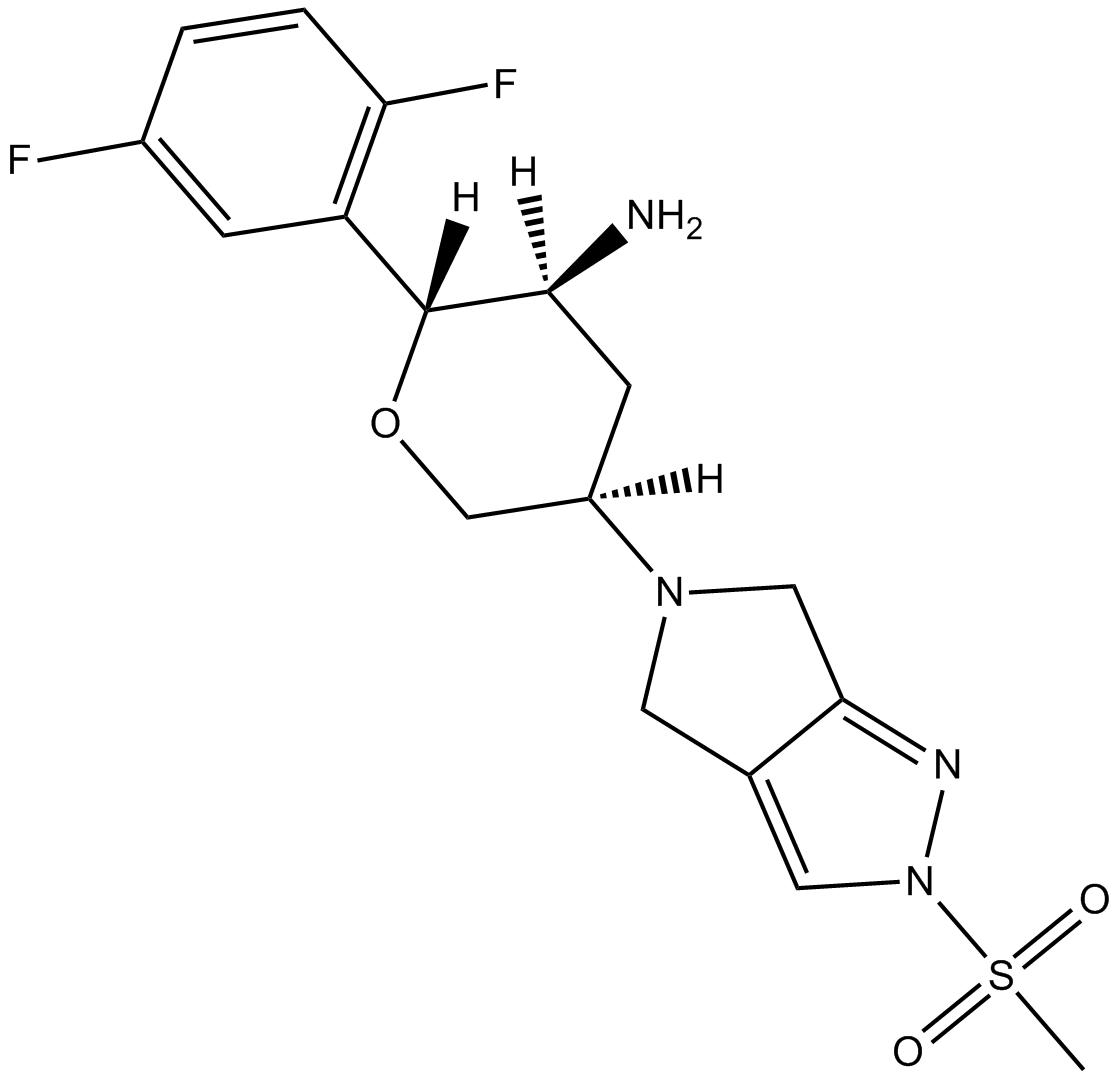
Cas No.: 1226781-44-7
Sample solution is provided at 25 µL, 10mM.
MK3102(Omarigliptin) ist ein neuartiger, einmal wöchentlich zu verabreichender Dipeptidylpeptidase-4(DPP-4)-Inhibitor(IC50-Wert: 2.2 nM), der zur Behandlung von Typ-2-Diabetes entwickelt wurde[1,2]. Aufgrund seines niedrigen Molekulargewichts und seiner lipophilen Eigenschaften überwindet MK3102 die Blut-Hirn-Schranke[3].
MK3102(3, 10, 30 und 50 µM, 4 Stunden) reduzierte die durch 6-OHDA (50 µM, 24 Stunden) oder Rotenon(1 µM, 24 Stunden) induzierte Zytotoxizität. MK3102 hemmte die durch 6-OHDA oder Rotenon induzierte intrazelluläre ROS-Produktion in PC12-Zellen[4]. MK3102 verringerte die 6-OHDA- und Rotenon-induzierte IκBα-Phosphorylierung und die nukleäre Translokation von NF-κB. Das führte zu einer reduzierten Produktion des Entzündungsmediators NO und einem verminderten iNOS-Expressionsniveau führte[4]. MK3102 hemmte die Freisetzung von HMGB-1 und verringerte die Permeabilität der Endothel-Zellschicht in bEnd.3-Hirnendothelzellen[1].
MK3102 hat in präklinischen Spezies eine lange Halbwertszeit(Ratte: 11 Stunden; Hund: 22 Stunden) und eine geringe Clearance(Ratte, 1.1 mL min-1 kg-1; Hund, 0.9 mL min-1 kg-1)[5]. Die Plasma-Konzentration von MK3102 bei Ratten(5 mg/kg, nach 2 Stunden, p.o) war 2688.79 ng/mL. Nach oraler Gabe überwand MK3102 die Blut-Hirn-Schranke(BBB) und erreichte im Hirngewebe eine Konzentration von 621.75 ng/g. Die intra-nasale Gabe von OG führte zu einem erheblich höheren Gehirn/Plasma-Konzentrationsverhältnis von 0.76, was einer 3.3-fachen Steigerung im Vergleich zur oralen Gabe entspricht[3]. MK3102 (5 mg/kg/Tag) hemmte die Freisetzung von Entzündungsfaktoren im Gehirn von LPS-stimulierten Mäusen und schützte die durch LPS-Stimulation beeinträchtigte Integrität der Blut-Hirn-Schranke(BBB)[1].
References:
[1]. Du H, Wang S. Omarigliptin Mitigates Lipopolysaccharide-Induced Neuroinflammation and Dysfunction of the Integrity of the Blood-Brain Barrier. ACS Chemical Neuroscience. 2020 Nov 25;11(24):4262-9.
[2]. Hussain H, Abbas G, Green IR, Ali I. Dipeptidyl peptidase IV inhibitors as a potential target for diabetes: patent review (2015-2018). Expert opinion on therapeutic patents. 2019 Jul 3;29(7):535-53.
[3]. Ayoub BM, Mowaka S, Safar MM, Ashoush N, Arafa MG, Michel HE, Tadros MM, Elmazar MM, Mousa SA. Repositioning of omarigliptin as a once-weekly intranasal anti-parkinsonian agent. Scientific Reports. 2018 Jun 12;8(1):8959.
[4]. Gouda NA, Cho J. Omarigliptin Mitigates 6-Hydroxydopamine-or Rotenone-Induced Oxidative Toxicity in PC12 Cells by Antioxidant, Anti-Inflammatory, and Anti-Apoptotic Actions. Antioxidants. 2022 Sep 28;11(10):1940.
[5]. Biftu T, Sinha-Roy R, Chen P, Qian X, Feng D, Kuethe JT, Scapin G, Gao YD, Yan Y, Krueger D, Bak A. Omarigliptin (MK-3102): a novel long-acting DPP-4 inhibitor for once-weekly treatment of type 2 diabetes.
| Zellexperiment [1]: | |
Zelllinien | PC12-Zellen |
Vorbereitungsmethode | PC12-Zellen wurden 24 Stunden lang mit MK3102 in verschiedenen Konzentrationen in serumarmem Kulturmedium(1% FBS, 1% HS, 100 IU/mL Penicillin und 100 µg/mL Streptomycin) behandelt. Kontrollzellen wurden mit demselben serumarmen Medium und einem äquivalenten Volumen DMSO(0.5%) inkubiert. Die protektive Wirkungen von MK3102 gegen 6-OHDA- oder Rotenon-induzierte Toxizität in PC12-Zellen wurden untersucht. Dazu wurden die Zellen 4 Stunden lang mit MK3102 in verschiedenen Konzentrationen vorbehandelt und dann 24 Stunden lang 6-OHDA (50 µM) oder Rotenon(1 µM) ausgesetzt. Der Effekt von ZnPP, einem HO-1-Inhibitor, auf die protektive Wirkung von MK3102 gegen 6-OHDA- oder Rotenon-induzierte Toxizität wurde auch untersucht. Kurz gesagt, die Zellen wurden 30 Minuten lang mit 0.2 µM ZnPP vorbehandelt und dann 4 Stunden lang MK3102 ausgesetzt. Dann wurden 6-OHDA oder Rotenon in Endkonzentrationen von 50 bzw. 1 µM zugegeben und 24 Stunden lang inkubiert. |
Reaktionsbedingungen | 0-100 µM für 24 Stunden; 0-50 µM Vorbehandlung für 4 Stunden |
Anwendungen | Die Vorbehandlung mit MK3102 führte bei Konzentrationen von 30 und 50 µM zu einer erheblichen Umkehrung der durch 6-OHDA-induzierten Toxizität. |
| Tierversuch [2]: | |
Tiermodelle | Männliche C57BL/6-Mäuse |
Vorbereitungsmethode | Die 24 Mäuse(6-8 Wochen alt) wurden in 4 Gruppen eingeteilt: Vehikel-Gruppe, MK3102-Gruppe, LPS-Gruppe und LPS + MK3102-Gruppe. Die Tiere erhielten 15 Tage lang täglich entweder Vehikel(Kochsalzlösung) oder MK3102(5 mg/kg/Tag). Am letzten Tag wurde den Tieren der LPS- und der LPS + MK3102-Gruppe LPS (5 mg/kg) intraperitoneal injiziert. Die Kontrollgruppe und die MK3102-Gruppe erhielten die gleiche Menge Kochsalzlösung intraperitoneal. |
Dosierungsform | 5 mg/kg/Tag, oral, über 15 Tage. |
Anwendungen | Im Vergleich zur Kontrollgruppe waren die Expressionsniveaus von TNF-α, IL-6 und IL-8 im Gehirn von LPS-stimulierten Mäusen erheblich erhöht, wurden aber durch die gleichzeitige Verabreichung von MK3102 stark unterdrückt. |
| References: [1]: Gouda NA, Cho J. Omarigliptin Mitigates 6-Hydroxydopamine-or Rotenone-Induced Oxidative Toxicity in PC12 Cells by Antioxidant, Anti-Inflammatory, and Anti-Apoptotic Actions. Antioxidants. 2022 Sep 28;11(10):1940. | |
| Cas No. | 1226781-44-7 | SDF | |
| Überlieferungen | Omarigliptin | ||
| Chemical Name | (2R,3S,5R)-2-(2,5-difluorophenyl)-5-(2-(methylsulfonyl)pyrrolo[3,4-c]pyrazol-5(2H,4H,6H)-yl)tetrahydro-2H-pyran-3-amine | ||
| Canonical SMILES | CS(N1C=C2CN([C@](CO3)([H])C[C@@](N)([H])[C@@]3([H])C4=C(F)C=CC(F)=C4)CC2=N1)(=O)=O | ||
| Formula | C17H20F2N4O3S | M.Wt | 398.43 |
| Löslichkeit | ≥ 17.15mg/mL in DMSO | Storage | Store at -20°C |
| General tips | Please select the appropriate solvent to prepare the stock solution according to the
solubility of the product in different solvents; once the solution is prepared, please store it in
separate packages to avoid product failure caused by repeated freezing and thawing.Storage method
and period of the stock solution: When stored at -80°C, please use it within 6 months; when stored
at -20°C, please use it within 1 month. To increase solubility, heat the tube to 37°C and then oscillate in an ultrasonic bath for some time. |
||
| Shipping Condition | Evaluation sample solution: shipped with blue ice. All other sizes available: with RT, or with Blue Ice upon request. | ||
| Prepare stock solution | |||

|
1 mg | 5 mg | 10 mg |
| 1 mM | 2.5099 mL | 12.5493 mL | 25.0985 mL |
| 5 mM | 502 μL | 2.5099 mL | 5.0197 mL |
| 10 mM | 251 μL | 1.2549 mL | 2.5099 mL |
Step 1: Enter information below (Recommended: An additional animal making an allowance for loss during the experiment)
 g
μL
g
μL
Step 2: Enter the in vivo formulation (This is only the calculator, not formulation. Please contact us first if there is no in vivo formulation at the solubility Section.)
Calculation results:
Working concentration: mg/ml;
Method for preparing DMSO master liquid: mg drug pre-dissolved in μL DMSO ( Master liquid concentration mg/mL, Please contact us first if the concentration exceeds the DMSO solubility of the batch of drug. )
Method for preparing in vivo formulation: Take μL DMSO master liquid, next addμL PEG300, mix and clarify, next addμL Tween 80, mix and clarify, next add μL saline, mix and clarify.
Method for preparing in vivo formulation: Take μL DMSO master liquid, next add μL Corn oil, mix and clarify.
Note: 1. Please make sure the liquid is clear before adding the next solvent.
2. Be sure to add the solvent(s) in order. You must ensure that the solution obtained, in the previous addition, is a clear solution before proceeding to add the next solvent. Physical methods such as vortex, ultrasound or hot water bath can be used to aid dissolving.
3. All of the above co-solvents are available for purchase on the GlpBio website.
Quality Control & SDS
- View current batch:
- Purity: >99.00% Appearance: A solid
- COA (Certificate of Analysis)
- SDS (Safety Data Sheet)
- Datasheet
-
Related Biological Data

MK3102 reduced hematoma size and improved functional recovery after ICH.(C) Representative microphotographs of Nissl staining in the perihematomal area.The small black squares in the coronal section of brain indicate the area where microphotograph was taken.
For the MK3102 treatment, the MK3102 (Glpbio, USA) was dissolved in 10% DMSO and was given (7 mg/kg/day) via gavage starting from 1 hour after collagenase injection.
J Inflamm Res (2023): 2535-2548. PMID: 37342770 IF: 4.6307 -
Related Biological Data

MK3102 reduces the neurotoxicity of hemin in cultured primary cortical neurons in a concentrationdependent manner. (B) The toxicity of 20 μM of hemin was attenuated by MK3102 in a concentration-dependent manner.
For the MK3102 treatment, the MK3102 (Glpbio, USA) was dissolved in 10% DMSO and administrated (7 mg/kg/day) by gastric injection starting from 1 h after surgery.
Sci Rep-Uk 13.1 (2023): 14339. PMID: 37658227 IF: 4.6
Average Rating: 5 (Based on Reviews and 36 reference(s) in Google Scholar.)