

ML216 (Synonyms: CID49852229) |
Katalog-Nr.GC12786
 One-Click Copy Product Info
|

ML216 (CID-49852229) ist ein potenter, selektiver und zellgÄngiger Inhibitor der DNA-Unwinding-AktivitÄt von BLM-Helikase mit IC50-Werten von 2,98 μM und 0,97 μM fÜr BLM in voller LÄnge bzw. BLM636-1298. ML216 hemmt die ssDNA-abhÄngige ATPase-AktivitÄt von BLM mit einem Ki von 1,76 μM. Antitumor-AktivitÄt.
Products are for research use only. Not for human use. We do not sell to patients.
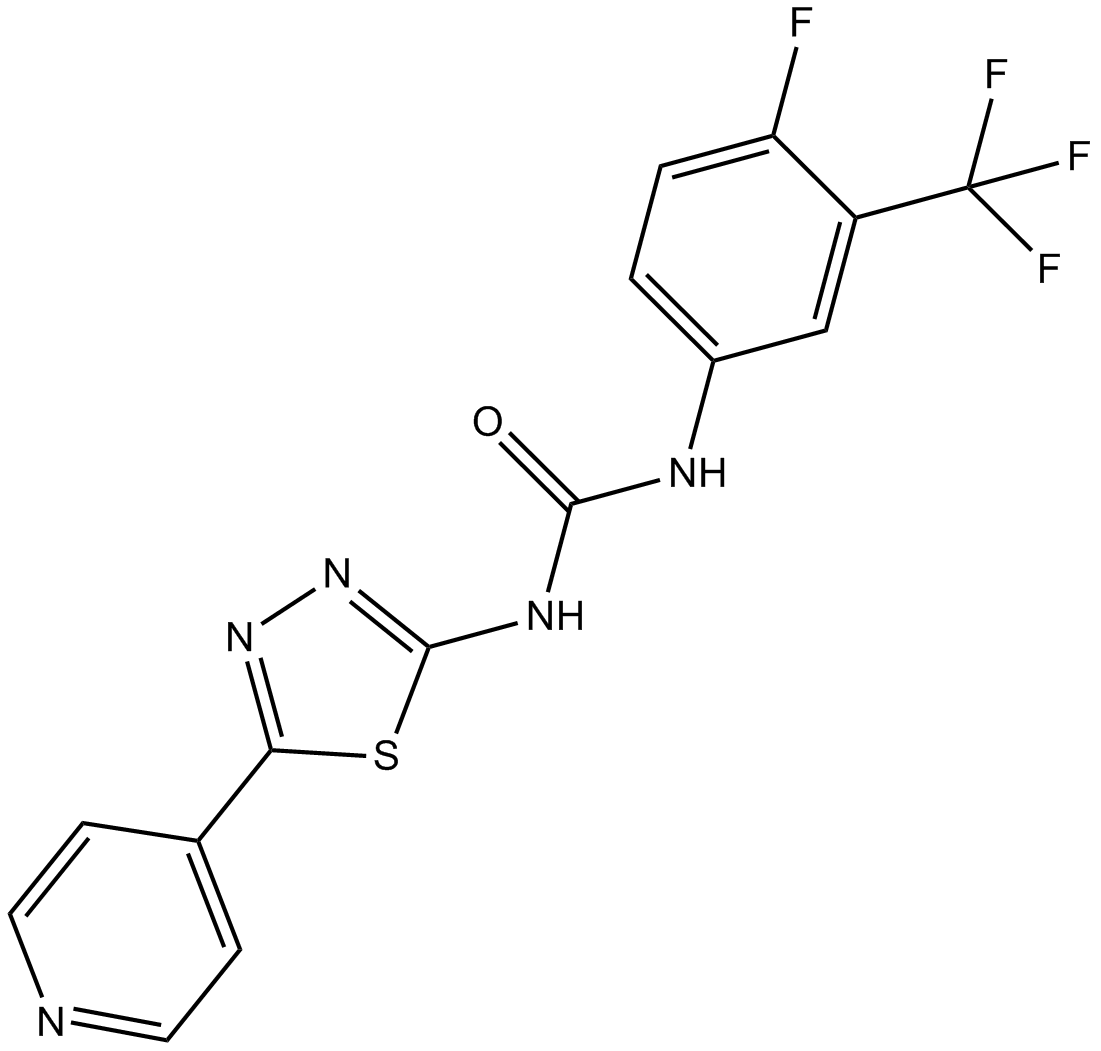
Cas No.: 1430213-30-1
Sample solution is provided at 25 µL, 10mM.
_1-3.$$$39978408@51.jpg');)
_1-9.$$$38538795@65.jpg');)
_1-9.$$$39112701@51.jpg');)
_1-7.$$$37316672@70.jpg');)
_366-372.$$$36198801@70.jpg');)
.$$$38565142@65.jpg');)
_1867-1883.$$$33248023@67.jpg');)
_eads6055.$$$39977546@45.jpg');)
_eadm9805.$$$40080571@45.jpg');)
_eadj3020.$$$39666821@45.jpg');)
_1-20.$$$39757301@28.jpg');)
_1-24.$$$38898113@28.jpg');)
_273-287.$$$36806353@46.jpg');)
_1-16.$$$37156877@44.jpg');)
_1-19.$$$37460805@44.jpg');)
_1291-1307.$$$34518654@46.jpg');)
ML216 is a potent, selective, and cell-permeable inhibitor of Bloom syndrome protein (BLM) helicase with IC50 values of 2.98μM for full-length BLM and 0.97μM for BLM636-1298[1]. ML216 competitively interferes with BLM binding to deoxyribonucleic acid (DNA), inhibits BLM-dependent DNA unwinding and single-stranded DNA (ssDNA)-dependent adenosine triphosphatase (ATPase) activity, and perturbs homologous recombination (HR) repair and chromosome stability[1,2]. ML216 is used in research on DNA-damage repair, replication stress, chromosome stability, cellular senescence, tumor-cell sensitization to DNA-damaging agents, and xenograft responses[1,3,4,5,6,7].
In vitro, ML216 (12.5μM and 50μM; 24h, 48h, and 72h) concentration- and time-dependently reduced the proliferation of BLM-complemented PSNF5 fibroblasts while exerting minimal effects on BLM-deficient PSNG13 fibroblasts[1]. ML216 (50μM; 36h) increased sister chromatid exchange (SCE) frequency in PSNF5 cells without significantly changing SCE frequency in PSNG13 cells[2]. ML216 (10μM) combined with cisplatin (CDDP; 1μM; 48h) reduced PC3 prostate cancer cell proliferation, increased phosphorylated histone H2AX (γH2AX) foci and cleaved caspase-3, activated checkpoint kinase 1 (Chk1) and checkpoint kinase 2 (Chk2), and increased apoptosis[3]. ML216 (10μM; 24h) with 8Gy irradiation reduced RAD51 recombinase (RAD51) foci, increased phosphorylated DNA-dependent protein kinase catalytic subunit (pDNA-PKcs), and delayed DNA double-strand break (DSB) repair in H460, H1299, and A549 non-small cell lung cancer (NSCLC) cells[4]. ML216 (0.78125μM, 1.5625μM, 3.125μM, 6.25μM, 12.5μM, and 25μM) combined with melphalan (0.78125μM, 1.5625μM, 3.125μM, 6.25μM, 12.5μM, 25μM, and 50μM; 4 days) reduced proliferation and increased apoptosis and DNA damage in XG19, XG2, and XG1 multiple myeloma cells[5]. ML216 (50μM) combined with etoposide (100μM; 24h) strengthened deleted in breast cancer 1 (DBC1)-BLM interaction, preserved cellular BLM, and reduced p21 induction in HEK293T cells[6]. ML216 (5μM) combined with olaparib (40μM; 48h) reduced PC3 cell viability, proliferation, clonogenic growth, migration, and invasion[7].
In vivo, ML216 (1mg/kg; intraperitoneal injection twice weekly for 5 weeks) reduced pulmonary senescence and fibrosis and improved pulmonary function in 22-month-old mice[6]. ML216 (15mg/kg) combined with olaparib (30mg/kg; intraperitoneal injection three times weekly for 3 weeks) reduced tumor volume, tumor weight, and Ki-67 expression in male BALB/c nude mice bearing PC3 xenografts[7].
References:[1] Nguyen GH, Dexheimer TS, Rosenthal AS, Chu WK, Singh DK, Mosedale G, et al. A small molecule inhibitor of the BLM helicase modulates chromosome stability in human cells. Chem Biol. 2013;20(1):55-62. doi:10.1016/j.chembiol.2012.10.016.
[2] Rosenthal AS, Dexheimer TS, Gileadi O, Nguyen GH, Chu WK, Hickson ID, et al. Synthesis and SAR studies of 5-(pyridin-4-yl)-1,3,4-thiadiazol-2-amine derivatives as potent inhibitors of Bloom helicase. Bioorg Med Chem Lett. 2013;23(20):5660-5666. doi:10.1016/j.bmcl.2013.08.025.
[3] Ma XY, Zhao JF, Ruan Y, Zhang WM, Xu HQ. ML216-induced BLM helicase inhibition sensitizes PCa cells to the DNA-crosslinking agent cisplatin. Molecules. 2022;27(24):8790. doi:10.3390/molecules27248790.
[4] Kong Y, Xu C, Sun X, Sun H, Zhao X, He N, et al. BLM helicase inhibition synergizes with PARP inhibition to improve the radiosensitivity of olaparib-resistant non-small cell lung cancer cells by inhibiting homologous recombination repair. Cancer Biol Med. 2022;19(8):1150-1171. doi:10.20892/j.issn.2095-3941.2021.0178.
[5] Ovejero S, Viziteu E, Dutrieux L, Devin J, Lin YL, Alaterre E, et al. The BLM helicase is a new therapeutic target in multiple myeloma involved in replication stress survival and drug resistance. Front Immunol. 2022;13:983181. doi:10.3389/fimmu.2022.983181.
[6] Cui F, Han X, Zhang X, Wang S, Liang N, Tan Q, et al. ML216 prevents DNA damage-induced senescence by modulating DBC1-BLM interaction. Cells. 2023;12(1):145. doi:10.3390/cells12010145.
[7] Huang M, Chen L, Guo Y, Ruan Y, Xu H. PARP1 negatively regulates transcription of BLM through its interaction with HSP90AB1 in prostate cancer. J Transl Med. 2023;21(1):445. doi:10.1186/s12967-023-04288-z.
| Cell experiment [1]: | |
|
Cell lines |
Bloom syndrome protein (BLM)-complemented PSNF5 and BLM-deficient PSNG13 human fibroblasts |
|
Preparation Method |
PSNF5 and PSNG13 human fibroblasts were cultured with different ML216 concentrations, and cell proliferation was quantified at each time point. In a separate arm, cells were labeled with bromodeoxyuridine, exposed to ML216, and prepared as metaphase chromosome spreads for microscopic quantification of sister chromatid exchange frequency. |
|
Reaction Conditions |
12.5μM and 50μM; 24h, 48h, and 72h |
|
Applications |
ML216 concentration- and time-dependently reduced proliferation in BLM-complemented PSNF5 cells, exerted minimal effects on BLM-deficient PSNG13 cells, and increased sister chromatid exchange frequency in PSNF5 cells. |
| Animal experiment [2]: | |
|
Animal models |
PC3 prostate cancer xenograft model in male BALB/c nude mice |
|
Preparation Method |
PC3 cells were implanted subcutaneously into male BALB/c nude mice to establish xenografts. Mice were randomized to ML216, olaparib, the combination, or vehicle control. Tumor volume was measured every 4 days, and tumor weight and Ki-67 expression were assessed at the study endpoint. |
|
Dosage form |
15mg/kg; intraperitoneal injection three times weekly for 3 weeks |
|
Applications |
ML216 combined with olaparib reduced PC3 xenograft tumor volume, tumor weight, and Ki-67 expression and inhibited tumor growth more strongly than either monotherapy. |
| References: [1] Nguyen GH, Dexheimer TS, Rosenthal AS, Chu WK, Singh DK, Mosedale G, et al. A small molecule inhibitor of the BLM helicase modulates chromosome stability in human cells. Chem Biol. 2013;20(1):55-62. doi:10.1016/j.chembiol.2012.10.016. [2] Huang M, Chen L, Guo Y, Ruan Y, Xu H. PARP1 negatively regulates transcription of BLM through its interaction with HSP90AB1 in prostate cancer. J Transl Med. 2023;21(1):445. doi:10.1186/s12967-023-04288-z. | |
| Cas No. | 1430213-30-1 | SDF | |
| Überlieferungen | CID49852229 | ||
| Chemical Name | 1-(4-fluoro-3-(trifluoromethyl)phenyl)-3-(5-(pyridin-4-yl)-1,3,4-thiadiazol-2-yl)urea | ||
| Canonical SMILES | FC(C(C(F)(F)F)=C1)=CC=C1NC(NC2=NN=C(C3=CC=NC=C3)S2)=O | ||
| Formula | C15H9F4N5OS | M.Wt | 383.32 |
| Löslichkeit | 25mg/ml in DMSO with gentle warming | Storage | Desiccate at -20°C |
| General tips | Please select the appropriate solvent to prepare the stock solution according to the
solubility of the product in different solvents; once the solution is prepared, please store it in
separate packages to avoid product failure caused by repeated freezing and thawing.Storage method
and period of the stock solution: When stored at -80°C, please use it within 6 months; when stored
at -20°C, please use it within 1 month. To increase solubility, heat the tube to 37°C and then oscillate in an ultrasonic bath for some time. |
||
| Shipping Condition | Evaluation sample solution: shipped with blue ice. All other sizes available: with RT, or with Blue Ice upon request. | ||
| Prepare stock solution | |||

|
1 mg | 5 mg | 10 mg |
| 1 mM | 2.6088 mL | 13.0439 mL | 26.0879 mL |
| 5 mM | 521.8 μL | 2.6088 mL | 5.2176 mL |
| 10 mM | 260.9 μL | 1.3044 mL | 2.6088 mL |
Step 1: Enter information below (Recommended: An additional animal making an allowance for loss during the experiment)
 g
μL
g
μL
Step 2: Enter the in vivo formulation (This is only the calculator, not formulation. Please contact us first if there is no in vivo formulation at the solubility Section.)
Calculation results:
Working concentration: mg/ml;
Method for preparing DMSO master liquid: mg drug pre-dissolved in μL DMSO ( Master liquid concentration mg/mL, Please contact us first if the concentration exceeds the DMSO solubility of the batch of drug. )
Method for preparing in vivo formulation: Take μL DMSO master liquid, next addμL PEG300, mix and clarify, next addμL Tween 80, mix and clarify, next add μL saline, mix and clarify.
Method for preparing in vivo formulation: Take μL DMSO master liquid, next add μL Corn oil, mix and clarify.
Note: 1. Please make sure the liquid is clear before adding the next solvent.
2. Be sure to add the solvent(s) in order. You must ensure that the solution obtained, in the previous addition, is a clear solution before proceeding to add the next solvent. Physical methods such as vortex, ultrasound or hot water bath can be used to aid dissolving.
3. All of the above co-solvents are available for purchase on the GlpBio website.
Quality Control & SDS
- View current batch:
- Purity: >99.50% Appearance: A solid
- COA (Certificate of Analysis)
- SDS (Safety Data Sheet)
- Datasheet
Average Rating: 5 (Based on Reviews and 20 reference(s) in Google Scholar.)