


PQ 401 |
| Katalog-Nr.GC16991 |
PQ 401 ist ein potenter Inhibitor der IGF-IR-Signalgebung. PQ 401 hemmt die IGF-I-stimulierte IGF-IR-Autophosphorylierung mit einem IC50 von 12,0 μM in einer Reihe von Studien in MCF-7-Zellen. PQ 401 hemmt wirksam das IGF-I-stimulierte Wachstum von MCF-7-Zellen (IC50, 6 μM). PQ 401 ist ein potenzieller Wirkstoff für Brustkrebs und andere IGF-I-empfindliche Krebsarten. PQ 401 induziert Caspase-vermittelte Apoptose.
Products are for research use only. Not for human use. We do not sell to patients.
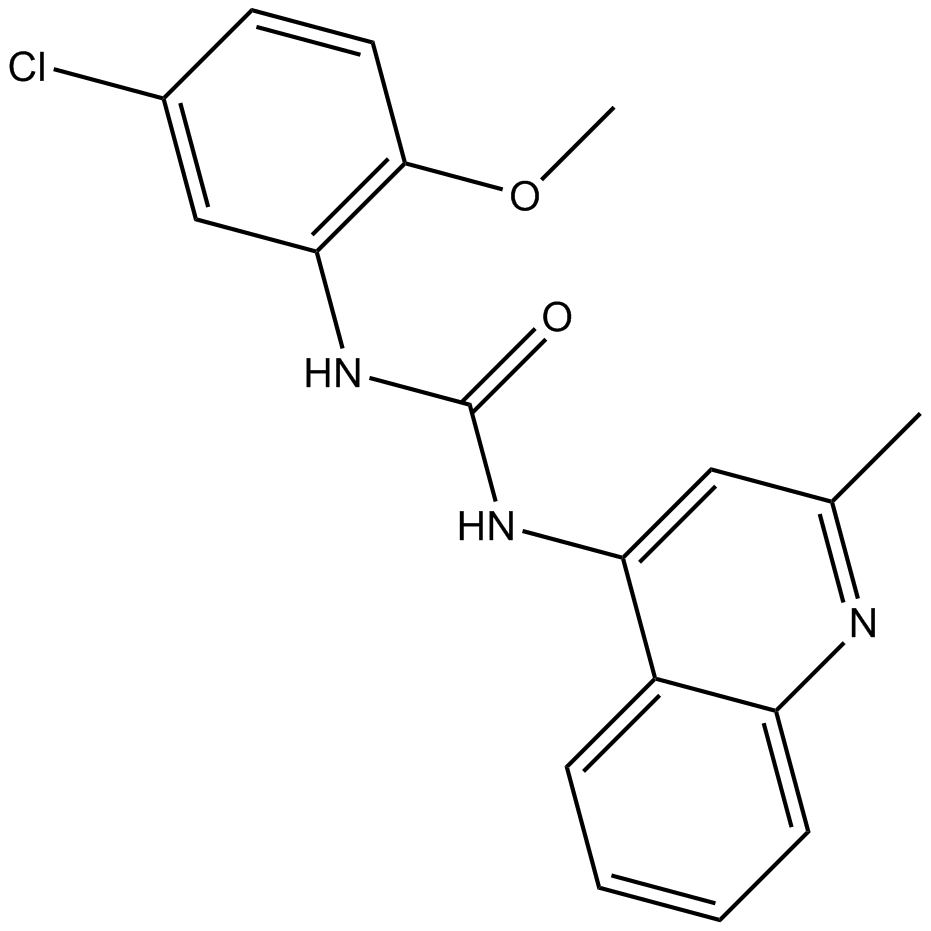
Cas No.: 196868-63-0
Sample solution is provided at 25 µL, 10mM.
;)
,-1-7$$$37316672.jpg');)
;)
;)
$$$36806353.jpg');)
;33(7)%EF%BC%9A546-561$$$37156877.jpg');)
;)
;)
;)
%201124-1138.$$$35908550.jpg');)
%20766-780.$$$37100057.jpg');)
%20418-432.$$$36893736.jpg');)
%EF%BC%9A-240-255.$$$35108512.jpg');)
533-545$$$36543525.jpg');)
%201-13.$$$36600053.jpg');)
;)
PQ401 is a novel, potent inhibitor of IGF-IR with IC50 of 12μM [1].
In human MCF-7 cells, PQ401 inhibited autophosphorylation of the IGF-IR with IC50 of 12 μM and autophosphorylation of the isolated kinase domain of the IGF-IR with IC50 < 1μM. In addition, PQ401 inhibited the growth of cultured breast cancer cells in serum at 10μM. PQ401 can decrease IGF-I-mediated signaling through the Akt antiapoptotic pathway. Twenty-four hours treatment of 15 μM PQ401 induced caspase-mediated apoptosis [1]. In small trigeminal ganglion neurons, PQ401 blocked the IGF-1-induced A-type K(+) currents (IA) that were associated with a hyperpolarizing shift in the voltage dependence of inactivation [2].
In vivo, a treatment with PQ401 triple per week reduced the growth rate of MCNeuA cells implanted into mice [1].
References:
[1]. Gable KL, Maddux BA, Penaranda C, Zavodovskaya M, Campbell MJ, Lobo M, Robinson L, Schow S, Kerner JA, Goldfine ID, Youngren JF. Diarylureas are small-molecule inhibitors of insulin-like growth factor I receptor signaling and breast cancer cell growth. Mol Cancer Ther. 2006 Apr;5(4):1079-86.
[2]. Wang H, Qin J, Gong S, Feng B, Zhang Y, Tao J. Insulin-like growth factor-1 receptor-mediated inhibition of A-type K(+) current induces sensory neuronal hyperexcitability through the phosphatidylinositol 3-kinase and extracellular signal-regulated kinase 1/2 pathways, independently of Akt. Endocrinology. 2014 Jan;155(1):168-79.


Average Rating: 5 (Based on Reviews and 18 reference(s) in Google Scholar.)
GLPBIO products are for RESEARCH USE ONLY. Please make sure your review or question is research based.
Required fields are marked with *