

Pristane |
Katalog-Nr.GC64748
 One-Click Copy Product Info
|

Pristane ist eine farb- und geruchlose Flüssigkeit, die hauptsächlich aus natürlichen Quellen wie Haifischleberöl gewonnen wird und auch in geringen Mengen in verschiedenen Pflanyen und Meeresorganismen vorkommt.
Products are for research use only. Not for human use. We do not sell to patients.
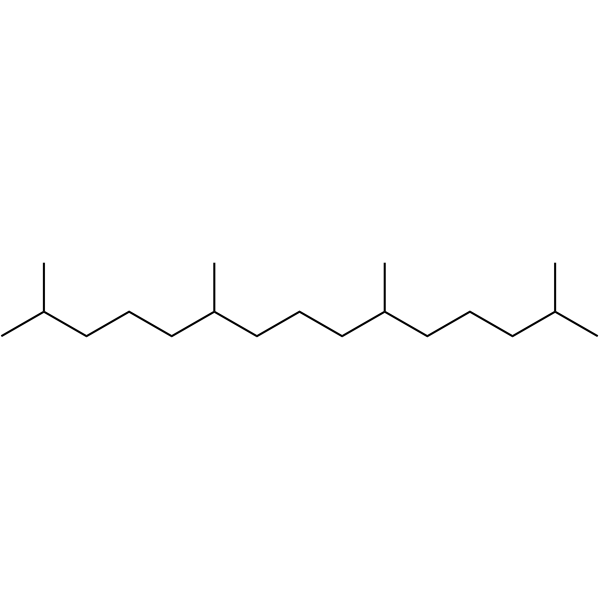
Cas No.: 1921-70-6
Sample solution is provided at 25 µL, 10mM.
_1-3.$$$39978408@51.jpg');)
_1-9.$$$38538795@65.jpg');)
_1-9.$$$39112701@51.jpg');)
_1-7.$$$37316672@70.jpg');)
_366-372.$$$36198801@70.jpg');)
.$$$38565142@65.jpg');)
_1867-1883.$$$33248023@67.jpg');)
_eads6055.$$$39977546@45.jpg');)
_eadm9805.$$$40080571@45.jpg');)
_eadj3020.$$$39666821@45.jpg');)
_1-20.$$$39757301@28.jpg');)
_1-24.$$$38898113@28.jpg');)
_273-287.$$$36806353@46.jpg');)
_1-16.$$$37156877@44.jpg');)
_1-19.$$$37460805@44.jpg');)
_1291-1307.$$$34518654@46.jpg');)
Pristane ist eine farb- und geruchlose Flüssigkeit, die hauptsächlich aus natürlichen Quellen wie Haifischleberöl gewonnen wird und auch in geringen Mengen in verschiedenen Pflanyen und Meeresorganismen vorkommt[1]. Pristane wird aufgrund seiner Fähigkeit, in Tiermodellen Autoimmun-Erkrankungen auszulösen, oft in der medizinischen Forschung verwendet und ist somit ein wertvolles Werkzeug zur Untersuchung der Pathogenese von Erkrankungen wie rheumatoider Arthritis(RA) und Lupus[4][5][6][7].
In vivo induzierte die Behandlung von aus einem Mausstamm stammenden Thymus-Lymphom-Zellen BW5147 mit Pristane(5-400μM) über 48 Stunden zeit- und dosisabhängig Apoptose über den mitochondrialen Signalweg, was durch die Freisetzung von Cytochrom c nachgewiesen wurde[2]. Pristane (1mM) stimulierte Knochenmark-abgeleitete Makrophagen(BMM) über 6 oder 24 Stunden, induzierte Autophagie in BMM und erhöhte die TLR3-Expression durch Aktivierung des STAT1-IRF1-Signalwegs[3].
In vivo führte die einmalige intraperitoneale Injektion von 0.5 mL Pristane bei BALB/c-Mäusen zur Entwicklung einer Immunkomplex-vermittelten Glomerulonephritis, einem Kennzeichnen von SLE. Das durch Pristane induzierte Autoimmun-Syndrom ähnelt dem idiopathischen SLE bei Menschen, einschließlich der Entwicklung antinukleärer Antikörper[4]. Swiss Jim Lambert Mäuse, denen 0.5mL Pristane injiziert wurden, entwickelten eine schwere Glomerulonephritis, die wie bei BALB/c-Mäusen durch Proteinurie, mesangiale Proliferation und glomeruläre Immunkomplex-Ablagerungen charakterisiert war. Unerwarteterweise waren die durch Pristane in SJL-Mäusen induzierten Autoantikörper nicht in der Pristane-induzierten Erkrankung in BALB/c-Mäusen assoziiert, sondern anti-ribosomales P, eine weitere Lupus-assoziierte Spezifität. Die Autoantikörper reagierten stark mit den C-terminalen 22 Aminosäuren des ribosomalen P2-Proteins. Das deutet darauf hin, dass sie eine ähnliche Feinspezifität wie Anti-P-Antikörper(Abs) beim humanen SLE aufwiesen. Im Gegensatz dazu zeigten C57BL/6J-Mäuse nach intraperitonealer Injektion von Pristane (0.5mL) eine mildere Nephritis, die durch verringerte CD3- und CD4-Spiegel in den Gesamt-Leukozyten bei gleichzeitiger Hochregulation von CD11b, Ly6G, Ly6C, F4/80 und CD86 gekennzeichnet war[6]. Bei LEW-Ratten, denen 150 μl Pristane intradermal an der Schwanzwurzel injiziert wurden, entwickelte sich 2 bis 3 Wochen nach der Behandlung eine schwere Arthritis mit plötzlichem Beginn. Bis zum 122. Tag waren die klinisch betroffenen Gelenke durch Erosionen stark geschädigt und der Knorpel war nahezu vollständig abgebaut[7].
References:
[1] Avigan J, Milne G W A, Highet R J. The occurrence of pristane and phytane in man and animals. 1967 Dec;144(1),0–131.
[2] Calvani N, Caricchio R, Tucci M, et al. Induction of apoptosis by the hydrocarbon oil pristane: implications for pristane-induced lupus. J Immunol. 2005 Oct 1;175(7):4777-82.
[3] Zhu W H, Xu J, Jiang C S, et al. Pristane induces autophagy in macrophages, promoting a STAT1-IRF1-TLR3 pathway and arthritis. Clin Immunol. 2017 Feb:175:56-68.
[4] Satoh M, Kumar A, Kanwar Y S, Reeves W H. Anti-nuclear antibody production and immune-complex glomerulonephritis in BALB/c mice treated with pristane. Proc Natl Acad Sci USA. 1995 Nov 21;92(24):10934-8.
[5] Satoh M, Hamilton KJ, Ajmani AK, et al. Autoantibodies toribosomal P antigens with immune complex glomerulonephritisin SJL mice treated with pristane. J Immunol. 1996;157(7):3200‐3206.
[6] Zhou Y L, Yang B B, Long H J, et al. Immune cell alterations in a pristane-induced lupus model in C57BL/6J mice. Rheumatology & Autoimmunity. 2024 Nov 27. 2767-1410
[7] Vingsbo C, Sahlstrand P, Brun J G, et al. Pristane-induced arthritis in rats: a new model for rheumatoid arthritis with a chronic disease course influenced by both major histocompatibility complex and non-major histocompatibility complex genes. Am J Pathol. 1996 Nov;149(5):1675-83.
| Zellexperiment [1]: | |
Zelllinien | aus dem Knochenmark stammende Makrophagen NR8383-Zellen |
Vorbereitungsmethode | Knochenmarkzellen wurden von DA-Ratten isoliert und in einer Dichte von 2 × 10⁶/ml in L929-konditioniertem Medium ausgesät, um sie mithilfe von Cold Spring Harbor Protocols zu knochenmarkstämmigen Makrophagen(BMM) zu differenzieren. Nach 7 Tagen wurden die BMM für 6 oder 24 Stunden mit 1 mM Pristane stimuliert und das Protein wurde zur Genexpressionsanalyse isoliert. |
Reaktionsbedingungen | 1 mM; 6 oder 24 Stunden |
Anwendungen | Pristane führte zu einer erhöhten Expression von LC3-II und TLR3 und induzierte Autophagie in Makrophagen. |
| Tierversuch [2]: | |
Tiermodelle | C57Bl/10-Mäuse |
Vorbereitungsmethode | Acht Wochen alte C57Bl/10-Mäusen erhielten eine einmalige intraperitoneale Injektion von 0.5mL Pristane. Kontrollmäuse erhielten eine Injektion mit phosphatgepufferter Kochsalzlösung(PBS). 2 Wochen nach der Pristane-Injektion und dann monatlich wurde den Mäusen Blut für serologische Untersuchungen und den Nachweis antinukleärer Antikörper(ANA) entnommen. Zur Charakterisierung der Lungenerkrankung wurde eine bronchoalveoläre Lavage(BAL) zur Bestimmung der Gesamt- und Differenzial-Zellzahl durchgeführt. Die Zytokin-Spiegel von IL-2, IL-4, TNF-α, IFN-γ, IL-6 und IL-10 wurden bestimmt. Die Lungen wurden histopathologisch und elektronenmikroskopisch untersucht. |
Dosierungsform | 0.5 mL; i.p.; einmalige Gabe |
Anwendungen | Alle mit Pristane injizierten Mäuse entwickelten eine pulmonale Kapillaritis mit perivaskulärer Infiltration durch Makrophagen, Neutrophile, Lymphozyten und Eosinophile. Die IL-6- und IL-10-Konzentrationen in der Bronchoalveolären Lavage(BAL) waren erhöt, die Konzentrationen von TNF-α, IFN-γ, IL-2 und IL-4 hingegen nicht. |
References: | |
| Cas No. | 1921-70-6 | SDF | |
| Formula | C19H40 | M.Wt | 268.52 |
| Löslichkeit | DMSO : 100 mg/mL (372.41 mM; Need ultrasonic) | Storage | Store at -20°C, protect from light |
| General tips | Please select the appropriate solvent to prepare the stock solution according to the
solubility of the product in different solvents; once the solution is prepared, please store it in
separate packages to avoid product failure caused by repeated freezing and thawing.Storage method
and period of the stock solution: When stored at -80°C, please use it within 6 months; when stored
at -20°C, please use it within 1 month. To increase solubility, heat the tube to 37°C and then oscillate in an ultrasonic bath for some time. |
||
| Shipping Condition | Evaluation sample solution: shipped with blue ice. All other sizes available: with RT, or with Blue Ice upon request. | ||
| Prepare stock solution | |||

|
1 mg | 5 mg | 10 mg |
| 1 mM | 3.7241 mL | 18.6206 mL | 37.2412 mL |
| 5 mM | 744.8 μL | 3.7241 mL | 7.4482 mL |
| 10 mM | 372.4 μL | 1.8621 mL | 3.7241 mL |
Step 1: Enter information below (Recommended: An additional animal making an allowance for loss during the experiment)
 g
μL
g
μL
Step 2: Enter the in vivo formulation (This is only the calculator, not formulation. Please contact us first if there is no in vivo formulation at the solubility Section.)
Calculation results:
Working concentration: mg/ml;
Method for preparing DMSO master liquid: mg drug pre-dissolved in μL DMSO ( Master liquid concentration mg/mL, Please contact us first if the concentration exceeds the DMSO solubility of the batch of drug. )
Method for preparing in vivo formulation: Take μL DMSO master liquid, next addμL PEG300, mix and clarify, next addμL Tween 80, mix and clarify, next add μL saline, mix and clarify.
Method for preparing in vivo formulation: Take μL DMSO master liquid, next add μL Corn oil, mix and clarify.
Note: 1. Please make sure the liquid is clear before adding the next solvent.
2. Be sure to add the solvent(s) in order. You must ensure that the solution obtained, in the previous addition, is a clear solution before proceeding to add the next solvent. Physical methods such as vortex, ultrasound or hot water bath can be used to aid dissolving.
3. All of the above co-solvents are available for purchase on the GlpBio website.
Quality Control & SDS
- View current batch:
- Purity: >99.50% Appearance: A liquid
- COA (Certificate of Analysis)
- SDS (Safety Data Sheet)
- Datasheet
Average Rating: 5 (Based on Reviews and 30 reference(s) in Google Scholar.)